人称代词,物主代词和反身代词表格
- 格式:doc
- 大小:28.00 KB
- 文档页数:3
1 / 3 人称代词,物主代词,反身代词
一.人称代词指代人或物,在句中作主语或宾语,所以有主格和宾格。
宾格代词用于替代处于宾语位置上的名词,可以用作直接宾语和间接宾语。
例如:I am a student. (I 主语)
Please help me. (me 直接宾语)
Give me a book. (me 间接宾语)
二.物主代词是表示所有关系的一种代词,亦称所有格代词。物主代词有两种形式:形容词性物主代词和名词性物主代词。
形容词性物主代词为限定词,放在名词或名词短语前作定语。 第一人称 第二人称 第三人称
单数 复数 单数 复数 单 数 复 数
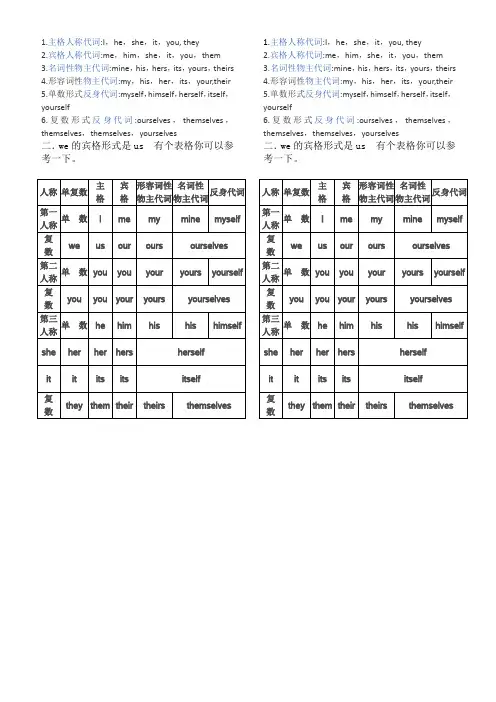
人称代词 主 格 I we you you she he it they
宾 格 me us you you her him it them
物主代词 形容词性 my our your your her his its their
名词性 mine ours yours yours hers his its theirs
反身代词 myself our-
selves your-
self your-
selves herself, himself , itself them-
selves 2 / 3 如:This is my book.
名词性物主代词起名词的作用,后面不可以再接名词。在句子中可以作主语、宾语或表语。
如:1. Your pen is red. Mine is black.
你的钢笔是红色的,我的是黑色的。
2. He didn’t use his ink. He used mine.
他没有用他自己的墨水,他用了我的。
3. That book is hers, not yours.
那本书是她的,不是你的。
三.反身代词
1. 作动词或介词的宾语:经常在enjoy, teach, hurt, buy, introduce, seat, dress,
express, amuse, behave等动词和by, for, to, of等介词后作宾语。如:
He is teaching herself English.她在自学英语。
She was talking to herself.她自言自语。
He lives by himself in the country.他独自住在乡下。
2. 作主语或宾语的同位语:主要起加强语气的作用,译作“亲自,本身,本人”。如:
Did you make the cake yourself?这蛋糕是你亲自做的吗?(yourself作主语you的同位语)
The work itself is easy.这工作本身很容易。(itself作主语the work的同位语)
Did you see Mr. Wang himself?你见过王先生本人吗(himself作宾语Mr. Wang的同位语)
3. 作表语:在be, feel, look, seem等系动词后作表语,表示身体或精神状态处于正常。
I’m not myself today.今天我感觉不舒服。
I am feeling myself again.我觉得健康如昔。
4. 用于一些简短的会话用语或固定说法中。如:
Help yourself! 请随便吃吧!/请自己去取吧!
Make yourself at home! 别客气!
Don’t upset yourself! 别自寻烦恼(from www.yygrammar)!
Make yourself heard /understood. 使你的话被人听得见/理解。 3 / 3