高中英语:Unit 1《 Great Scientists》学案(新人教版必修5)
- 格式:doc
- 大小:148.50 KB
- 文档页数:20
用心 爱心 专心 Unit One Great Scientists
高中英语:Unit 1《 Great Scientists》学案(新人教版必修5)
一、语音及拼读规则
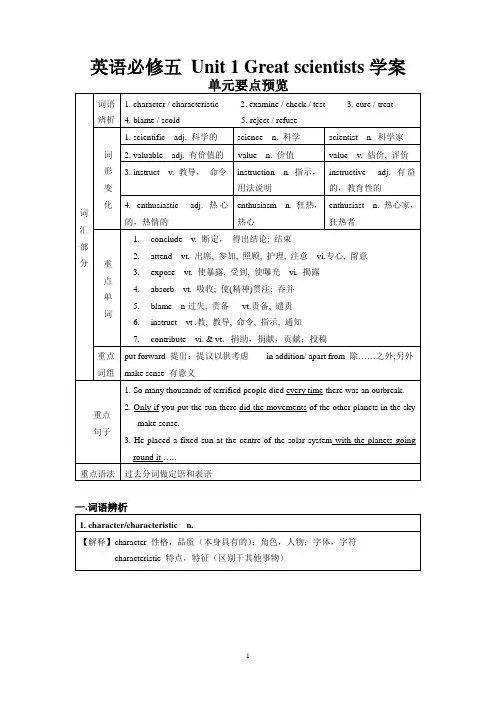
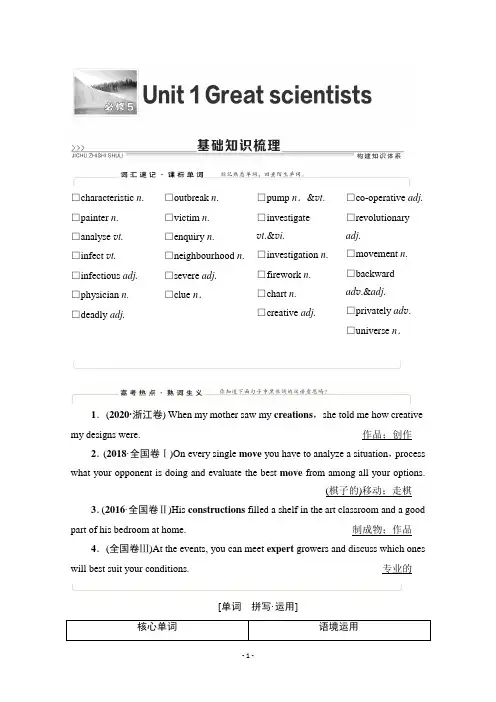
二、单元重点单词
1.characteristic adj. & n.
(1) adj. 典型性的(typical)
e.g.He spoke with characteristic enthusiasm.
他以特有的热情说话。
(2) n. (与众不同的)特征;特性(distinguishing feature) 用心 爱心 专心 e.g.What characteristics distinguish the Americans from the Canadians?
美国人和加拿大人的特征有什么不同?
2.theory n. 学说;理论;意见;想法;设想
e.g.Darwin’s theory of evolution
达尔文的进化论
He has a theory that wearing hats makes men go bald.
他有个看法是男人戴帽子就会秃顶。
It sounds fine in theory, but will it work?
道理是不错,但能否行得通?
3.scientific adj. 科学的,用于科学研究的,关于科学的(of, used in or involved in science)
e.g.They are very scientific in their approach.
他们的方法很科学。
a scientific discovery, instrument, textbook, researcher
科学发现、科学仪器、理科教科书、科学研究人员
4.examine v. 仔细观察;检查;调查;审查(look at carefully in order to learn about or from.)
e.g.The detective examined the window frame for fingerprints.
侦探仔细查看窗框,寻找指纹。
The doctor examined her patient carefully.
那位医生仔细侦察病人。
5.conclude vt. & vi.
(1)(使某事物)结束(come or bring sth. to an end.)
e.g.The meeting concluded at 8 o’clock.
会议于8时结束。
The story concludes with the hero’s death. 用心 爱心 专心 这故事随主人公死亡而告终。(conclude with)
He concluded by saying that…
他结束讲话时说……
She concluded her talk with a funny story.
她以一个有趣的故事结束谈话。(conclude…with)
(2)推断出;达成;决定(come to believe sth. as a result of reasoning)
e.g.Those are the facts; what do you conclude from them?
这些都是事实,你能从中的出什么结论?(conclude sth. from sth.)
The jury concluded, from the evidence, that she was guilty.
陪审团根据证据作出结论,认定她有罪。
We concluded to go out.
我们决定出去。(conclude to do sth.)
6.analyse vt. 分析;研究(examine and explain sth. or study its nature or structure)
e.g.By analyzing the parts of the sentence we learn more about English grammar.
分析句子成分就能多了解一些英语语法。
We must try to analyse the causes of the strike.
我们得研究一下罢工的原因。
7.repeat v. & n.
(1) v. 重复;反复(地说和做)(say or write sth. again once or more than once)
e.g.She repeated what she had said.
她重复了自己说的话。
He repeated her statement word for word.
他一字不差地重复她的话。
Don’t repeat what I said to anyone---it’s confidential. 用心 爱心 专心 别把我的话告诉别人——这是秘密。
(2)n. 重复;反复;背诵(act of repeating; thing repeated)
e.g.a repeat performance, showing
重演,重映
8.defeat vt. & n.
(1)vt. 战胜(某人);击败(win a victory over sb.; overcome)
e.g.The enemy was defeated in a decisive battle.
敌人在一场决定性的战斗中被击败。
He has been soundly defeated at chess.
他在国际象棋比赛中一败涂地。
(2)vt.使(某人)困惑;难住(be puzzling for sb.; baffle)
e.g.I’ve tried to solve the problem, but it defeats me!
这个问题我想解决,但把我难倒了!
Why you stay indoors on a beautiful day like this defeats me!
天气这样好你却呆在屋里,真叫人莫名其妙!
(3)n. 击败;失败(defeating or being defeated)
e.g.suffer defeat 遭到失败
I never consider the possibility of defeat.
我从未考虑有失败的可能性。
9.expose vt. 暴露;揭露;使曝光(uncover or make sth. visible; make known; reveal)
e.g.The baby was left exposed to the wind and rain.
婴儿被离弃于风雨之中。(expose to)
She exposed her skin to the sun.
她使皮肤暴露于阳光下。(expose to) 用心 爱心 专心 expose crime, scandal, injustice ,fraud, etc
揭露罪行、丑闻、冤假错案、骗局等
10.cure n. & v. 治愈;痊愈;治疗
e.g.The doctor cured her of cancer.
医生治愈了她的癌症。
This illness cannot be cured easily.
这个病不好治。
Her cure took six weeks.
她的病花了六个星期才治疗好。
The doctor cannot guarantee a cure.
医生不能保证治愈。
11.blame vt. & n. 责备;谴责;过失
e.g. I don’t blame you.
我不怪你。(我认为你做得有道理)
If you fail the exam you’ll only have yourself to blame.
你若考试不及格,只能怪自己。
She blamed him for the failure of their marriage.
= She blamed the failure of their marriage on him.
她把婚姻的触礁归咎于他。
A bad workman blames his tools.
拙匠埋怨工具差(不承认错在自己)。
Which driver was to blame for the accident?
这事故是哪个司机的责任?(be to blame for sth.)
She was in no way to blame. 用心 爱心 专心 决不应该责备她。(be to blame for sth.)
Where does the blame for our failure lie?
我们失败的症结在哪里?
12.handle n. & vt. 把手;处理;操纵
e.g.His carelessness gave his enemies a handle to use against him.
他的不大意给予敌人以反对他的可乘之机。
Wash your hands before you handle food.
洗完手再拿食物。
Fragile---handle with care.
易碎品——小心轻放。
An officer must know how to handle his men.
当军官的应懂得怎样统帅士兵。
13.instruct vt. 命令;指示;教导
e.g.They haven’t instructed us where to go.
他们还未指示我们到何处去。
I’ve instructed them to keep the room locked.
我已吩咐他们那房间要上锁。
instruct—instructor(教员;教练;指导员)—instruction(n.)
14.contribute vt. & vi. 捐献;贡献;捐助——contributor——contribution
e.g. Everyone should contribute what he or she can afford.
人人都应该尽自己的能力作贡献。
He wants to contribute ten pounds to a charity collection.
他想捐献十英镑给慈善事业。
15.positive adj. 积极的;肯定的;确实的