中国传统文化英语翻译
- 格式:docx
- 大小:1.91 MB
- 文档页数:22
中国传统文化英语翻译
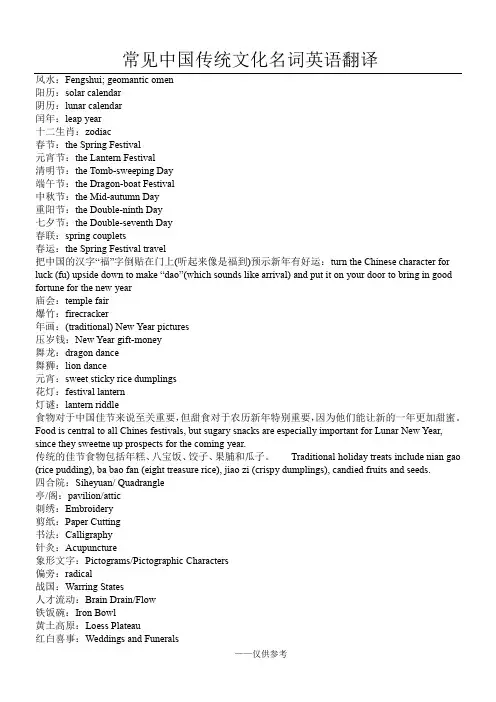
元宵节: Lantern Festival
2. 刺绣:embroidery
3. 重阳节:Double-Ninth Festival
4. 清明节:Tomb sweeping day
5. 剪纸:Paper Cutting
6. 书法:Calligraphy
7. 对联:(Spring Festival) Couplets
8. 象形文字:Pictograms/Pictographic Characters
9. 人才流动:Brain Drain/Brain Flow
10.四合院:Siheyuan/Quadrangle
11.战国:Warring States
12.风水:Fengshui/Geomantic Omen
13.铁饭碗:Iron Bowl
14.函授部:The Correspondence Department
15.集体舞:Group Dance
16.黄土高原:Loess Plateau
17.红白喜事:Weddings and Funerals
18.中秋节:Mid-Autumn Day
19.结婚证:Marriage Certificate
20.儒家文化:Confucian Culture
21.附属学校:Affiliated school
22.古装片:Costume Drama
23.武打片:Chinese Swordplay Movie
24.元宵:Tangyuan/Sweet Rice Dumpling (Soup)
25.一国两制:One Country, Two Systems
26.火锅:Hot Pot
27.四人帮:Gang of Four
28.《诗经》:The Book of Songs
29.素质教育:Essential-qualities-oriented Education
30.《史记》:Historical Records/Records of the Grand Historian
31.大跃进:Great Leap Forward (Movement)
32.《西游记》:The Journey to the West
33.除夕:Chinese New Year’s Eve/Eve of the Spring Festival
34.针灸:Acupuncture
35.唐三彩:Tri-color Pottery of the Tang Dynasty/ The Tang Tri-colored pottery
36.中国特色的社会主义:Chinese-charactered Socialist/Socialist with Chinese characteristics
37.偏旁:radical
38.孟子:Mencius
39.亭/阁: Pavilion/ Attic
40.大中型国有企业:Large and Medium-sized State-owned Enterprises
41.火药:gunpowder
42.农历:Lunar Calendar
43.印/玺:Seal/Stamp
44.物质精神文明建设:The Construction of Material Civilization and Spiritual Civilization
45.京剧:Beijing Opera/Peking Opera
years. The ancients in China considered
the dragon (or loong) a fetish that
combines animals including the fish,
snake, horse and ox with cloud, thunder,
lightning and other natural celestial
phenomena. The Chinese dragon was
formed in accordance with the
multicultural fusion process of the
Chinese nation. To the Chinese, the
dragon signifies innovation and cohesion.
二、秧歌舞是中国汉族的一种民间传统舞蹈,通常在北方省份表演。秧歌舞者通常穿上明亮多彩的表演服装,他们的表演动作有力迅速。在农历春节、元宵节等节日期间,人们一旦听到锣鼓声,不管外面天气有多冷,他们都会蜂拥到街上看秧歌舞表演。近年来,中国东北某些城市的老年人自发组织了了秧歌队,队员常年通过跳秧歌舞来保持健康,同事他们也乐在其中。
Yangko is one of tradition folk dance of
Han in China.It is usually performed in
northern provinces. The dancers usually
wear colorful and light costumes, and the
performance is powerful and rapid.
During some festivals such as Spring
Festival, Lantein Festival, if people hear
the sound of drum and gong, no matter
how cold the weather is , they will come
to street and appreciate the Yangko.
Recent years, the old people in city of
east-northern of China organized the
team of Yangko by themselves, the teamers keep their health by dancing
Yangko the whole year.
三、长城是人类创造的世界奇迹之一。如果你到了中国却没去过长城,就想到了巴黎没有去看看菲尔铁塔,或者就像到了埃及没有去看金字塔一样。人们常说:“不到长城非好汉。”实际上,长城最初只是一些断断续续的城墙,直到秦朝统一中国后才将其连城长城。然而,今天我们看到的长城——东起山海关,西至嘉峪关——大部分都是在明代修建的。
The Great Wall is one of the wonders of
the world that created by human beings!
If you come to China without climbing
the Great Wall, it's just like going Paris
without visiting the Eiffel Tower; or going
to Egypt without visiting the Pyramids!
Men often say, "He who doest not reach
the Great Wall is not a true man."In fact,
it began as independent walls for
different states when it was first built,
and did not become the "Great Wall" until
the Qin Dynasty. However, the wall we
see today, starting from Shanhaiguan
Pass in the east to Jiayunguan Pass in the
west, was mostly built during the Ming Dynasty.
四、Dumplings Dumplings are one of the
Chinese people’s favorite traditional
dishes. According to an ancient Chinese
legend, dumplings were first made by the
medical saint---Zhang Zhongjing. There
are three steps involved in making
dumplings: 1) make dumpling wrappers out of dumpling flour; 2) prepare the
dumpling stuffing; 3) make dumplings
and boil them. With thin and elastic
dough skin, fresh and tender stuffing,
delicious taste, and unique shapes,
dumplings are worth eating hundreds of
times. There’s an old saying that claims,
“Nothing could be more delicious than
dumplings”. During the Spring Festival and other holidays, or when treating
relatives and friends, Chinese people like
to follow the auspicious custom of eating
dumplings. To Chinese people who show