
新概念英语第二册 lesson96
- 格式:ppt
- 大小:7.03 MB
- 文档页数:67

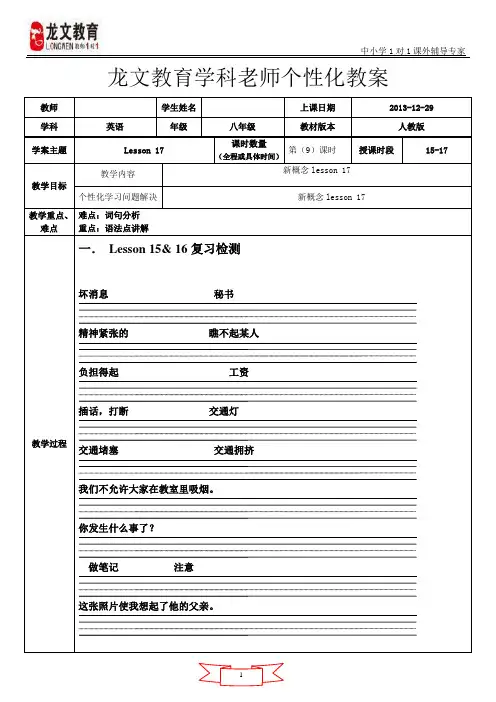
中小学1对1课外辅导专家
1
龙文教育学科老师个性化教案
教师 学生姓名 上课日期 2013-12-29
学科 英语 年级 八年级 教材版本 人教版
学案主题 Lesson 17 课时数量
(全程或具体时间) 第(9)课时 授课时段 15-17
教学目标 教学内容 新概念lesson 17
个性化学习问题解决 新概念lesson 17
教学重点、难点 难点:词句分析
重点:语法点讲解
教学过程 一. Lesson 15& 16复习检测
坏消息 秘书
精神紧张的 瞧不起某人
负担得起 工资
插话,打断 交通灯
交通堵塞 交通拥挤
我们不允许大家在教室里吸烟。
你发生什么事了?
做笔记 注意
这张照片使我想起了他的父亲。
中小学1对1课外辅导专家
2
二. Lesson 11,12, 13 , 14,15&16单词听写
三.课文背诵 中小学1对1课外辅导专家
3
四.Lesson 17 Always young
My aunt Jennifer is an actress.
以-or,-er结尾的是男性,以-ess结尾的是女性(基本上是这样)

1 / 8 Lesson96 The dead return Everyday English Rome was not built in a day. 成功并非一朝一夕的事。 Key Structures 定语从句讲解及练习 一.定语从句及相关术语 1.定语从句:修饰一个名词或代词的从句称为定语从句,一般紧跟在它所修饰的先行词后面。 2.关系词:引导定语从句的关联词成为关系词 关系词有关系代词和关系副词。关系代词有that, which, who, whom, whose, as 等; 关系副词有where, when, why等。 关系词常有3个作用:1,引导定语从句。2,代替先行词。3,在定语从句中担当一个成分。 二.关系代词引导的定语从句 1.who指人,在从句中做主语 (1)The boys who are playing football are from class one. (2) Yesterday i helped an old man who lost his way. 2. whom指人,在定语从句中充当宾语,常可省略。 (1) Mr. Ling is the person (whom) you talked about on the bus. (2)Mr. ling is just the boy whom i want to see. 注意:关系代词whom在口语和非正式语体中常用who代替,可省略。 (3)The man who/whom you met just now is my friend. 3. which指物,在定语从句中做主语或者宾语,做宾语时可省略 (1) Football is a game which is liked by most boys. (2) This is the pen (which) he bought yesterday. 4. that指人时,相当于who 或者whom;指物时,相当于which。在宾语从句中做主语或者宾语,做宾语时可省略。 (5) The number of the people that/who come to visit the city each year rises one million. (6) Where is the man that/whom i saw this morning? 5. whose通常指人,也可指物,在定语从句中做定语 (1) He has a friend whose father is a doctor. (2) I once lived in a house whose roof has fallen in. whose指物时,常用以下结构来代替 (3) The classroom whose door is broken will soon be repaired. (4) The classroom the door of which is broken will soon be repaired. (5) Do you like the book whose cover is yellow? (6) Do you like the book the color of which is yellow? 三.介词+关系代词引导的定语从句 关系代词在定语从句中做介词宾语时,从句常由介词+关系代词引导 (1) The school (that/which) he once studied in is very famous. (2) The school in which he once studied is very famous. (3) Tomorrow i will bring here a magazine (that/which) you asked for. (4) Tomorrow i will bring here a magazine for which you asked. (5) We'll go to hear the famous singer (whom/that/who) we have often talked about. 2 / 8 (6) We'll go to hear the famous singer about whom we have often talked. 注意:1. 含有介词的动词短语一般不拆开使用,如:look for, look after, take care of等 (1) This is the watch which/that i am looking for. (T) (2) This is the watch for which i am looking. (F) 2. 若介词放在关系代词前,关系代词指人时用whom,不可用who或者that;指物时用which,不能用that;关系代词是所有格时用whose (1) The man with whom you talked is my friend. (T) (2) The man who/that you talked with is my friend. (F) (3) The plane in which we flew to Canada is very comfortable. (T) (4) The plane in that we flew in to Canada is very comfortable. (F) 3.“介词+关系代词”前可有some, any, none, both, all, neither, most, each, few等代词或者数词 (1He loved his parents deeply, both of whom are very kind to him. (2) In the basket there are quite many apples, some of which have gone bad. (3) There are forty students in our class in all, most of whom are from big cities. 解答"介词+关系代词 "类型的定语从句题时,关键在于分析定语从句中的谓语动词(该动词是不及物动词)习惯上常与什么介词搭配使用。这就需要同学们在平时学习时要注重某些不及物动词和介词惯用的情形,并要灵活运用。例如: In the dark street, there wasn't a single person ________ she could turn for help. A、that B、Who C、from whom D、to whom 简析:本题定语从句中的turn 与介词 to 构成固定短语"turn to sb. for help (向某人求助)"。所以,d是正确选项。 四.关系副词引导的定语从句 1. when指时间,在定语从句中做时间状语 (1) I still remember the day when i first came to the school. (2) The time when we got together finally came. 2. where指地点,在定语从句中做地点状语 (1) Shanghai is the city where i was born. (2) The house where i lived ten years ago has been pulled down. 3. why指原因,在定语从句中做原因状语 (1) Please tell me the reason why you missed the plane. (2) I don't know the reason why he looks unhappy today. 注意:关系副词引导的从句可以由“介词+关系代词”引导的从句替换 (1) The reason why/ for which he refused the invitation is not clear, (2) From the year when/in which he was going to school he began to know what he wanted when he grew up. (3) Great changes have taken place in the city in which/where i was born. 关系副词when, where, why的含义相当于"介词+ which"结构,因此常常和"介词+ which"结构交替使用,例如: There are occasions when (on which) one must yield. 任何人都有不得不屈服的时候。 Shanghai is the place where (in which) i was born. 上海是我的出生地。 Is this the reason why (for which) he refused our offer? 这就是他拒绝我们帮助他的理由吗? 3 / 8 I.新概念链接 A、单词填空:根据提示补全空缺 1.I__nt __ __n n.灯笼 2.sp__ctac__e n. ( ) 3、f__stiv__I n.( ) 4.cr__ __d v.拥挤 5.__ntil prep. ( ) 6、journ__y n. ( ) 7.__ __lucky adj.不幸的 8.__apan n.日本 ( ) 9、w__lc__me v.欢迎 10.h__ngry adj.饿的 B、词汇:从下面四个选项中选出正确的一项 【 】1.At the festival, this is a moving spectacle, for crowds of people stand on the shore_________the lanterns drifting away until they can be seen no more. A、watch B、watching C、watched D、being watched 【 】2.Specially-made lanterns are hung outside each house to help the dead to find their way_________on the festival. A、house B、home C、room D、space 【 】3.The sunrise as seen from the top of a mountain was a wonderful_________ A、sun B、light C、sponge D、spectacle 【 】4.The government will_________the country through the difficulties ahead. A、guess B、guide C、inform D、adjust 【 】5.Mary never tells anyone what she does for a_________. A、job B、work C、profession D、living C、单项选择 【 】1.The place _______interested me most was the children's palace. A、which B、where C、what D、in which 【 】2.Do you know the man _______? A、whom I spoke B、to who spoke C、I spoke to D、that I spoke 【 】3.This is the hotel _______last month. A、which they stayed B、at that they stayed C、where they stayed at D、where they stayed 【 】4. Do you know the year ______the Chinese communist party was founded? A、which B、that C、when D、on which 【 】5. That is the day ______I'll never forget. A、Which B、on which C、in which D、when 【 】6. The factory ______we'll visit next week is not far from here. A、where B、to which C、which D、in which 【 】7. Great changes have taken place since then in the factory _______we are working. A、where B、that C、which D、there 【 】8. This is one of the best films _______. A、that have been shown this year B、that have shown C、that has been shown this year D、that you talked

Lesson96 The dead return 亡灵返乡
A Festival for the Dead is held
once a year in Japan. 日本每年过一次“亡灵节”。 festival ['festiv?l] n.节日
The dead和the living均为“定冠词+形容词”结构,表示某类人。
This festival is a cheerful
occasion, for on this day, the dead
are said to return to their homes
and they are welcomed by the
living.这个节日是个欢乐的日子,因为在这一天,据说死去的人要回到他们的家里来,活着的人则对他们表示欢迎。
As they are expected to be hungry
after their long journey, food is
laid out for them. 因为预料到他们在经过长途旅行之后会感到饥饿,所以为他们摆放好了食品。 lay out 摆放,展示,摆设,摊开
Just as he laid out his book, the
telephone rang.他刚把书摊开电话就响了。
Don’t lay out your clothes on the
bed. Put them away.别把你的衣服都摊在床上.把它们收起来.
Specially-made lanterns are hung
outside each house to help the dead
to find their way. 特制的灯笼挂在各家的门外,为的是帮助亡灵看清道路。 lantern ['l?nt?n] n.灯笼
specially-made是个复合形容词,由副词+形容词构成。过去分词经常与其他词构成复合形容词:

新概念第二册课后题答案详解:Lesson96
新概念英语第二册课后习题Lesson 96
1. d
从课文第1-3行能够看出,只有d. the dead are welcomed home
by the living 与课文内容相符,并能说明这个节日为什么是欢乐的,而其他3个选择虽然都是课文所涉及的内容,但不是这节日欢乐的原因,所以选d.
2. c
根据课文第5-6行,只有c. They are supposed to help the
dead to find their way 与课文内容相符合,而其他3个选择都与课文内容不符。所以选c.
3. c
这是一个针对频度提问的疑问句,回答是Only once a year (一年只有一次),需要选一个合适的疑问词,使其与回答相符。a. How
much 是问不可数名词的多少,而不是问频度的;b. How many (多少)和d. Which times (哪些时候)也不是问频度的;只有c. How many
times (多少次)能够对频度提问,并与回答相符合,所以应该选c.
4. b
本句是将前面的被动语态句The dead are said to return (据说死去的人要回来)变成了主动语态,需要选出合适的主语和谓语。a.
It is saying 不合乎逻辑,因为主动语态的主语应该是人,不应该用it 做主语;c. People are said 是被动语态,不合乎逻辑和语法;d.
it said 也不准确,因为主语是it,不是人;只有b. People say 是主动语态并且是以人作主语,最合乎语法和题目意思。
5. a 本句需要一个同前一句的时间状语All night long(整个夜晚)含义相同的短语,才能使两个句子意义相同。
b. in all the night 不符合习惯用法,应将介词in 去掉才准确;