
the events in China during the time .
- 格式:pptx
- 大小:3.79 MB
- 文档页数:10

介绍中国伟大的日子英语作文China, a country with a rich tapestry of history and culture, has numerous significant days that are celebratedwith great enthusiasm and pride. These days are not only a testament to the nation's past but also a celebration of its present achievements and the promise of a bright future. In this essay, we will delve into some of the most importantdays in China that hold great significance for the Chinese people.National DayThe first and perhaps most significant of these isChina's National Day, which falls on October 1st. It marksthe anniversary of the founding of the People's Republic of China in 1949. This day is observed with a grand display of patriotism and national pride. Major cities across thecountry are adorned with red flags and decorations, and alarge military parade is held in Beijing to showcase the country's military might and technological advancements. The celebrations also include cultural performances and fireworks, symbolizing the joy and unity of the Chinese people.Spring Festival (Chinese New Year)No discussion of great days in China would be complete without mentioning the Spring Festival, also known as Chinese New Year. It is the most important traditional festival inChina and is celebrated on the first day of the Chinese lunar calendar, which falls between January 21st and February 20th. The festival is a time for family reunions, with people traveling from all corners of the country to be with their loved ones. Traditional customs include cleaning the house to sweep away ill-fortune, decorating with red lanterns andpaper cuts, and setting off fireworks to ward off evilspirits. The Spring Festival is also marked by the giving of red envelopes filled with money, symbolizing the passing of good luck and prosperity.Qingming FestivalThe Qingming Festival, also known as Tomb-Sweeping Day,is a traditional Chinese festival observed on the 15th day after the Spring Equinox, usually around April 4th or 5th. It is a day for honoring ancestors and remembering the dead. Families visit the graves of their ancestors to clean the tombstones, offer food, and burn incense. The festival also encourages people to appreciate the beauty of nature as itfalls during a time when the weather warms up and the countryside is lush and green.Mid-Autumn FestivalThe Mid-Autumn Festival is another significant day in China, celebrated on the 15th day of the 8th month of thelunar calendar, when the moon is at its fullest and brightest. It is a time for family gatherings and is associated with the legend of Chang'e, the Moon Goddess of Immortality.Traditional activities include eating mooncakes, which areround pastries filled with various sweet or savory fillings, and admiring the beauty of the full moon, which is believed to symbolize unity and harmony.Lantern FestivalThe Lantern Festival, marking the end of the Chinese New Year celebrations, falls on the 15th day of the first lunar month. It is characterized by the display of colorful lanterns and the solving of riddles that are attached to the lanterns. The festival is a vibrant and lively event, with people of all ages participating in the festivities, which often include dragon and lion dances, and the eating of sweet rice balls known as tangyuan.May Day (Labour Day)May Day, celebrated on May 1st, is recognized as International Workers' Day in China. It is a public holiday that honors the contributions of workers to the country's development. The day is marked with various activities, including parades, cultural performances, and speeches that highlight the importance of labor in society.Armed Forces DayChina's Armed Forces Day, celebrated on August 1st, commemorates the founding of the People's Liberation Army (PLA) in 1927. It is a day to honor the military's role in defending the nation and its achievements. Military parades and exhibitions are held, and the day serves as a reminder ofthe sacrifices made by the armed forces in maintaining peace and stability.ConclusionThese great days of China are more than just holidays; they are a reflection of the country's deep cultural roots and its journey towards modernity. They serve to strengthen the bonds within families and communities and foster a sense of national identity and pride. As China continues to grow on the global stage, these celebrations will remain an integral part of the country's cultural heritage, reminding the world of its rich history and its people's resilience and spirit.。

中国历史上重要的历史事件英语作文One of the most important historical events in Chinese history is the Qin Dynasty unification of China. The Qin Dynasty, under the rule of Emperor Qin Shi Huang, successfully unified the warring states of China in 221 BC, establishing the first centralized and imperial government in Chinese history.The Qin Dynasty unification of China was a significant event as it laid the foundation for the future development of China as a unified and powerful empire. It brought an end to the era of the warring states and established a system of centralized government that would be followed by the subsequent dynasties.During the Qin Dynasty unification, Emperor Qin Shi Huang implemented a series of reforms to strengthen the central government, standardize laws and measurements, and promote economic development. He also ordered the construction of the Great Wall of China as a means of protecting the newly unified empire from invasions by northern nomadic tribes.The unification of China under the Qin Dynasty also hada lasting impact on Chinese culture and society. It promoted the spread of Confucianism as the dominantideology and laid the groundwork for the development of Chinese civilization.Overall, the Qin Dynasty unification of China was a pivotal moment in Chinese history that shaped the future direction of the country and left a lasting legacy that is still felt today.中国历史上最重要的历史事件之一是秦朝统一中国。
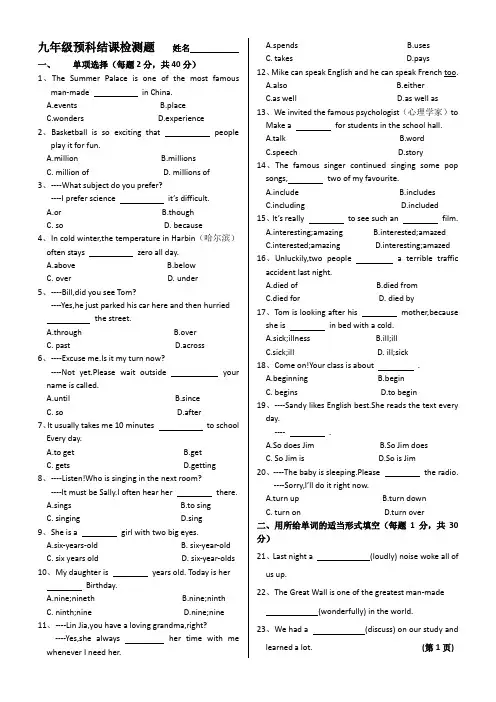
九年级预科结课检测题姓名一、单项选择(每题2分,共40分)1、The Summer Palace is one of the most famousman-made in China.A.eventsB.placeC.wondersD.experience2、Basketball is so exciting that peopleplay it for fun.lionlionsC. million ofD. millions of3、----What subject do you prefer?----I prefer science it’s difficult.A.orB.thoughC. soD. because4、In cold winter,the temperature in Harbin(哈尔滨)often stays zero all day.A.aboveB.belowC. overD. under5、----Bill,did you see Tom?----Yes,he just parked his car here and then hurriedthe street.A.throughB.overC. pastD.across6、----Excuse me.Is it my turn now?----Not yet.Please wait outside your name is called.A.untilB.sinceC. soD.after7、It usually takes me 10 minutes to school Every day.A.to getB.getC. getsD.getting8、----Listen!Who is singing in the next room?----It must be Sally.I often hear her there.A.singsB.to singC. singingD.sing9、She is a girl with two big eyes.A.six-years-oldB. six-year-oldC. six years oldD. six-year-olds10、My daughter is years old. Today is herBirthday.A.nine;ninethB.nine;ninthC. ninth;nineD.nine;nine11、----Lin Jia,you have a loving grandma,right?----Yes,she always her time with me whenever I need her.A.spendsesC. takesD.pays12、Mike can speak English and he can speak French too.A.alsoB.eitherC.as wellD.as well as13、We invited the famous psychologist(心理学家)to Make a for students in the school hall. A.talk B.wordC.speechD.story14、The famous singer continued singing some pop songs, two of my favourite.A.includeB.includesC.includingD.included15、It’s really to see such an film.A.interesting;amazingB.interested;amazedC.interested;amazingD.interesting;amazed16、Unluckily,two people a terrible traffic accident last night.A.died ofB.died fromC.died forD. died by17、Tom is looking after his mother,because she is in bed with a cold.A.sick;illnessB.ill;illC.sick;illD. ill;sick18、Come on!Your class is about .A.beginningB.beginC. beginsD.to begin19、----Sandy likes English best.She reads the text every day.---- .A.So does JimB.So Jim doesC. So Jim isD.So is Jim20、----The baby is sleeping.Please the radio.----Sorry,I’ll do it right now.A.turn upB.turn downC. turn onD.turn over二、用所给单词的适当形式填空(每题1分,共30分)21、Last night a (loudly) noise woke all of us up.22、The Great Wall is one of the greatest man-made(wonderfully) in the world.23、We had a (discuss) on our study and learned a lot. (第1页)24、I don’t like the blue shirt.I prefer the green(first).25、I think this story sounds (fantastic) than that one.26、She’d like (visit) the Summer Palace this summer.27、Students should answer questions loudly and(clear) in class.28、My cousin John (arrive) in Beijing in two hours.29、It’s late into the night and the whole city has become(silence).30、Ten years (pass) since they(meet) ten years ago.31、They spent a long time (finish) the interesting film Dying to Survive(《我不是药神》) 32、I heard some students (sing) songs when I passed by the classroom.33、----Helen,have you (find) out when the People’s Republic of China was(found) ?34、May is the (five) month of the year.35、We help wash the (dish) after dinner.36、While Mary (cross) the street,a car suddenly came.37、They give (thank) to the police for helping find their lost dog.38、Tom (lie) in bed and didn’t feel like getting up because he had a fever.39、He learns English by (listen) to the tape.40、Tom is (clever) than any other boy in his class.41、Zheng Chenggong is one of the national. (第2页)(hero) in our country.We are proud of him.42、(what) you do,please don’t break the rules.43、The child is crying.Please do something to make him stop (cry) .44、In the interview she told me an(amaze) story.45、You can enjoy water sports,or(simple) lie on the beach.46、Jim went to school in a hurry this morning without(eat) breakfast.47、The nurses from the front(前线) took good care of the (wound) .48、Several doctors are having an(operate) on the boy’s head at the moment.49、Bill continued (read) books after doing his homework.50、Do you think you can manage (get) us the tickets?三、阅读理解(每题2分,共20分)AThe Spring Festival is one of the most important festival in China.During the festival,Chinese people have many activities.They paste Spring Festival Couplets(贴春联),greeting the New Year and saying goodbye to the old year.On the first day of the Spring Festival,people hang out(四处拜访),wearing new clothes.Nowadays,children get red packets from their parents and their relatives.It is a good time for people to visit relatives and friends.More importantly,the Spring Festival is celebrated not only in China but also in other parts of the world.The Spring Festival was celebrated in the UK from 1980.Every new year, people also get together and have lots of activities. They singsongs, dance and share photos with friends or watch movies in the cinema. Besides, the Spring Festival has become a key time for Chinese living in the US. They go to a large evening party to welcome the traditional New Year. The Chinese New Year will be welcomed with three weeks of celebration across Australia. Thousands of people come to Sydney’s Chinatown. They enjoy fireworks and lion dances. The family dinner on New Year’s Eve is an important tradition for Chinese whether they were born in Singapore(新加坡) or moved there from China. They usually hold it at home because having it in a restaurant takes away the meaning of the tradition.51、Which activity is not mentioned(提及) in Paragraph One?A.Hold a New Year party.B.Hang out, wearing new clothes.C.V isit relatives and friends.D.Paste Spring Festival Couplets.52、The underlined(划线的) word “fireworks”in the second paragraph means “” in Chinese.A.火炉工B.消防员C.烟花表演D.畅销书53、How many countries are mentioned in the passage?A.TwoB.ThreeC.FourD.F ive54、People In Singapore were all born in Singapore?A.YesB.NoC.No idea55、What festival is the passage about?A.Mid-autumn DayB.Dragon Boat FestivalC.Spring FestivalD.Double Ninth FestivalBHave you ever been ill? When you are ill,you must be unhappy because your body becomes hot,and there are pains all over your body. You don't want to work,you stay in bed,feeling very sad.What makes us ill? It is germs(细菌). Germs are everywhere. They are very small and you can't find them with your eyes,but you can see them with a microscope. They are very small and there could be hundreds of them on a very small thing.Germs are always found in dirty water. When we look at dirty water under the microscope,we shall see them in it. So your father and mother will not let you drink dirty water.Germs aren't found only in water. They are found in air and dust. If you cut your finger,if some of the dust from the floor goes into the cut(割开处),some of the germs would go into your finger. Your finger would become big and red,and you will have much pain in it. Sometimes the germs would go into all of your body,and you would have pain everywhere.56、Which of the following is TRUE?A.If things are very small,they are germs.B. If things can't be seen,they must be germs.C. Germs are only in dirty water.D. Germs are everywhere around us.57. What is a microscope used for?A. Making very small things look much bigger.B. Making very big things look much smaller.C. Helping you read some newspapers.D. Helping you if you can't see things clearly.58. Why don't your parents let you drink dirty water?A. You haven't looked at it carefull y.B. Water can't be drunk in this way.C. There must be lots of germs in it.D. Water will make you ill.59. Which of the following is NOT true?A. Germs can be found both in water and in the air.B. Germs can go into your finger if it is cut. (第3页)C. If your temperature is not OK,there must be germs in your body.D. If your finger isn't cut,there aren't any germs on it.60. What's the main idea of the passage?A. Germs may make us ill.B. Germs are in dirty water.C. Don't drink dirty water.D. Take care of your fingers.四、请从框中选择单词并用其正确形式填在相应横线上。

中国历史上重要的历史事件英语作文The Enduring Legacy of China's Pivotal Historical EventsChina's rich and complex history is marked by a tapestry of pivotal events that have shaped the nation's trajectory and influenced the course of global affairs. From the unification of the Middle Kingdom to the dawn of the modern era, these milestones have left an indeluring impact on the world. In this essay, we will explore some of the most significant historical events that have defined China's enduring legacy.One of the most transformative events in Chinese history is the unification of the country under the Qin Dynasty in 221 BCE. Led by the formidable Qin Shi Huang, this momentous achievement marked the end of the Warring States period and the establishment of the first centralized imperial dynasty. The Qin Dynasty's legacy is evident in the creation of a standardized writing system, a unified legal code, and the construction of the iconic Great Wall, which served as a defensive barrier against northern invasions. This period also witnessed the development of a sophisticated bureaucratic system that would become the foundation for subsequent dynasties.Another pivotal event in Chinese history is the Tang Dynasty, which reigned from 618 to 907 CE. This era is often regarded as the golden age of Chinese civilization, characterized by artistic and cultural flourishing, technological advancements, and expansive territorial control. The Tang Dynasty saw the rise of Chang'an, the capital city, as a bustling cosmopolitan center that attracted scholars, artists, and merchants from across the known world. The dynasty's openness to foreign influences and its promotion of trade along the Silk Road facilitated the exchange of ideas, goods, and technologies, contributing to China's global prominence during this period.The Song Dynasty, which followed the Tang, is renowned for its remarkable achievements in the realms of science, technology, and commerce. During this era, China experienced a remarkable economic and social transformation, with the development of a sophisticated monetary system, the rise of urban centers, and the expansion of international trade. The Song Dynasty also witnessed the emergence of Neo-Confucianism, a philosophical movement that profoundly shaped the intellectual and cultural landscape of China for centuries to come.The Mongol conquest of China, culminating in the establishment of the Yuan Dynasty in 1271, represents another pivotal moment in Chinese history. This period marked the first time that China was ruled by a non-Han dynasty, and it brought about significantchanges in the political, economic, and social structures of the country. The Yuan Dynasty's openness to foreign ideas and its promotion of trade and cultural exchange with the West had a lasting impact on Chinese society, paving the way for the subsequent Ming and Qing dynasties.The Ming Dynasty, which ruled from 1368 to 1644, is particularly noteworthy for its cultural and technological achievements. During this era, China experienced a renaissance in the arts, with the development of exquisite porcelain, intricate silk textiles, and the iconic Ming architecture. The Ming Dynasty also saw the expansion of China's maritime power, culminating in the voyages of the legendary admiral Zheng He, who led a series of expeditions that established China's presence across the Indian Ocean and beyond.The Qing Dynasty, the last imperial dynasty of China, is significant for its role in shaping the modern Chinese state. Under the Manchu rule, China experienced a period of territorial expansion, economic prosperity, and cultural efflorescence. The Qing Dynasty's legacy is also marked by its engagement with the West, as the dynasty grappled with the challenges posed by Western colonial powers and the gradual erosion of its traditional power structures.The establishment of the People's Republic of China in 1949, following the Chinese Civil War, represents a pivotal moment in thenation's modern history. This event ushered in a new era of socialist transformation and the consolidation of Communist Party rule, which has had a profound impact on China's political, economic, and social development. The reforms and opening-up policies initiated by Deng Xiaoping in the late 1970s further accelerated China's integration into the global economy and its emergence as a major power on the world stage.These are just a few of the many momentous events that have shaped China's rich and complex history. Each of these pivotal moments has left an indelible mark on the country, contributing to its unique cultural heritage, its geopolitical influence, and its enduring legacy as one of the world's most ancient and influential civilizations. As China continues to evolve and shape the global landscape, the study and understanding of these historical events remain crucial in comprehending the nation's past, present, and future.。