
情态动词讲解
- 格式:ppt
- 大小:713.50 KB
- 文档页数:45


情态动词情态动词表示说话人对动作或状态的各种观点和态度,如需要、猜测、意愿或怀疑等。
情态动词有词义,但不完全,是所谓的“辅助性”动词,在句中不能单独充当谓语。
一、情态动词的特征和形式A.情态动词的各种形式如下:情态动词may、might 、can、could、must、have to、ought to、will/ would、shall/should、need、dare、used to否定式may not、might not、can not 、could not、must not、do not have to、ought not to、will not、would not、shall not、should not、need not、dare not、used not to、did not use to简略否定式mayn't(老式英语,现在不常见)、mightn't、can't、couldn't、mustn't、don't have to、oughtn't to(否定句中to可省略)、won't、wouldn't、shan't(只用于英国英语)shouldn't、needn't、daren't、usedn't to、didn't use toB.情态动词除ought to, used to等外,后面只接不带to的不定式。
1.情态动词+doYou shouldn't be so careless.你不该这样粗心大意。
Jessica told him yesterday she might not go on the trip.杰西卡昨天告诉他,她可能不去旅行了。
Difficulties can and must be overcome.困难能够而且必须克服。
2.情态动词+be doingShe must be listening to pop music.她肯定在听流行音乐。

链接中考语法:情态动词一、情态动词的特点:情态动词,又叫情态助动词。
它们具有以下特点:⑴它们必须与其他动词连用,即:情态动词+动词原形,表示说话人对所述动作的看法,如需要、可能、意愿或怀疑等。
⑵绝大多数情态动词没有人称和数的变化,即第三人称单数不加-s (以be和have开头的情态动词短语除外)。
⑶在意义上,情态动词具有“多义性”。
例如:can既可表示能力,又可表示可能、允许等意义。
二、部分情态动词的基本用法:1.can的基本用法:⑴表示体力或智力上的能力,即“能够,会”,可与beableto转换。
例如:HecanspeakEnglish./HeisabletospeakEnglish.?他会讲英语。
Canyouplaybasketball? —No,I can’t.?你会打篮球吗?——我不会。
如果表示将来具备的能力,要用willbeableto。
例如:IfIhaveagoodsleep,Iwillbeabletodotheproblem.?假如我睡个好觉,我就能做那道题目了。
⑵表示许可,主要用于口语,书面语一般用may。
例如:Canwegohomenow,please? —No,youcan’t.?我们可以现在就回家吗?——不可以。
Youcanonlysmokeinthisroom.?你只能在这间房间里抽烟。
You can’t keepthelibrarybooksformorethanamonth.?图书馆的书借期不可超过一个月。
⑶表示“可能”,与may同义,但一般用在疑问句中。
例如:Whatcanhepossiblywant?他可能会想要什么呢?另外,在否定句中,否定形式can’t表示推测“不大可能”。
例如:Anybodycanmakemistakes.?任何人都可能会犯错误。
Thenews can’t betrue.?那消息不大可能是真的。
与第一、二人称连用时,还可以就可能的解决问题的方式或可能的行为提出建议。

常见情态动词讲解情态动词是一种特殊的动词,它不能单独作为谓语,必须和其他动词一起构成谓语。
情态动词没有人称和数的变化,后面必须跟动词原形。
2、常见的情态动词包括can、could、may、must、shall、should、need和would。
3、情态动词的用法主要包括:询问能否帮忙,回答可以或不行。
用XXX询问某人是否能做某事,回答可以或不行。
询问是否可以借用某物,回答可以或不行。
询问是否可以在书上写字,回答不行。
用could或XXX请求帮忙,回答可以或肯定。
询问去动物园的路,请求指路。
询问是否可以进入某处,回答可以。
询问是否可以坐在某处,回答可以或不行。
询问是否可以喝可乐,回答可以。
用may、could或XXX询问是否可以和某人通话,回答正在通话中。
should和XXX表示劝告,如早起、不要玩电脑游戏等。
用should询问某人是否应该做某事,回答肯定或否定。
表示建议时可以用“你愿意…吗”来引导。
He said it was okay for me to smoke in the room。
Instead of using "may" to answer ns。
it's better to use phrases like "Yes。
please," "Certainly," "Please don't," "You'd better not," or "No。
you mustn't" XXX。
He might be at home。
but I'm not sure。
She may not be aware of this matter。
They could be having a meeting。
but I'm uncertain。
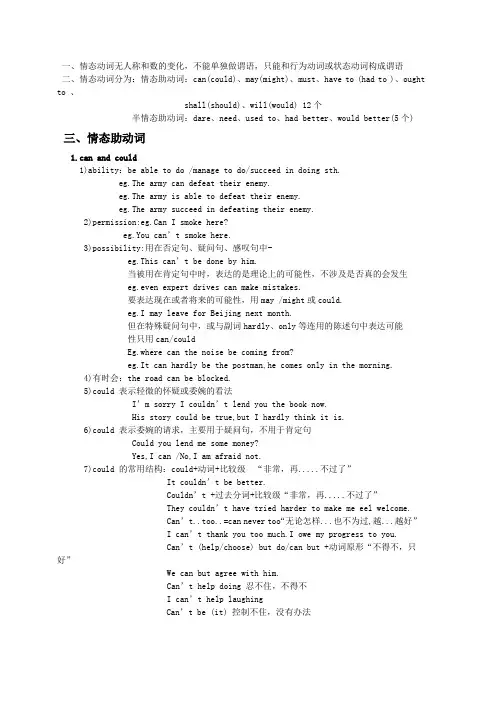
一、情态动词无人称和数的变化,不能单独做谓语,只能和行为动词或状态动词构成谓语二、情态动词分为:情态助动词:can(could)、may(might)、must、have to (had to )、oughtto 、shall(should)、will(would) 12个半情态助动词:dare、need、used to、had better、would better(5个)三、情态助动词1.can and could1)ability:be able to do /manage to do/succeed in doing sth.eg.The army can defeat their enemy.eg.The army is able to defeat their enemy.eg.The army succeed in defeating their enemy.2)permission:eg.Can I smoke here?eg.You can’t smoke here.3)possibility:用在否定句、疑问句、感叹句中-eg.This can’t be done by him.当被用在肯定句中时,表达的是理论上的可能性,不涉及是否真的会发生eg.even expert drives can make mistakes.要表达现在或者将来的可能性,用may /might或could.eg.I may leave for Beijing next month.但在特殊疑问句中,或与副词hardly、only等连用的陈述句中表达可能性只用can/couldEg.where can the noise be coming from?eg.It can hardly be the postman,he comes only in the morning.4)有时会:the road can be blocked.5)could 表示轻微的怀疑或委婉的看法I’m sorry I couldn’t lend you the book now.His story could be true,but I hardly think it is.6)could 表示委婉的请求,主要用于疑问句,不用于肯定句Could you lend me some money?Yes,I can /No,I am afraid not.7)could 的常用结构:could+动词+比较级“非常,再.....不过了”It couldn’t be better.Couldn’t +过去分词+比较级“非常,再.....不过了”They couldn’t have tried harder to make me eel welcome.Can’t..too..=can never too“无论怎样...也不为过,越...越好”I can’t thank you too much.I owe my progress to you.Can’t (help/choose) but do/can but +动词原形“不得不,只好”We can but agree with him.Can’t help doing 忍不住,不得不I can’t help laughingCan’t be (it) 控制不住,没有办法It can’t be helpedCan’t....without 没有...就不能One can’t succeed without perseverance.2.may and might1)permission:May I use your pen?Yes,you may./No,you may not.2)Possibility:用于推测,表示不确定,不用于疑问句中She may know Tom’s address.出现I’m afraid.I’m not sure等表示不确定时,常用may/might.I’m afraid he might not come to attend the meeting today.从语气上判断,may表示的可能性比might 大,might更多的表示怀疑He may be very busy now.He might be very busy now.3)用于让步状语从句中However hard you may study,you cannot master English in a month.4)用于祈使句,表示祝愿May you succeed!5)might 常用于表示轻微的责备和委婉的请求You might post the letter for me if you are going near a post box.You might have let me know before!6)习惯用法:may as well do”理所当然,有足够的理由”She may be proud of her sonMay /might (just) as well do=had better do(最好)You might as well stay at home tonight.May/might as well+do A+as+do+B”与其做B不如做A”You might as well throw the money away as lend it to him.One may as well not know a thing at all as know it but imperfectly 3.must and have to1)表示义务,一定要,必须You must arrive in good time.The meeting is very important.2)表示肯定性或难以避免,必然会,肯定会All men must die.3)must 表示有把握的推测,一定是,准时Must do/must be doing/must have doneThe tall fellow must be a basketball player.Let’s have something.You must be starving.He must have received mu letter which has mailed last week.4)must 表示非要,偏要,常以第二人称为主语,意指不耐或令人不愉快的事情,用于其他人称,表示主语固执,意为偏偏Why must you buy that car?Jane was never a pleasant young girl.After you gave her your advice,she must goand do the opposite.5)must 的三种否定形式表示不可能 must be --can’t be must have done--can’t have done You must have met him before.You can’t have met him before.表示不必 must do--need not to/don’t have toWe must get up at six tomorrow morning.We don’t have to get up at six tomorrow morning.表示决不能,严禁 must--mustn’tYou mustn’t park your car here.6)回答以must提问的句子Must we clean all the rooms?Yes ,you must/No ,you don’t have to/No ,you needn’t7)must 可做名词,表示必须有的东西,必须做的事Warm clothes are a must in the mountains.8)must和have to 表示必须时,有一下差别Must 表示的是说话人主观的看法,而have to则往往强调客观需要The play is not interesting ,I really must go now.I have to work when I was your age.Must 一般只表现在,have to 则有更多的时态。