
现在完成时语法讲解
- 格式:ppt
- 大小:5.15 MB
- 文档页数:7

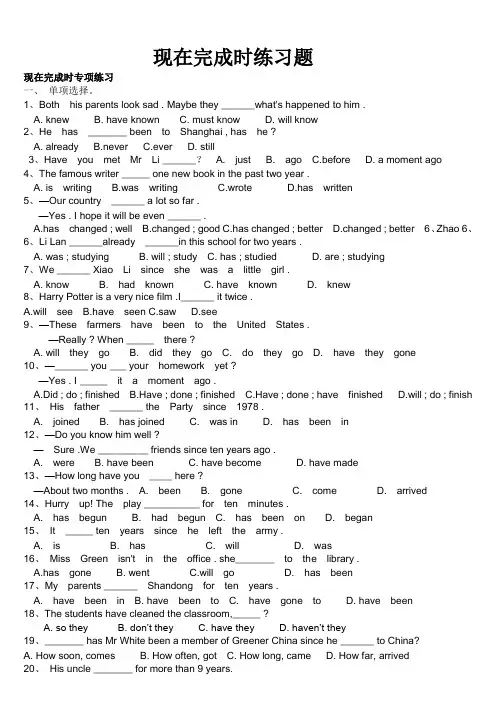
现在完成时练习题
现在完成时专项练习
一、 单项选择。
1、Both his parents look sad . Maybe they ______what's happened to him .
A. knew B. have known C. must know D. will know
2、He has _______ been to Shanghai , has he ?
A. already B.never C.ever D. still
3、Have you met Mr Li ______? A. just B. ago C.before D. a moment ago
4、The famous writer _____ one new book in the past two year .
A. is writing B.was writing C.wrote D.has written
5、—Our country ______ a lot so far .
—Yes . I hope it will be even ______ .
A.has changed ; well B.changed ; good C.has changed ; better D.changed ; better 6、Zhao 6、6、Li Lan ______already ______in this school for two years .
A. was ; studying B. will ; study C. has ; studied D. are ; studying
7、We ______ Xiao Li since she was a little girl .

1
现在完成时讲解
一、构成:
肯定式:主语 + 助动词have/has + 动词的过去分词.
疑问式:助动词Have/Has + 主语 + 动词的过去分词?
否定式: 主语 + 助动词have/has + not + 动词的过去分词.
过去分词规则变化:
a)一般情况下,直接加ed, (work---worked,water---watered, finish---finished等;)
b)以“辅音字母+ y”结尾的动词, 把y 变成i 再加ed, (carry-- -carried study---studied等;)
c)以辅+元+辅结尾且中读的动词,要双写最后一个辅音字母,再加ed。 (stop---stopped,shop---shopped)
d)以不发音的e结尾的动词,只加d (
过去分词不规则变化表:
二、用法:
用法一:表示过去(已经、曾经或从未)发生的某一动作对现在造成的影响或结果。
标志词: ①already, ②never, ③ever, ④just, ⑤yet, ⑥before,
⑦once/twice/数字+ times
例: I have cleaned my room. 我已打扫了房间(房间现在是干净的,不需要打扫了)
They have left. --他们已经离开了,也就是说现在他们人不在这里
I have never had a car (我从未有过汽车。)
I have been there twice.
a)already 往往用于肯定句,用在疑问句时表示强 调或加强语气;yet 用于否定句和疑问句。
• He has already left here. 他已经离开这里了。
• Has he already left here? 他(真的)已经离开这里了吗?(表示加强语气)
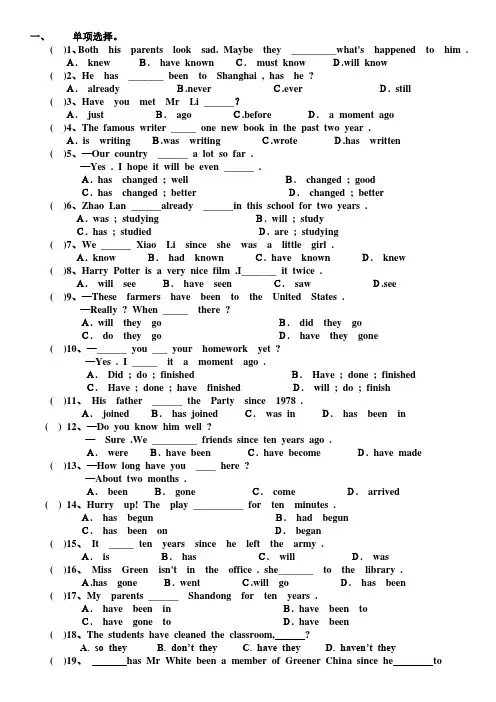
一、 单项选择。
( )1、Both his parents look sad. Maybe they _________what's happened to him . A. knew B. have known C. must know D.will know
( )2、He has _______ been to Shanghai , has he ?
A. already B.never C.ever D. still
( )3、Have you met Mr Li ______?
A. just B. ago C.before D. a moment ago
( )4、The famous writer _____ one new book in the past two year .
A. is writing B.was writing C.wrote D.has written
( )5、—Our country ______ a lot so far .
—Yes . I hope it will be even ______ .
A. has changed ; well B. changed ; good
C. has changed ; better D. changed ; better
( )6、Zhao Lan ______already ______in this school for two years .

Great hopes make great man
1 时态讲解:现在完成时
(1)构成:现在完成时由助动词have + 过去分词构成,助动词have 有人称和数的变化。第三人称单数用has,其余用have.
现在完成时的否定式直接在助动词后面加上not、疑问式是把助动词提到主语之前。以study 为例,其否定式、疑问式和简单回答形式如下:
否定式 疑问式
I have not (haven’t) studied…. Have I studied…?
You have not (haven’t) studied…. Have you studied…?
He has not (hasn’t) studied…. Has he studied…?
否定疑问式 简单回答(肯定/否定)
Have I not (Haven’t I) studied…? Yes, you have. No, you haven’t.
Have you not (Haven’t you) studied…? Yes, I have. No, I haven’t.
Has he not (Hasn’t he) studied…? Yes, he has. No, he hasn’t.
(2)用法:
1)现在完成时通常表示在说话之前已经完成的动作或存在的状态。说话人强调的是该动作或状态对现在的结果或影响。
My daughter has just gone out. 我女儿刚出去。
I’m sure we’ve met before. 我肯定我们以前见过面。
She has arrived. 她到了。
2)表示持续到现在的动作或状态,往往和包括现在在内的表示一段时间的状语连用,如recently, already, just, lately, for…, since…,yet等。如:
I haven’t heard from her these days. 这些日子我没有收到她的信。