初中英语代词详解
- 格式:docx
- 大小:149.94 KB
- 文档页数:4
初中英语语法——代词
代词的分类:人称代物/主代词/反身代词/不定代词/指示代词/疑问代词
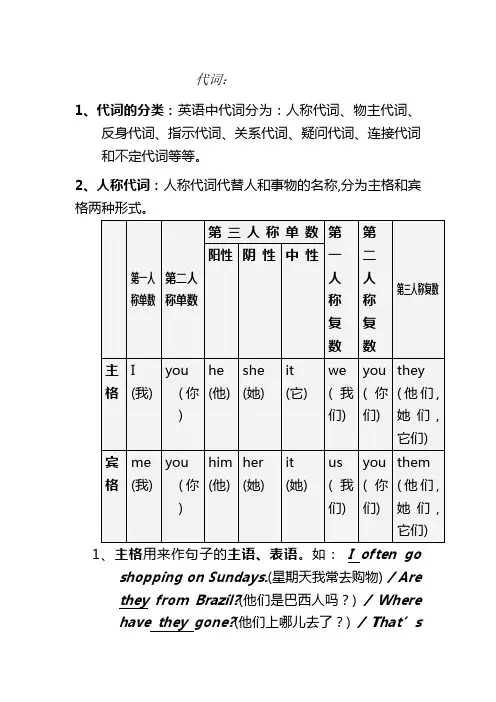
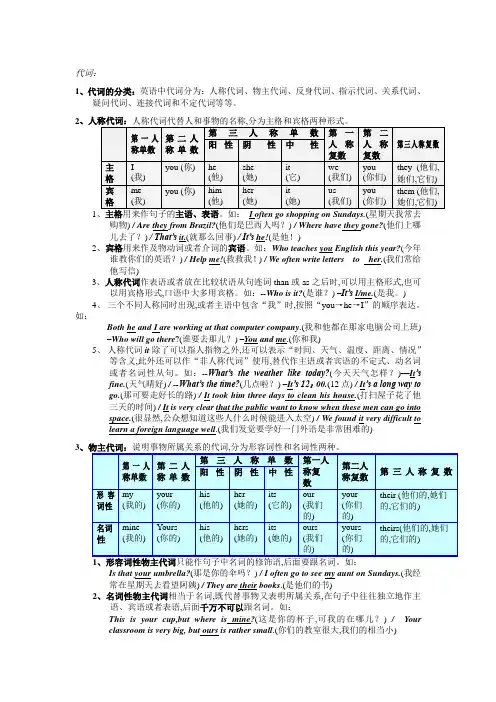
人称代词
人称代词代替人和事物的名称,分为主格和宾格两种形式。
人称代词作主语时用主格,作宾语时用宾格
They all like him very much. 他们都很喜欢他。
She gave the books to you and me. 这些书是她送给你和我的。
2. 人称代词在作表语时用宾格——Who’s knocking at the door? ——It’s me
3. 人称代词在并列使用时的顺序“第二人称,第三人称,第一人称”
You, she and I all enjoy the music. 你我她都喜欢音乐。
4. she可以用来代表国家可以用来代表国家We love our motherland, we hope
she’ll be stronger and bigger. 我们热爱我们的祖国,我们希望她更强大。
The ship is leaving. She’s on her first trip to Boston.
轮船要起航了。这是她第一次去波士顿。
5. it作为人称代词时可以表示天气,距离、时间环境等
——What’ the weather like today?——It’s windy. 今天的天气怎么样?- 有风。
It’s about five minutes’ walk from home to school. 从家到学校的路程大约5分钟。
6. it可作为形式主语,将不定式,动名词等构成的主语后移等构成的主语,使句子显得平稳
It’s hard to reach the apples. 很难够到苹果。
It’s good for you taking a walk after supper. 对你来说饭后散步是有好处的 1. 形容词性物主代词在句中只能作定语
My brother is a worker. 我弟弟是个工人。
His parents are very friendly. 他的父母非常友善。
2. 形容词性物主代词和名词性物主代词的关系
形容词性物主代词+名词名词名词名词=名词性物主代词
3. 注意,名词性物主代词在句中所指代的关系是单数还是复数。。。
4. These books aren't ours. Ours are new. (our books = ours)
5. This is not our room. Ours is over there(our room = ours)
4. “of +名词性物主代词名词性物主代词名词性物主代词名词性物主代词”表示所属 A sister of his is a nurse. 他的一个妹妹是个护士。 Tom is a friend of mine
1. 反身代词在句中可以作宾语,表语,和同位语
He thinks more of others than of himself. 他想到别人比想到自己更多一些。 That poor boy was myself. 那个可怜的孩子就是我自己。
He himself was a doctor. 他本人就是一个大夫。
I myself can work the problem out. 我能亲自算出这道题
反身代词有以下常见搭配
enjoy oneself = have a good time by oneself = alone help oneself
to„„„„ learn sth. by oneself =teach oneself sth. 注意:oneself 有单复数之分 I enjoy myself. Children, help yourselves to
some fish.
all, each, every, both, either, neither none, one, little, few, many, much
other, another, some, any, no 由some, any, no, every 等构成的合成代词,在用法上容易混淆
1. some/any some(一些,某)一般用于肯定句中
There are some flowers in front of the house.
any(一些,任何)多用于疑问句和否定句
Do you have any picture-books? 注意some有时也可用于表示请求的疑问
Would you like some meat? 你想要些肉吗?
May I ask some questions? 我可以问问题吗?
Could I have some apples? 我可以吃苹果吗?
Will you give me some water? 你能给我些水吗?
2. many/much many 修饰或指代复数名词There are many eggs in the
basket. Many of us like playing games.
much 修饰或指代不可数名词
He doesn’t know much English.
3. another/other another 泛指三个或三个以上中的另一个
I don’t want this coat. Please show me another.
other 后面接名词,泛指别的、其他的 Do you have any other questions? 4.
the other / others / the others / the other
1. 特指两个中的另一个 He has two sons. One is a worker, the other
is a doctor.
2. 修饰名词,特指另一个、另一些
Tom likes swimming, and the other boys in his class like swimming, too. others泛指其他的人或物 He often helps others. Some are playing basketball, others
are playing football.
the others 特指确定范围内剩下的全部人或物
There are fifty students in our class. Twenty of them are girls, the others are
boys.
5. few/a few/little/a little
few/a few 修饰可数名词
little/a little 修饰不可数名词修饰不可数名词修饰不可数名词修饰不可数名词
few, little 表示否定意义译为译为译为译为“没有几
a few, a little 表示肯定译为“有几个
6. every/each every+单数名词,表示“每一个”,强调共性、整体,只作定语,形式上为单数.不与of 连用
Every child likes playing games.
each 表示“每一个”,强调个性,作定语主语、宾语和同位语,常与of 连用
Each student was asked to try again. Each of them has a nice skirt.
7. all/none all “(全部)都”, 表示三者或三者以上,作同位语时,一般放在连系动词、助动词之后,行为动词之前。 We are all from CaThey all like English.
none “没有”,表示三者或三者以上都不,后常跟介词of(谓语动词单、复数均可) None of us is/are afraid of dogs.
8. both/either/neither both “两者都”,作主语时看作复数;作定语时后跟名词复数My parents are both teachers. =Both of my parents are teachers.
neither “两者都不”,含有否定意义,作主语时谓语用第三人称单数; 作定语时后跟名词 Neither answer is right.
either “两者中任何一个,作主语时谓语用第三人称单数,作定语时后跟名词单数 There are trees on either side of the street. = There are trees on both
sides of the street.
有关词组及应用有关词组及应用有关词组及应用有关词组及应用
both of/either of/neither of Both of them swim well. 他们俩都游得很好
Either of you goes to Beijing. 你们俩随便谁去北京都可以。
Neither of them stopped to have a rest.他们俩谁都不停下来休息。
both„„„„and谓语动词用复数形式用复数形式
either„„„„or/neither„„„„nor谓语动词遵循就近原则
Both Tom and Lucy are in Grade Two. Tom 和 Lucy 都在二年级。
Either my father or my mother cooks at home. 或者我爸爸或者我妈妈在家烧饭。
Neither he nor I am free today. 我和他今天都没
9. Something/anything/nothing Somebody/anybody/nobody 当形容词修饰这些不定代词时,常后置 I have something important to tell you. Is
there anything else in the box? Nobody can answer the question.
指示代词
表示空间和时间远近关系的代词,包括this/that (单数) these/those (复数) 1.
this, these指在方位上较近的人或物较近的人或物较近的人或物 that, those指在方位上较远的人或物 This is my shirt, that’s yours.