初中英语代词用法大全
- 格式:docx
- 大小:16.85 KB
- 文档页数:14
初中英语代词用法大全
代词的定义
用来代替名词、名词短语或句子的词称为代词。代词可分为:人称代词、指示代词、疑问代词、反身代词和不定代词等。
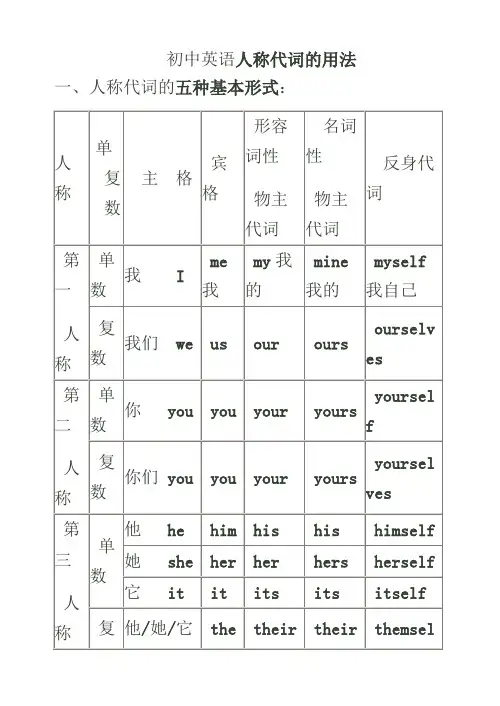
人称代词
初中英语代词用法大全,英语代词有哪些
人称 :主格(单数) 宾格(单数) 主格(复数) 宾格(复数)
句子的成份 例句
作主语(代替上文中提到的人或物) Mrs. Suen is an
English teacher. She teaches us geography. I can’t
read the story. It is written in Russian
直接宾语: Let her play now. We often meet him at the
school gate
间接宾语: Granny offered us fruit The sun gives us
light and heat
介词宾语: Please sit between him and me. The teacher
took good care of us.
作表语 (用主格或宾格) Who is that? It was I whom you
saw at the station
1. 人称代词不仅仅指人,也可以指事或物。 2. 人称代词主格单数he, she和it的复数,都是they,宾格形式也相同,为them。
3. 第三人称的人称代词分阳性he(him),阴性she(her)和中性it(it),复数只有一个形式they(them),不分性别。
4. 选用什么人称代词,取决于所要代替的名词。在数和性上要与所代替的名词保持一致。
物主代词
初中英语代词用法大全,英语代词有哪些
物主代词是用来表示所有关系的,分为形容词性物主代词和名词性物主代词两种。形容词性物主代词放在名词前作定语,相当于形容词;名词性物主代词相当于“形容词性物主代词+名词”,相当于名词,可以作主语、表语或宾语。
物主代词的用法:
(1)形容词性物主代词放在名词前作定语。例如:
His pencil box is on the desk.
This is our school.
(2)名词性物主代词作名词用
本身就相当于“形容词性物主代词+名词”,因此,后面不可再加名词。
作主语: Richard’s school bag is blue and mine is black. 里查德的书包是蓝色的,我的书包是黑色的。(mine=my school
bag)
作表语:
It’s his. 这是他的(东西)。
作宾语:
He borrows your dictionary and you may borrow mine. 他借你的字典,你可以借我的。(作及物动词的宾语)
“of+名词性物主代词”可以放在名词后作定语,表示强调:
He is a friend of mine. 他是我的一个朋友。
注意:
试比较下面两句句子:
This is a photo of mine. 这是我的一张照片。(照片是我拥有的,但不一定照的是我本人)
This is a photo of me. 这是一张我本人的照片。(照片上是我本人)
反身代词
初中英语代词用法大全,英语代词有哪些
反身代词用于所强调的动作与动作执行者的关系,强调主语或宾语为同一人或物。
反身代词的形式: 单数:myself我自己yourself你自己himself他自己herself她自己itself它自己
复数:ourselves我们自己yourselves你们自己 hemselves他们自己
反身代词的用法:
直接宾语:
My father taught himself Japanes
Please help yourselves to some fruit, everyone.
介词宾语:
The twelve-year-old boy can take care of himself.
Don’t think too much of yourself
主语同位语:
She taught Thomas Edison herself
The detective story itself is worth reading
宾语同位语:
— Li Ming, I want to ask for leave.
— You’d better ask the teacher herself / himself
表语同位语:
— Who is the man?
— It was Mr. Yang himself. 表语:I’m not quite myself today itself. 今天我感到不舒服。
指示代词
(一)指示代词是具有指示概念的代词
this 这; that 那; these 这些; those 那些; such 如此的; same 同样的
(二)指示代词的用法
(1)this、 that、 these、 those 在句子中作主语、宾语、表语或定语。
(2)such 一般在句子中作定语或主语。such “这样”,such a 这样一个,such as 像…这样的…。
(3)same 可作定语、表语、主语和宾语。例如:
1) That is our English teacher. (主语)
2) This storybook is thicker than that one. (定语)
3) I prefer this (these) to that (those).(宾语)
4) What he like best is this/that? (表语)
5) I have never read such an excited book. (定语)
6) I like such sports as basketball and swimming. (定语)
7) Such is our trip plan. (主语) (指上文提到过或刚说过的内容)。
8) She wants the book and I want the same. (宾语) 9) We were born on the same day. (定语)
注意:
1) this、 these 指空间上离说话人较近的人或物,可以与
here 连用;that、 those 指空间上离说话人 较远的人或物,可以与 there 连用。
2) 打电话或其他场合,看得到的一方用 this 或 these. 反之用 that 或 those。
3) such 作定语时,如名词前有不定冠词,则用 such a/an
+ 名词。
4) 在 same 之前必须加冠词 the.。
疑问代词
疑问代词的用法:
主语(例句):Who invited you to dinner? Whose is the
best?
直接宾语(例句):Whom did you meet on your way home?
What is she doing?
间接宾语(例句):Whom are you waiting for? What are you
talking about?
表语(例句):Who are those women? What are you?
定语(例句):Which class are you in? Whose report is
this?
注意: 1.Who 用于询问别人姓名,身份或关系。What 用于询问别人职业。
2.Which 指的物有范围限制,侧重于哪一个;What 指的物无范围限制,侧重于种类。
3.Whose 用于明确所有者,Whom 在口语中,whom 多为 who
代替。
不定代词
不是指明代替任何特定名词的代词叫不定代词。常见的不定代词有all, both, each, every, some, any, many, much,
(a)few, (a)little, one, ones, either, neither, other,
another, no, none以及含有some-, any-, no-等的合成代词(如:anybody, something, no one)。这些不定代词大都可以代替名词和形容词,在句子中作主语、宾语、表语和定语。但none和由some, any, no, every thing, -body, -one构成的复合不定代词(如somebody等)只能作主语、宾语和表语;而every和no只能作定语。
不定代词的形式:
不定代词 词义 复合形式说明
some 一些(可数或不可数) something 某物、某事someone
某人somebody某人 一般用于肯定句
any 一些,任何(可数或不可数) nything 任何事物anyone
任何人=anybody 多用于否定句,疑问句或条件状语从句中
no 没有,无 nothing 无物nobody 无人no one 无一人 修饰可数或不可数名词,复合形式只具有名词的作用 every 每个,所有的 everything 每一个事物,一切everyone 每人=everybody 强调共性,词义和 all 相近
all 全体、所有的 这里表示 这里表 代替或修饰可数名词时,指两个以上的人或物,也可代替或修饰不可数名词。
each 每个 这里表示 这里表 强调个性,指两个或两个以上的人或物。
few 很少(可数) 这里表示 这里表 表示否定
a few 一些,几个(可) 这里表示 这里表 表示否定
little 很少(不可数) 这里表示 这里表 表示否定
a little 一些(不可数) 这里表示 这里表 表示否定
many 很多(可数) 这里表示 这里表
much 很多(不可数) 这里表示 这里表
both 两个,两者都 这里表示 这里表 仅指两个人或物
neither 没有人或物 这里表示 这里表 仅指两个人或物
none 没有人或物 这里表示 这里表 指两个以上的人或物,当指可数名词时,谓语动词用单、复数都可以。
either 每个 这里表示 这里表 强调个性,指两个或两个以上的人或物。
other(s) 另一个(些) 这里表示 这里表
another 另一个,又一个 这里表示 这里表 当于 an other
one 一个(人或物) 这里表示 这里表 one 的复数形式是 ones