初高中英语衔接讲座1
- 格式:doc
- 大小:70.50 KB
- 文档页数:6
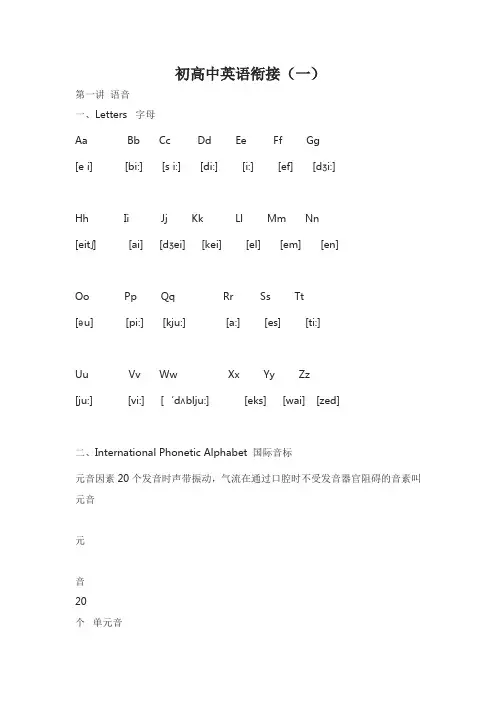
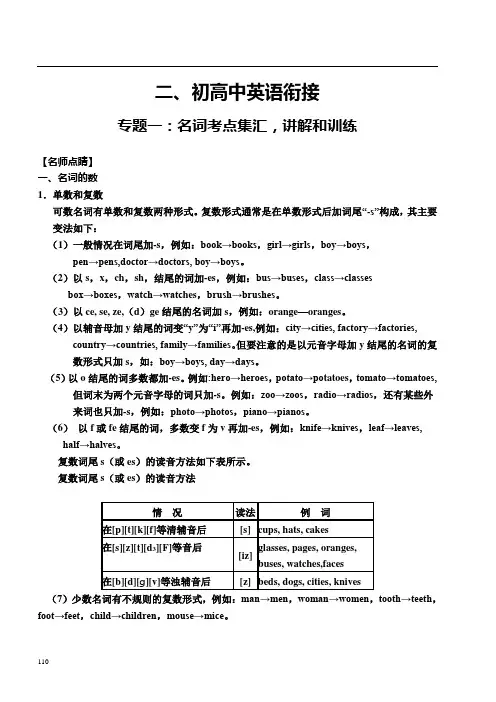
初高中英语衔接专题讲座一1 语音衔接目标:能根据音标正确朗读单词,根据读音规则记忆单词内容:国际音标48个,字母组合的读音规则2 词法衔接目标:认识单词的词性,根据构词法识记单词内容:英语10大词性;构词法3 句法衔接目标:能识别句子的成分,分清主、谓、宾、表、同、定、状、补;能识别句子的结构,认识各种从句内容:句子的成分;句子的结构;简单句的五种基本句型;各种从句词法衔接英语词性分类1. n. 名词(nouns):名词分为专有名词(Proper Nouns)和普通名词(Common Nouns)。
专有名词是某个(些)人、地方、机构等专有的名称,如Beijing,China等;普通名词是一类人或东西或是一个抽象概念的名词,如:book,sadness等。
2. pron. 代词(pronoun):代词是代替名词的一种词类。
大多数代词具有名词和形容词的功能。
英语中的代词,按其意义、特征及在句中的作用分为:人称代词、物主代词、指示代词、反身代词、相互代词、疑问代词、关系代词、连接代词和不定代词九种。
3. num. 数词(numeral):表示“多少”和“第几”的词,叫数词。
其用法相当于名词或者形容词。
数词分为基数词和序数词两种。
4. adj. 形容词(adjective):修饰名词或代词,表示人或事物的性质、状态,和特征。
5. adv. 副词(adverb):修饰动词、形容词或全句,说明时间、地点、程度、方式等概念。
6. v. 动词(Verb).:表示各类动作的词汇。
基本上每个完整的句子都有一个动词。
动词分为及物动词(vt.)和不及物动词(vi.)。
及物动词在使用中要有宾语或使用被动语态。
动词还包括系动词、助动词、情态动词。
7. art. 冠词(article) :包括定冠词(the)、不定冠词(a/an)和零冠词(即不用冠词)。
8. prep. 介词(preposition):介词是一种用来表示词与词、词与句之间的关系的虚词,在句中不能单独作句子成分。
介词后面一般有名词、代词或相当于名词的其他词类、短语或从句作它的宾语。
介词和它的宾语构成介词词组,在句中作状语、表语、补语或介词宾语。
介词可以分为时间介词、地点介词、方式介词、原因介词和其他介词。
9. conj. 连词(conjunction):连词是一种虚词,它不能独立担任句子成分而只起连接词与词、短语与短语以及句与句的作用。
连词主要可分为4类:并列连词.转折连词.选择连词和因果连词。
10. interj. 叹词:(interjection):叹词是语法学术语。
表示感叹、呼唤、应答的词,如hi, hello, hey等。
构词法英语中常见的构词法有合成、派生和转化。
(一)派生:在词根上加后缀或前缀构成新词。
1 常见的后缀:——名词后缀:(1)-er,-or表示“动作者,人”,如:leader, teacher, singer, actor, visitor, monitor等。
(2)-ese表示“语言,人”,如:Chinese, Japanese等。
(3)-ian表示“人”,如musician, politician, Russian等。
(4)-ist表示“人, 主义者”,如:scientist, artist, communist, socialist等。
(5)-ment表示“运动,结果”,如:development, movement, government等。
(6)-ness表示“状态,性质”,如:kindness, darkness, weakness, happiness, illness等。
(7)-sion表示“动作,状态”,如:discussion, possession, permission等。
(8)-tion表示“动作,状态”,如: action, pronunciation, instruction, education, liberation等。
(9)-al 表示“动作,过程”,如:arrival, signal等。
(10)-dom表示“状态,职位,领域或身份”,如:freedom, kingdom, wisdom等。
(11)-ence表示“动作,过程,性质,状态,程度”,如: conference, difference, patience, silence 等。
(12)-age表示“状态,身份,地点,场所”,如:advantage, average, baggage, voyage等。
(13)-ess附在名词后,表示“女性的,雌性的”,如:actress, waitress等。
(14)-ics表示“学科名”,如: mathematics, physics, polities等。
(15)-ing表示“动作,动用的过程,动作的结果”,如:building, living, feeling, shopping等。
(16)-ship表示“状态,性质,身份”,如:citizenship, friendship, relationship等。
(17)-th附在部分形容词之后,表示“状态,程度,过程,性质”,如:breath, death, depth, growth, length, strength, truth, warmth等。
(18)-ture表示“动作,结果,状态”,如:adventure, agriculture, furniture, mixture等。
(19)-ure附在动词后,表示“动作,过程、结果”,如:failure, pleasure, treasure, measure等。
(20)-(i)ty构成抽象名词,表示“状态、性质、结果”,如:ability, beauty, electricity, majority, nationality, reality, safety, society等。
(21)-y表示“性质,境遇”,如:bravery, difficulty, discovery, slavery等。
——形容词后缀:(1)-al表示“的”,如: national, chemical, political等。
(2)-an表示“(地,人)的”,如:African, Asian, American, Italian等。
(3)-ble表示“能够”,如:reasonable, valuable, unforgettable, enjoyable等。
(4)-ern表示“方向”,如:southern, northern, eastern, western等。
(5)-ful表示“充满”,如:beautiful, careful, harmful, successful, mouthful, spoonful等。
(6)-ish表示“属于,稍微,……语的”,如:British, Spanish, English, foolish, childish等。
(7)-ive 表示“性,倾向”,如:active, expensive, native, relative, protective等。
(8)-less表示“无(反义词后缀)”,如:careless, harmless, useless等。
(9)-y表示“充满,性质”,如: rainy, windy, snowy, cloudy, lucky, dirty等。
(10)-ly表示“像……的,有……性质的”,如:daily, friendly, lively, lonely, lovely等。
(11)-ent表示“动作,性质”,如: absent, convenient, different, frequent, excellent, present等。
(12)-ant表示“……的”,如:distant, important, pleasant等。
(13)-en表示“由……制(构)成的”,如: wooden, golden等。
(14)-ic表示“与……有关的”,如:scientific, electric等。
(15)-some表示“易于……的,有……倾向的”,如:tiresome, troublesome等。
(16)-ous表示“……的”,如:famous, mountainous, continuous等。
——动词后缀:(1)-en“使……”,如:sharpen, deepen, loosen等。
(2)-ize, 如:modernize, industrialize, organize等。
2 常见的前缀:(1)dis-否定,如:discover, disappear, discourage, disagree, disadvantage, disappoint等。
(2)en-“使……”,如:enable, encourage, enlarge等。
(3)in-(il-, im-, ir-)“不,非”,如:invisible, illegal (非法的), impossible, irregular等。
(4)mis-“误”,如:mistake, misunderstand等。
(5)re-“重复,再”,如:return, rewrite, remarry等。
(6)tele-“远程”,如:telephone, telescope等。
(7)un-“不”,如:unfit, unfair, unknown等。
(二)合成:由两个或更多的词合成一个词。
如:1 合成名词:bookcase, classroom, dining-room, classmate, housework等。
2 合成形容词:seasick, ever-green, good-looking, snow-white, hard-working等。
3 合成动词:overcome, dumbfound, white-wash等。
4 合成副词:however, whenever, maybe, beforehand等。
5 合成代词:himself, everyone, nobody, anything等。
(三)转化:由一种词类转化为另一种或几种词类。
如:1 You must wash your hands before each meal. (hands为名词)2 He took off his cap and handed it to me. (handed为动词)3 You must try to catch up with others. (try为动词)4 Have a try and you might succeed. (try为名词)5 The sports meet was held two days ago. (meet为名词)6 They often meet here in the afternoon. (meet为动词)7 He was lying on his back in the sun. (back为名词)8 He came back before supper yesterday. (back为副词)9 They came on through the back door. (back为形容词)巩固练习:根据句意,用所给单词的适当形式填空。