
句型转换
- 格式:ppt
- 大小:191.50 KB
- 文档页数:24


英语句子转换类型及方法
一、英语句子转换的类型
英语句子转换可以分为两种类型:句型转换和句式转换。
1. 句型转换
句型转换是指将一个句子的结构转换为另一种结构,但语义不发生变化。
句型转换可以分为以下几种:
(1) 主语和谓语的转换
例如:She reads books. -> Books are read by her.
(2) 宾语和谓语的转换
例如:He gives me a book. -> A book is given to me by him.
(3) 形容词和动词的转换
例如:The book is interesting. -> The book interests me.
2. 句式转换
句式转换是指将一个句子的结构和语义都转换为另一种结构和
语义。
句式转换可以分为以下几种:
(1) 肯定句和否定句的转换
例如:He likes apples. -> He doesn"t like apples.
(2) 疑问句和陈述句的转换
例如:Does he like apples? -> He likes apples.
(3) 陈述句和感叹句的转换
例如:He likes apples. -> How does he like apples?
二、英语句子转换的方法
英语句子转换的方法可以分为两种:语法转换和语义转换。
1. 语法转换
语法转换是指通过改变句子的语法结构来实现句子的转换。

句型转换50个1. 原句:He is a good student.- 否定句:He isn't a good student.- 一般疑问句:Is he a good student?2. 原句:They play football every day.- 否定句:They don't play football every day.- 一般疑问句:Do they play football every day?3. 原句:She has a beautiful dress.- 否定句:She doesn't have a beautiful dress.- 一般疑问句:Does she have a beautiful dress?4. 原句:I like reading books.- 否定句:I don't like reading books.- 一般疑问句:Do you like reading books?5. 原句:There are some apples on the table.- 否定句:There aren't any apples on the table. - 一般疑问句:Are there any apples on the table?6. 原句:He can speak English well.- 否定句:He can't speak English well.- 一般疑问句:Can he speak English well?7. 原句:My mother made a cake yesterday.- 否定句:My mother didn't make a cake yesterday.- 一般疑问句:Did your mother make a cake yesterday?8. 原句:We will go to the park tomorrow.- 否定句:We won't go to the park tomorrow.- 一般疑问句:Will you go to the park tomorrow?9. 原句:The boy is running fast.- 否定句:The boy isn't running fast.- 一般疑问句:Is the boy running fast?10. 原句:She was at home last night.- 否定句:She wasn't at home last night.- 一般疑问句:Was she at home last night?11. 原句:They have been to Beijing.- 否定句:They haven't been to Beijing.- 一般疑问句:Have they been to Beijing?12. 原句:He had a great time at the party.- 否定句:He didn't have a great time at the party. - 一般疑问句:Did he have a great time at the party?13. 原句:I will be a teacher in the future.- 否定句:I won't be a teacher in the future.- 一般疑问句:Will you be a teacher in the future?14. 原句:There is a lot of water in the glass.- 否定句:There isn't a lot of water in the glass.- 一般疑问句:Is there a lot of water in the glass?15. 原句:She reads English every morning.- 否定句:She doesn't read English every morning.- 一般疑问句:Does she read English every morning?16. 原句:They are going to have a party this weekend.- 否定句:They aren't going to have a party this weekend. - 一般疑问句:Are they going to have a party this weekend?17. 原句:He does his homework carefully.- 否定句:He doesn't do his homework carefully.- 一般疑问句:Does he do his homework carefully?18. 原句:I saw a movie last week.- 否定句:I didn't see a movie last week.- 一般疑问句:Did you see a movie last week?19. 原句:We have a lot of homework to do.- 否定句:We don't have a lot of homework to do.- 一般疑问句:Do you have a lot of homework to do?20. 原句:The cat is sleeping under the tree.- 否定句:The cat isn't sleeping under the tree.- 一般疑问句:Is the cat sleeping under the tree?21. 原句:She will write a letter soon.- 否定句:She won't write a letter soon.- 一般疑问句:Will she write a letter soon?22. 原句:There were some people in the room.- 否定句:There weren't any people in the room.- 一般疑问句:Were there any people in the room?23. 原句:He has lived here for five years.- 否定句:He hasn't lived here for five years.- 一般疑问句:Has he lived here for five years?24. 原句:I am reading an interesting book.- 否定句:I'm not reading an interesting book.- 一般疑问句:Are you reading an interesting book?25. 原句:They played basketball yesterday afternoon.- 否定句:They didn't play basketball yesterday afternoon. - 一般疑问句:Did they play basketball yesterday afternoon?26. 原句:She can dance beautifully.- 否定句:She can't dance beautifully.- 一般疑问句:Can she dance beautifully?27. 原句:My father bought a new car last month.- 否定句:My father didn't buy a new car last month.- 一般疑问句:Did your father buy a new car last month?28. 原句:We are going to see a film tonight.- 否定句:We aren't going to see a film tonight.- 一般疑问句:Are you going to see a film tonight?29. 原句:There is some milk in the fridge.- 否定句:There isn't any milk in the fridge.- 一般疑问句:Is there any milk in the fridge?30. 原句:He likes playing the guitar.- 否定句:He doesn't like playing the guitar.- 一般疑问句:Does he like playing the guitar?31. 原句:I have finished my work.- 否定句:I haven't finished my work.- 一般疑问句:Have you finished your work?32. 原句:They were watching TV at eight o'clock last night.- 否定句:They weren't watching TV at eight o'clock last night. - 一般疑问句:Were they watching TV at eight o'clock last night?33. 原句:She will go shopping tomorrow.- 否定句:She won't go shopping tomorrow.- 一般疑问句:Will she go shopping tomorrow?34. 原句:There are five students in the classroom.- 否定句:There aren't five students in the classroom.- 一般疑问句:Are there five students in the classroom?35. 原句:He has a pet dog.- 否定句:He doesn't have a pet dog.- 一般疑问句:Does he have a pet dog?36. 原句:I am going to visit my grandparents this weekend.- 否定句:I'm not going to visit my grandparents this weekend.- 一般疑问句:Are you going to visit your grandparents this weekend?37. 原句:They have seen that movie.- 否定句:They haven't seen that movie.- 一般疑问句:Have they seen that movie?38. 原句:She was reading a novel when I came in.- 否定句:She wasn't reading a novel when I came in.- 一般疑问句:Was she reading a novel when you came in?39. 原句:He will be back soon.- 否定句:He won't be back soon.- 一般疑问句:Will he be back soon?40. 原句:There were some books on the desk.- 否定句:There weren't any books on the desk.- 一般疑问句:Were there any books on the desk?41. 原句:I can play the piano.- 否定句:I can't play the piano.- 一般疑问句:Can you play the piano?42. 原句:My mother cooks delicious food.- 否定句:My mother doesn't cook delicious food.- 一般疑问句:Does your mother cook delicious food?43. 原句:We had a party last weekend.- 否定句:We didn't have a party last weekend.- 一般疑问句:Did you have a party last weekend?44. 原句:She is going to sing a song at the concert.- 否定句:She isn't going to sing a song at the concert. - 一般疑问句:Is she going to sing a song at the concert?45. 原句:He has read this book twice.- 否定句:He hasn't read this book twice.- 一般疑问句:Has he read this book twice?46. 原句:I saw him in the park yesterday.- 否定句:I didn't see him in the park yesterday.- 一般疑问句:Did you see him in the park yesterday?47. 原句:They will build a new house next year.- 否定句:They won't build a new house next year.- 一般疑问句:Will they build a new house next year?48. 原句:There is a big tree in front of my house.- 否定句:There isn't a big tree in front of my house.- 一般疑问句:Is there a big tree in front of your house?49. 原句:She likes wearing skirts.- 否定句:She doesn't like wearing skirts.- 一般疑问句:Does she like wearing skirts?50. 原句:I am a doctor.- 否定句:I'm not a doctor.- 一般疑问句:Are you a doctor?。

句子的转换有多少种形式文章一:句子的转换有多少种形式?对于句子的转换,我们可以采用多种形式,通过不同的方法改变原有的句子结构,以达到表达更加准确、生动的效果。
下面列出三个知识点并进行分析。
1. 句型转换的目的与方法句子的转换是为了表达更加准确、复杂的含义,或者为了让同一种表达方式更加生动、具有表现力。
句型转换的方法主要有以下几种:(1)主动变被动:通过将原有句子中的主语变为被动语态的主语,来表达出被动的意义。
例如,“Tom opened the door”可以转换为“The door was opened by Tom”。
(2)疑问变陈述:通过将原有疑问句中的语气改为陈述句,来表达出强烈的肯定或否定的意义。
例如,“Do you like pizza?”可以转换为“I like pizza”。
(3)倒装句:通过将原有句子中的谓语动词与主语倒置,来表达出强调、反问等意义。
例如,“I have never seen such a beautiful girl”可以转换为“Never have I seen such a beautiful girl”。
2. 句型转换的适用场景句型转换的适用场景主要有以下几种:(1)表达强调:通过强调某个词语或句子成分,来表达出强烈的情感或意义。
例如,“I didn't say you were crazy”可以通过倒装句,强调“you were crazy”,以表达出强烈的否定意义。
(2)表达比较:通过将原有句子中的成分进行比较,来表达出事物之间的差异或相似之处。
例如,“I like coffee more than tea”可以转换为“Tea is not as good as coffee”,以表达出两种饮料之间的比较。
(3)表达变化:通过改变句子中的时态、语态等成分,来表达出事物的变化趋势或发展方向。
例如,“He has been studying English for three years”可以转换为“He started studying English three years ago”,以表达出他学习英语的起点和变化趋势。
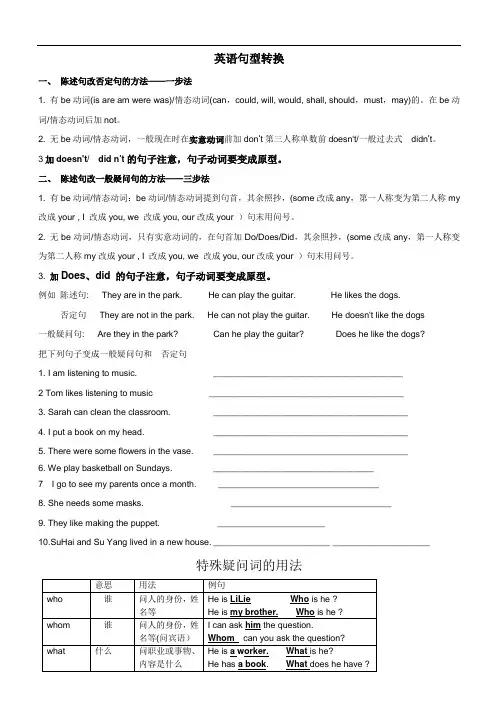
英语句型转换一、 陈述句改否定句的方法——一步法 1. 有 be 动词(is are am were was)/情态动词(can,could, will, would, shall, should,must,may)的。
在 be 动 词/情态动词后加 not。
2. 无 be 动词/情态动词,一般现在时在实意动词前加 don’t 第三人称单数前 doesn't/一般过去式 didn’t。
3 加 doesn't/ did n’t 的句子注意,句子动词要变成原型。
二、 陈述句改一般疑问句的方法——三步法 1. 有 be 动词/情态动词:be 动词/情态动词提到句首,其余照抄,(some 改成 any,第一人称变为第二人称 my 改成 your , I 改成 you, we 改成 you, our 改成 your )句末用问号。
2. 无 be 动词/情态动词,只有实意动词的,在句首加 Do/Does/Did,其余照抄,(some 改成 any,第一人称变 为第二人称 my 改成 your , I 改成 you, we 改成 you, our 改成 your )句末用问号。
3. 加 Does、did 的句子注意,句子动词要变成原型。
例如 陈述句: 否定句 一般疑问句: They are in the park. They are not in the park. Are they in the park? He can play the guitar. He can not play the guitar. Can he play the guitar? He likes the dogs. He doesn't like the dogs Does he like the dogs?把下列句子变成一般疑问句和 否定句 1. I am listening to music. 2 Tom likes listening to music 3. Sarah can clean the classroom. 4. I put a book on my head. 5. There were some flowers in the vase. 6. We play basketball on Sundays. 7 I go to see my parents once a month. 8. She needs some masks. 9. They like making the puppet. _______________________________________ ________________________________________ ________________________________________ ________________________________________ ________________________________________ _________________________________ _________________________________ _________________________________ ______________________10.SuHai and Su Yang lived in a new house. ________________________ ____________________特殊疑问词的用法意思 who whom what 谁 谁 什么 用法 问人的身份,姓 名等 问人的身份,姓 名等(问宾语) 例句 He is LiLie He is my brother. Who is he ? Who is he ?I can ask him the question. Whom can you ask the question? What is he? What does he have ?问职业或事物、 He is a worker. 内容是什么 He has a book.which哪一个问一定范围内 特指的人或物 问所属关系The big box is mine. Which box is yours? The girl at the door is Ann. Which girl is Ann? This is her book. Whose book is this ? This book is hers. Whose is this book?whose what color What time when where why how谁的 什么颜色 几点 什么时候 什么地方 为什么 怎样问颜色(表语) My skirt is red. What color is your skirt? 问具体时间 问大致时间 We play games at five in the afternoon ? What time do you play games? We play games in the afternoon ? When do you play games?问地点(状语) We play games at home on Sunday ? Where do you play games on Sunday? 问原因 问健康状况、 做事的方式等 问年龄 跟复数名词, 问数量 跟不可数名词 问数量或价钱 问路程 问 in+一段时间 问一段时间, 问物体的长短 He isn't at school today because he is ill. Why isn't he at school today ? He is fine/strong. How is he ? I go home by bike. How do you go home? He is ten. How old is he ? There are thirty boys in my class. How many boys are there in your class? There is some milk in the bottle. How much milk is there in the bottle? It's five kilometers away from here? How far is it from here? He can finish it in half an hour. How soon can he finish it ? He has lived here for a year. How long has he lived here? The desk is one meters long. How long is the desk ? I go to see my parents once a month. How often do you go to see your parents?how old how many how much how far how soon how long多大几岁 多少 多少 多远 多快,多 久 多久how often多久 (一次)问频率How 的疑问句辨析 一、how many 和 how much 的区别 how many 用来询问可数名词的数量,它的句式是:How many+复数名词+一般疑问句+? how much 用来询问不可数名词的数量,也可询问价格。