
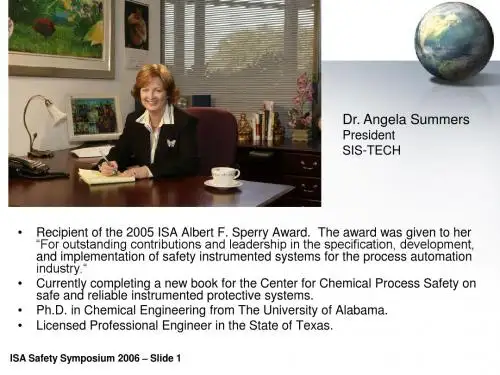
Recipient of the 2005 ISA Albert F Sperry Award The award
- 格式:ppt
- 大小:607.00 KB
- 文档页数:26

The Power of Persistence: A Journey towardsSuccessIn the realm of academic pursuits, the journey towards success is often fraught with challenges and obstacles. The path is not always smooth, and the destination is not always clearly visible. However, it is the persistence and determination of the individual that often serve as the guiding lights in this journey. This essay explores the essence of persistence and how it shapes our destiny, drawing inspiration from the 2005 postgraduate entrance examination English composition.Persistence is the steadfastness in doing something despite difficulty or delay in achieving success. It is the unwavering commitment to a goal or an objective, regardless of the obstacles that may arise. This quality is pivotal in academic pursuits, where the road to success is often marked by setbacks and failures. It is only through persistence that we can overcome these challenges and emerge victorious.The journey of an academician is akin to a marathon, where the finish line is not always visible, and the pacemay vary. However, it is the perseverance and determination that keep us going, even when the going gets tough. This perseverance is what separates the successful individuals from the rest. They refuse to give up easily, and their determination knows no bounds.The 2005 postgraduate entrance examination English composition, with its profound theme, serves as a testament to the power of persistence. The composition, with its thought-provoking questions and challenges, required the examinee to delve into their inner selves and extract the answers. It was a test not only of their language skills but also of their resolve and persistence.In the realm of academics, persistence is not just about never giving up. It is also about learning from failures, about constantly refining one's approach, and about staying focused on the goal. It is about turning weaknesses into strengths and using them as stepping stones towards success. It is about having the courage to face challenges head-on and the determination to overcome them. Moreover, persistence instills in us a sense of purpose and direction. It gives us a clear understanding of what wewant to achieve and how we want to achieve it. This clarity of purpose helps us stay focused and motivated, even when faced with difficulties and setbacks.In conclusion, the power of persistence is invaluablein the journey towards success. It is the driving forcethat propels us forward, even when faced with seemingly insurmountable obstacles. It is the glue that binds us to our goals and objectives, ensuring that we never stray too far from the path of success. As the 2005 postgraduate entrance examination English composition aptly illustrates, it is only through persistence and determination that wecan overcome the challenges that lie ahead and emerge victorious in our academic pursuits.**坚持的力量:走向成功的旅程**在学术追求的领域里,走向成功的旅程往往充满了挑战和障碍。

05年英语考研真题阅读理解部分2005年passage 1Everybody loves a fat pay rise. Yet pleasure at your own can vanish if you learn that a colleague has been given a bigger one. Indeed, if he has a reputation for slacking, you might even be outraged. Such behaviour is regarded as “all too human“,with the underlying assumption that other animals would not be capable of this finely developed sense of grievance. But a study by Sarah Brosnan and Frans de Waal of Emory University in Atlanta, Georgia, which has just been published in Nature, suggests that it all too monkey, as well.The researchers studied the behaviour of female brown capuchin monkeys. They look cute. They are good-natured, co-operative creatures, and they share their food tardily. Above all, like their female human counterparts, they tend to pay much closer attention to the value of “goods and services” than males. Such characteristics make them perfect candidates for Dr. Brosnan's and Dr. de waal's; study. The researchers spent two years teaching their monkeys to exchange tokens for food. Normally, the monkeys were happy enough to exchange pieces of rock for slices of cucumber. However, when two monkeys were placed in separate but adjoining chambers, so that each could observe what the other was getting in return for its rock, their behaviour became markedly different.In the world of capuchins grapes are luxury goods (and much preferable to cucumbers) So when one monkey was handed a grape in exchange for her token, the second was reluctant to hand hers over for a mere piece of cucumber. And if one received a grape without having to provide her token in exchange at all, the other either tossed her own token at the researcher or out of the chamber, or refused to ;accept the slice of cucumber Indeed, the mere presence of a grape in the other chamber (without an actual monkey to eat it) was enough to reduce resentment in a female capuchin.The researches suggest that capuchin monkeys, like humans, are guided by social emotions, in the wild, they are a co-operative, groupliving species, Such co-operation is likely to be stable only when each animal feels itis not being cheated. Feelings of righteous indignation, it seems, are not the preserve of people alone, Refusing a lesser reward completely makes these feelings abundantly clear to other members of the group. However, whether such a sense of fairness evolved independently in capuchins and humans, or whether it stems form the common ancestor that the species had 35 million years ago, is, as yet, an unanswered question.21.In the opening paragraph, the author introduces his topic by[A]. posing a contrast.[B]. justifying an assumption.[C]. making a comparison.[D]. explaining a phenomenon.22.The statement "it is all too monkey^ (Last line, paragraph I) implies that[A], monkeys are also outraged by slack rivals.[B]. resenting unfairness is also monkeys' nature.[C]. monkeys, like humans, tend to be jealous of each other.[D], no animals other than monkeys can develop such emotions.23.Female capuchin monkeys were chosen for the research most probably because they are[A], more inclined to weigh what they get.[B]. attentive to researchers' instructions.[C]. nice in both appearance and temperament.[D], more generous than their male companions24.Dr. Brosnan and Dr. de Waal have eventually found in their study that the monkeys[A], prefer grapes to cucumbers.[B]. can be taught to exchange things.[C]. will not be co-operative if feeling cheated.[D], are unhappy when separated from others.25.What can we infer from the last paragraph?[A]. Monkeys can be trained to develop social emotions.[B]. Human indignation evolved from an uncertain source.[C]. Animals usually show their feelings openly as humans do.[D]. Cooperation among monkeys remains stable only in the wild.passage 2Do you remember all those years when scientists argued that smoking would kill us but the doubters insisted that we didn't know for sure? That the evidence was inconclusive, the science uncertain? That the antismoking lobby was out to destroy our way of life and the government should stay out of the way? Lots of Americans bought that nonsense, and over three decades, some 10 million smokers went to early graves. There areupsetting parallels today, as scientists in one wave after another try to awaken us to the growing threat of global warming. The latest was a panel from the National Academy of Sciences, enlisted by the White House,to tell us that the Earth's atmosphere is definitely warming and that the problem is largely man-made. The clear message is that we should get moving to protect ourselves. The president of the National Academy, Bruce Alberts, added this key point in the preface to the panel's report w Science never has all the answers .But science does provide us with the best available guide to the future, and it is critical that out nation and the world base important policies on the best judgments that science can provide concerning the future consequences of present actions/" Just as on smoking, voices now come from many quarters insisting that the science about global warming is incomplete, that it's Ok to keep pouring fumes into the air until we know for sure. This is a dangerous game: by the 100 percent of the evidence is in, it may be too late. With the risks obvious and growing, a prudent people would take out an insurance policy now. Fortunately, the White House is starting to pay attention. But it's obvious that a majority of the president's advisers still don't take global warming seriously. Instead of a plan of action, they continue to press for more research-a classic case of “paralysis by analysis”. To serve as responsible stewards of the planet, we must press forward on deeper atmospheric and oceanic research But research alone is inadequate. If the Administration won't take the legislative initiative, Congress should help to begin fashioning conservation measures .A bill by Democratic Senator Robert Byrd of West Virginia, which would offer financial incentives for private industry is a promising start Many see that the country is getting ready to build lots of new power plants to meet our energy needs. If we are ever going to protect the atmosphere, it is crucial that those new plants be environmentally sound.26. An argument made by supporters of smoking was that[A]. there was no scientific evidence of the correlation between smoking and death.[B]. the number of early deaths of smokers in the past decades was insignificant.[C]. people had the freedom to choose their own way of life.[D]. antismoking people were usually talking nonsense.27. According to Bruce Alberts, science can serve as[A]. a protector.[B]. a judge.[C]. a critic.[D]. a guide.28. What does the author mean by “paralysis by analysis” (Last line, paragraph 4)[A]. Endless studies kill action.[B]. Careful investigation reveals truth.[C]. prudent planning hinders.[D]. Extensive research helps decision-making.29. According to the author, what should the Administration do about[A]. Offer aid to build cleaner power plants.[B]. Raise public awareness of conservation.[C]. Press for further scientific research.[D]. Take some legislative measures.30. The author associates the issue of global warming with that of smoking because[A]. they both suffered from the government's negligence.[B]. a lesson from the latter is applicable to the former.[C]. the outcome of the latter aggravates the former.[D]. both of them have turned from bad to worse.passage 3Of all the components of a good night's sleep, dreams seem to be least within our control. In dreams, a window opens into a world where logic is suspended and dead people speak. A century ago, Freud formulated his revolutionary theory that dreams were the disguised shadows of our unconscious desires and rears, by the late 1970s. neurologists had switched to thinking of them as just “mental noise” the random byproducts of the neural-repair work that goes on during sleep. Now researchers suspect that dreams are part of the mind's emotional thermostat, regulating moods while the brain is “off-line” And one leading authority says that these intensely powerful mental events can be not only harnessed but actually brought under conscious control, to help us sleep and feel better, “It's your dream” says Rosalind Cartwright, chair of psychology at Chicago's Medical Center. “If you don't like it , change it.”Evidence from brain imaging supports this view. The brain is as active during REM (rapid eye movement) sleep-when most vivid dreams occur-as it is when fully awake, says Dr, Eric Nofzinger at the University of Pittsburgh. But not all parts of the brain are equally involved, the limbic system (the “emotional brain”)is especia lly active, while the prefrontal cortex (the center of intellect and reasoning) is relatively quiet. “We wake up from dreams happy of depressed, and those feelings can stay with us all day” says Stanford sleep researcher Dr, William Dement.The link betwee n dreams and emotions shows up among the patients in Cartwright’s clinic. Most people seem to have more bad dreams early in the night, progressing toward happier ones before awakening, suggesting that they are working through negative feelings generated during the day. Because our conscious mind is occupied with daily life we don't always think about the emotional significance of the day’s events-until, it appears, we begin to dream.And this process need not be left to the unconscious. Cartwright believes one can exercise conscious control over recurring bad dreams As soon as you awaken, identify what is upsetting about the dream. Visualize how you would like it to end instead, the next time is occurs, try to wake up just enough to control its course. With much practice people can learn to, literally, do it in their sleep.At the end of the day, there's probably little reason to pay attention to our dreams at all unless they keep us from sleeping of “we wake u in a panic,” Cartwright says Terrorism, economic uncertainties and general feelings of insecurity have increased people's anxiety. Those suffering from persistent nightmares should seek help from a therapist For the rest of us, the brain has its ways of working through bad feelings. Sleep-or rather dream-onit and you'll feel better in the morning.31.Researchers have come to believe that dreams[A]. can be modified in their courses.[B]. are susceptible to emotional changes.[C]. reflect our innermost desires and fears.[D]. are a random outcome of neural repairs.32.By referring to the limbic system, the author intends to show[A]. its function in our dreams.[B]. the mechanism of REM sleep.[C]. the relation of dreams to emotions.[D]. its difference from the prefrontal cortex.33.The negative feelings generated during the day tend to[A]. aggravate in our unconscious mind.[B]. develop into happy dreams.[C]. persist till the time we fall asleep.[D]. show up in dreams early at night.34.Cartwright seems to suggest that[A]. waking up in time is essential to the ridding of bad dreams.[B]. visualizing bad dreams helps bring them under con troll.[C]. dreams should be left to their natural progression.[D]. dreaming may not entirely belong to the unconscious.35.What advice might Cartwright give to those who sometimes have had dreams?[A]. lead your life as usual.[B]. Seek professional help.[C]. Exercise conscious control.[D]. Avoid anxiety in the daytime.passage 4American no longer expect public figures, whether in speech or in writing, to command the English language with skill and gift. Nor do they aspire to such command themselves. In his latest book, Doing Our Own Thing. The Degradation of language and Music and why we should like, care, John McWhorter, a linguist and controversialist of mixed liberal and conservative views, sees the triumph of 1960s counter-culture as responsible for the decline of formal English.Blaming the permissive 1960s is nothing new, but this is not yet another criticism against the decline in education. Mr.McWhorter’s academic speciality is language history and change, and he sees gradual disappearance of “whom” ,for example, to be natural and no more regranttable than the loss of the case-endings of Old EnglishBut the cult of the authentic and the personal, “doing our own thing”, has spelt the death of formal sp eech, writing, poetry and music. While even the modestly educated sought an elevated tone when they put pen to paper before the 1960s, even the most well regarded writing since then has sought to capture spoken English on the page. Equally, in poetry, the highly personal, performative genre is the only form that could claim real liveliness. In both oral and written English, talking is triumphing over speaking, spontaneity over craft. Illustrated with an entertaining array of examples from both high and low culture, the trend that Mr. McWhorter documents is unmistakable. But it is less clear, to take the question of his subtitle, why we should, like care. As a linguist, he acknowledges that all varieties of human language, including non-standard ones like Black English, can be powerfully expressive-there exists no language or dialect in the world that cannot convey complex ideas .He is not arguing, as many do, that we can no longer think straight because we do not talk proper.Russians have a deep love for their own language and carry large chunks of memorized poetry in their heads, while Italian politicians tend to elaborate speech that would seem old-fashioned to most English-speakers. Mr. McWhorter acknowledges that formal language is not strictly necessary, and proposes no radical education reforms-he is really grieving over the loss of something beautiful more than useful. We now takeour English “on paper plates instead of china”. A shame, perhaps, but probably an inevitable one.36.According to Mc Whorter, the decline of formal English[A]. is inevitable in radical education reforms.[B]. is but all too natural in language development.[C]. has caused the controversy over the counter-culture.[D]. brought about changes in public attitudes in the 1960s.37.The word “talking” (Linge6, paragraph3) denotes[A]. modesty.[B]. personality.[C]. liveliness.[D]. informality.38.To which of the following statements would Mc Whorter most likely agree?[A]. Logical thinking is not necessarily related to the way we talk.[B]. Black English can be more expressive than standard English.[C]. Non-standard varieties of human language are just as entertaining.[D]. Of all the varieties, standard English Can best convey complex ideas.39.The description of Russians' love of memorizing poetry shows the author's[A]. interest in their language.[C]. admiration for their memory.[D]. contempt for their old-fashionedness.40.According to the last paragraph, “paper plates” is to “china” as[A]. “temporary” is to “permanent”.[B]. “radical” is to “conservative”.[C]. "functional” is to “artistic”.[D]. "humble” is to “noble”。

2005年6月英语6级考试真题The 2005 June English Proficiency Test (CET-6) is a comprehensive exam that aims to assess the English language proficiency of non-native speakers. The exam covers listening, reading, writing, and speaking skills, and is widely recognized by universities and employers in China as a benchmark for English proficiency.The CET-6 exam consists of four sections: Listening, Reading, Writing, and Translation. The Listening section includes short conversations and passages that test the test-taker’s ability to comprehend spoken English. The Reading section consists of longer, more complex passages that assess reading comprehension and vocabulary knowledge. The Writing section requires test-takers to write essays on a given topic, while the Translation section gauges their ability to translate English passages into Chinese.One of the key features of the CET-6 exam is its focus on real-world English language skills. The exam is designed to test not only the test-taker’s knowledge of grammar and vocabulary but also their ability to understand and communicate in English in practical, everyday situations. This makes the CET-6a valuable tool for assessing an individual’s proficiency in English for academic or professional purposes.In order to prepare for the CET-6 exam, test-takers are encouraged to practice all four language skills on a regular basis. This may involve listening to English podcasts or radio programs, reading English newspapers or books, writing essays or journal entries in English, and practicing translation exercises. Additionally, test-takers can benefit from participating in English language exchanges, attending English language classes, or working with a tutor to improve their English skills.The 2005 June CET-6 exam consisted of a variety of challenging questions that tested a wide range of language skills. Test-takers were required to listen to a series of short conversations and answer multiple-choice questions, read several passages and answer comprehension questions, write an essay on a given topic, and translate a passage from English to Chinese. The exam was designed to be comprehensive and to test the test-taker’s ability to understand and use English in a variety of contexts.Overall, the 2005 June CET-6 exam was a rigorous test of English language proficiency that required test-takers to demonstrate their listening, reading, writing, and translationskills. By successfully passing the exam, test-takers can demonstrate their ability to communicate effectively in English and open up new opportunities for academic and professional advancement.。

2005考研英语作文It's been a long time since I last sat down to write something like this. I remember back in college, I used to love writing essays and expressing my thoughts on paper. But as time went by, life got busier and I found myself writing less and less.Now, here I am, trying to put together a coherent piece of writing for the 2005 postgraduate entrance exam. It's funny how life comes full circle sometimes. I never thought I'd be sitting here, trying to prove my writing skills all over again.But here I am, and I have to say, it feels good to be back at it. Writing has always been a passion of mine, and I've missed the feeling of putting pen to paper (or fingers to keyboard, in this case) and letting my thoughts flow freely.I know this essay is just a small part of the wholeexam, but I'm determined to make it the best it can be. I want to show the examiners that I still have what it takes to write a compelling and engaging piece of work.So here's to the next few hours of brainstorming, drafting, and revising. I may be a little rusty, but I'm confident that I can pull this off. After all, writing is like riding a bike – once you learn, you never really forget. And I'm ready to prove that to myself and to everyone else.。