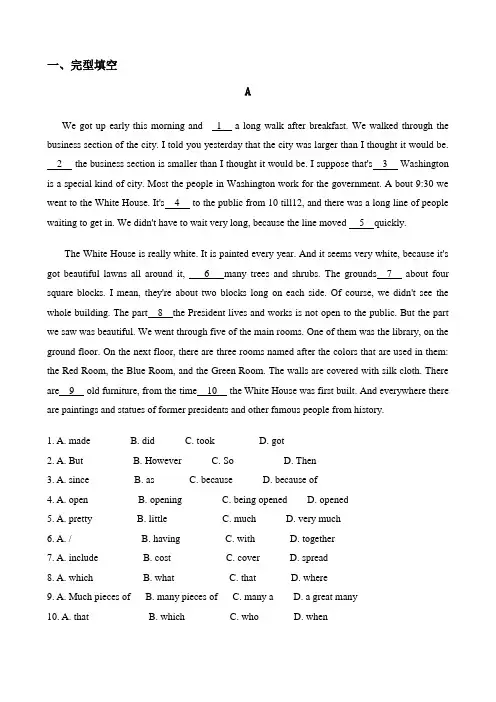
一、完型填空AWe got up early this morning and __1__ a long walk after breakfast. We walked through the business section of the city. I told you yesterday that the city was larger than I thought it would be. __2__ the business section is smaller than I thought it would be. I suppose that's__3__ Washington is a special kind of city. Most the people in Washington work for the government. A bout 9:30 we went to the White House. It's__4__ to the public from 10 till12, and there was a long line of people waiting to get in. We didn't have to wait very long, because the line moved __5__quickly.The White House is really white. It is painted every year. And it seems very white, because it's got beautiful lawns all around it, ___6___many trees and shrubs. The grounds__7__ about four square blocks. I mean, they're about two blocks long on each side. Of course, we didn't see the whole building. The part__8__the President lives and works is not open to the public. But the part we saw was beautiful. We went through five of the main rooms. One of them was the library, on the ground floor. On the next floor, there are three rooms named after the colors that are used in them: the Red Room, the Blue Room, and the Green Room. The walls are covered with silk cloth. There are__9__ old furniture, from the time__10__ the White House was first built. And everywhere there are paintings and statues of former presidents and other famous people from history.1. A. made B. did C. took D. got2. A. But B. However C. So D. Then3. A. since B. as C. because D. because of4. A. open B. opening C. being opened D. opened5. A. pretty B. little C. much D. very much6. A. / B. having C. with D. together7. A. include B. cost C. cover D. spread8. A. which B. what C. that D. where9. A. Much pieces of B. many pieces of C. many a D. a great many10. A. that B. which C. who D. whenBManpower Inc., with 560,000 workers, is the world's largest temporary employment agency. Every morning, its people ___1___ into the offices and factories of America, seeking a day's work for a day's pay. One day at a time as industrial giants ___2____ General Motors and IBM struggle to survive ____3_____ reducing the number of employees, Manpower, based in Milwaukee, Wisconsin, is booming even though its economy continues to recover, the US is increasingly ____4___ a nation of part timers and temporary workers. This ___5_____ work force is the most important ____6____ in American business today, and it is ____7____ changing the relationship between people and their jobs. The phenomenon provides a way for companies to remain globally competitive while avoiding market cycles _____8____ the growing burdens _____9___ by employment rules, healthcare costs and pension plans. For ___10____ it can mean an end to the security, benefits and sense of importance that came from being a loyal employee.1. A. swarm B. set C. separate D. shape2. A. unlike B. dislike C. like D. alike3. A. from B. in C. on D. by4. A. becoming B. becomes C. become D. became5. A. durable B. temporary C. available D. transferable6. A. approach B. way C. fashion D. trend7. A. instantly B. immediately C. fundamentally D. sufficiently8. A. but B. and C. while D. whereas9. A. imposed B. restricted C. illustrated D. confined10. A. government B. manager C. boss D. workersCIf a farmer wishes to succeed, he must try to keep a wide gap between his consumption and his production. He must store a large quantity of grain ___1____ consuming all his grain immediately. He can continue to support himself and his family ___2____ he produces a surplus. He must use this surplus in three ways: as seed for sowing, as an insurance ___3____ the unpredictable effects of bad weather and as commodity which he must sell in order to ___4____ old agricultural implementsand obtain chemical fertilizers to ___5____ the soil. He may also need money to construct irrigation ___6____ and improve his farm in other ways. If no surplus is available, a farmer cannot be ___7____. He must either sell some of his property or ___8____ extra funds in form of loans. Naturally he will try to borrow money at a low ___9____ of interest, but loans of this kind are not ___10____ obtainable.1. A. other than B. as well as C. instead of D. more than2. A. only if B. much as C. long before D. ever since3. A. for B. against C. supplement D. dispose4. A. replace B. purchase C. supplement D. dispose5. A. enhance B. mix C. feed D. raise6. A. vessels B. routes C. paths D. channels7. A. self-confident B. self-sufficient C. self-satisfied D. self-restrained8. A. search B. save C. offer D. seek9. A. section B. percentage C. rate D. part10. A. genuinely B. obviously C. presumably D. frequently二、阅读理解AIt was in a valley in northern California that the American dream was both re-defined and reinvigorated during the course of an event that brought hundreds of thousands of thousands of people rushing westward in search of a new life. An accidental discovery near the American River would forever change the young nation. For many Americans and immigrants alike, the simple agrarian life that had characterized most of the country up to that point would no longer be enough. In its place would come a new kind of dream; one that was entrepreneurial, wide-open and free. After 1848, the new American dream was to make a fortune. Rumors of gold to be found had begun to resonate throughout the land, and many were willing to risk everything for the chance to partake of it.By the winter of 1848, whispers of a gold strike had drifted eastward across the country, but few easterners thought them credible. It was an age when rumors were discounted, and governmentofficials were trusted. The gold discovery needed official validation to be taken seriously and in early December President James Polk delivered just that in words that enthralled millions. His simple description of the abundance of gold in far west was a powerful call to action. Lives were abandoned; farmers left their fields, merchants closed their shops and soldiers left their posts, all to head for California. Newspaper fanned the fires by describing how ―fortune lay upon the surface of the earth, as plentiful as the mud in the streets.‖By early 1849, gold fever had become epidemic. Discussions of gold could be heard anywhere one went in the country, and outside of it as well. Young men explained to their wives that in exchange for a short period of hardship their lives would be changed. Many foreigners were also caught up in the passion of the moment and enticed to make even longer journeys: Chinese, Chileans, Mexicans, Irish, Germans, French and Turks all came seeking fortune. They were dubbed ―Forty-Niners‖because the migration began in 1849. When, how, or even if they would return were questions they were more than willing to set aside. Those who came overland were compelled to brave a route that was fraught with danger; one blocked by high mountain ranges and parched, arid deserts, populated by bandits who preyed on settlers unaccustomed to their circumstances and ill-prepared to defend themselves.Many never reached their destination and bitter disappointment greeted most of those who did. They soon discovered that the image painted by the President and the media bore little resemblance to the reality of what they found in California. Gold was not scattered on the ground for the taking as they had been led to believe. It was there to be sure, but gathering it in significant amounts required a serious investment of time, effort and capital to establish mines where the precious metal could be extracted.When miners realized they could not make a profit working individually, they began to band together in informal companies to dam the rivers, reroute the water and expose the gold underneath. It wasn‘t long before even these informal cooperative arrangements proved inadequate. Soon, as the readily accessible deposits were depleted, more costly measures were needed to extract what remained of the precious metal and the loose knit groups of miners were replaced by corporations. By the mid 1850s, most of those still engaged in the search for these mining companies, a way of life many found every bit as distasteful as it was unavoidable.The miners weren‘t the only ones to suffer. The new mining corporations developed extractiontechniques that were both frightfully efficient and frightfully destructive; techniques that destroyed the rivers and caused California‘s first environmental disasters. Massive derricks lifted rock and sand from the mines, which after a short time obliterated the formerly pristine rivers. The most damaging of the large scale mining techniques came in 1853 with the advent of hydraulic mining. Huge jets of water tore apart the walls of the riverbeds. By the 1860s, it was clear that hydraulic mining was destroying the landscape, but few voices were raised in protest and little was done to stop it. Mining companies, hard-pressed to turn a profit, exploited the land for their own benefit, and cared little about the environmental devastation their activities caused.1. What is mentioned as an effect the gold rush had on the United States?A. It made the country wealthier.B. It added to the country‘s territory.C. It changed people‘s aspirations.D. It opened up the West.2. The word partake in the passage is closest in meaning to ____.A. sacrificeB. shareC. forfeitD. distribute3. According to the passage, what role did President Polk play in the gold rush?A. He helped to stimulate it.B. He tried to suppress it.C. He exploited it for political purpose.D. He encouraged the press to report it.4. Why were many Americans at first reluctant to believe gold had been found in California?A. They needed official confirmation.B. No one had actually come back with any gold.C. They had heard many false rumors about the West.D. Few stories were published about it in the press.5. Which of the following statements is supported by the passage?A. Many of the Forty-Niners found what they were looking for.B. The reports of gold rush had been greatly exaggerated.C. There was no gold to be found.D. The gold made California a wealthy state.BDesertification is the degradation of once-productive land into unproductive or poorly productive land. Since the first great urban-agricultural centers in Mesopotamia nearly 6,000 years ago, human activity has had a destructive impact on soil quality, leading to gradual desertification in virtually every area of the world.It is a common misconception that desertification is caused by droughts. Although drought does make land more vulnerable, well-managed land can survive droughts and recover, even in arid regions. Other mistaken belief is that the process occurs only along the edges of deserts. In fact, it may take place in any arid or semiarid region, especially where poor land management is practiced. Most vulnerable, however, are the transitional zones between deserts and arable land; wherever human activity leads to land abuse in these fragile marginal areas, soil destruction is unavoidable.Agriculture and overgrazing are the two major sources of desertification. Each furthers the process dramatically, but they act in quite different ways. Large-scale farming requires extensive irrigation, which completely destroys land by depleting its nutrients and leaching minerals into the topsoil. Grazing is especially destructive to land because, in additional to depleting cover vegetation, herds of grazing mammals also trample the fine organic particles of the topsoil, leading to soil compaction and erosion. It makes about 500 years for the earth to build up 3 centimeters of topsoil. However, cattle ranching and agriculture can deplete as much as 2 to 3 centimeters of topsoil every 25 years --- 60 to 80 times faster than it can be replaced by nature.Salination is a type of land degradation that contains an increase in the salt of the soil. This usually happens as a result of improper irrigation practices. The great Mesopotamian empires --- Sumer, Akkad and Babylon --- were built on the surplus of the enormously productive soil of the ancient Tigris Euphrates alluvial plain. After nearly a thousand years of intensive cultivation, land quality was in evidence decline. In response, around 2800 BC the Sumerians began digging the huge Tigris-Euphrates canal system to irrigate the exhausted soil. A temporary gain in crop yield was achieved in this way, but over-irrigation was to have serious and unforeseen consequences. From as early as 2400 BC we find Sumerian documents referring to salinization as a soil problem. It is believed that the fall of the Akkadian Empire around 2150 BC may have been due to a catastrophic failure in land productivity; the soil was literally turned into soil salt. Even today, four thousand years later, vast tracts of salinized land between the Tigris and Euphrates rivers still resemblerock-hard fields of snow.Soil erosion is another form of desertification. It is a self-reinforcing process; once the cycle of degradation begins, conditions are set for continual deterioration. As the vegetative cover begins to disappear, soil becomes more vulnerable to raindrop impact. Water runs off instead of soaking in to provide moisture for plants. This further diminishes plant cover by leaching away nutrients from the soil. As soil quality declines and runoff is increased, floods become more frequent and more serious. Flooding washes away topsoil, the thin, rich, uppermost layer of the earth‘s soil, and leaves finer underlying particles more vulnerable to wind erosion. Topsoil contains the earth‘s greatest concentration of organic matter and microorganisms, and is where most of the earth‘s land-based biological activity occurs. Without this fragile coat of nutrient-laden material, plant life cannot exist. An extreme case of its erosion is found in the Sahel, a transitional zone between the Sahara Desert and the tropical African rain forests; home to some 56 million people. Overpopulation and overgrazing have opened the hyper arid land to win erosion, which is stripping away the protective margin of the Sahel, and causing the desert to grow at an alarming rate. Between 1950 and 1975, the Sahara Desert spread 100 kilometers southward through the Sahel.One-third of the earth‘s land area of 150 million square kilometers is already classified as semiarid, arid or hyper arid. It is estimated that it is increasing by 215,000 square kilometers of land rendered unproductive by desertification every year. In America, salinization affects over 160,000 square kilometers of land in western and midwestern states, and is worsening annually. Africa loses 300 to 400 million tons of topsoil a year with the spreading of the desert. As a billion people are added to the world‘s population every decade, there is less and less arable land to provide food for them. At the present rate of soil deterioration, ecologists warn, another quarter of the earth‘s productive soil will disappear within the next century.6. Which of the following statements is true about desertification?A.It is quite a recent problem.B.Ancient societies managed the problem well.C.It has been a long time in desertification.D.It was much worse in the past than today.7. The word arable in the passage is closest in meaning to____.A. dryB. settledC. madeD. cultivatable8. According to the passage, many people‘s understanding of desertification is incorrect because_________.A. They do not think of it as a serious problem.B. They do not see it as being caused by human activity.C. They think of it as a very slow process.D. They see it as being reversible.9. According to the passage, agriculture furthers desertification through which of the following activities?A. Over fertilizationB. The stripping away of native vegetationC. IrrigationD. The repetitive planting of the same crops10. It can be inferred from paragraph 6 of the passage that _____.A. new technology will solve the problem of desertification.B. finding a way to stop desertification will become increasing urgent.C. desertification is more of a problem in developed countries.D. desertification is causing starvation in Africa.CThe United States is a country made up of many different races. Usually they are mixed together and can‘t be told from one another. But many of them still talk about where their ancestors came from. It is something they are proud of.The original Americans, of course were the Indians. The so-called white men who then came were mostly from England. But many came from other countries like Germany and France.One problem the United States has always had is discrimination. As new groups came to the United States they found that they were discriminated against. First it was the Irish and Italians. Later it was the blacks. Almost every group has been able to finally escape this discrimination.The only immigrants who have not are the blacks. Surprisingly enough the worst discrimination today is shown towards the Indians. One reason the Indians are discriminated against is that they have tried so hard to keep their identity. Of course they are not the only ones who have done so. The Japanese have their little Tokyo in Los Angeles and the Chinese have a Chinatown in New York. The Dutch settlement in Pennsylvania also stays separate from other people. Their towns are likesomething from the 19th century. They have a different reason from the other groups for staying separately. They live separately for religious reasons rather than keep together in a racial group.Although some groups have kept themselves separate and others have been discriminated against, all groups have helped make the United States a great country. There is no group that has not helped in some way. And there is no group that can say they have done the most to make it a great country.Many people still come from other countries to help the United States grow. A good example is the American project that let a man walk on the moon. It was a scientist from Germany who was responsible for doing that. It is certain that in the future the United States will still need the help of people from all racial groups to remain a great country.11. Which of the following statements can best describe the main idea of this passage?A. The United States is a country made up of many different races.B. Discrimination is the most serious problem in the United States.C. All races in the United States have helped make the country a great one.D. The prosperity of the United States is mainly due to the hard work of the most discriminated races.12. In the first paragraph the word“told” means _________.A. separatedB. distinguishedC. revealedD. made known13. This passage implies that discrimination is a problem which _______.A. many races in the United States have experiencedB. will still be not very serious in the United States in the futureC. has already been solved in the United StatesD. is strongly opposed by many different races in the United States14. The main reason why the Indians are most discriminated against is that ________.A. they have tried hard to keep their religionsB. they have tried hard to live together to keep their Indian customsC. they are the only ones who have tried to keep identityD. they discriminate many other races15. The Dutch live separately in Pennsylvania _________.A. to escape discriminationB. to keep together in a racial groupC. to enjoy themselves in their own townsD. for religious reasonsDMy father, Winston Churchill, began his love affair with painting in his 40s, amid disastrous circumstances. As first Lord of the Admiralty in 1915, he was deeply involved in a campaign in the Dardanelles that could have shortened the course of a bloody world war. But when the mission failed, with great loss of life, Churchill paid the price, both publicly and privately. He was removed from the admiralty and effectively sidelined.Overwhelmed by the catastrophe---―I thought he would die of grief,‖said his wife, Clementine---he retired with his family to Hoe Farm, a country retreat in Surrey. There, as Churchill later recalled. ―the muse of painting come to my rescue!‖Wandering in the garden one day, he chanced upon his sister in-law sketching with watercolors. He watched her for a few minutes, then borrowed her brush and tried of his hand. The muse had cast her spell!Churchill soon decided to experiment with oils. Delighted with this distraction from his dark broodings, Clementine rushed off to buy whatever paints she could find.For Churchill, however, the next step seemed difficult as he contemplated with unaccustomed nervousness the blameless whiteness of a new canvas. He started with the sky and later described how ―very gingerly I mixed at a little blue paint on the palette, and then with infinite precaution made a mark about as big as a bean upon the affronted snow-white shield. At that moment the sound of a motor car was heard in the drive. From this nice car stepped the gifted wife of Sir John Lavery. ‗Painting!‘ she declared. ‗But what are you hesitating about? Let me have the brush –the big one.‘Splash into the turpentine, wallop into the blue and the white, frantic flourish on the palette, and then several fierce strokes and slashes of blue on the completely cowering canvas. Anyone could be aware that it could not hit back. The spell was broken. I seized the largest brush and fell upon my victim with berserk fury. I have never felt any awe of a canvas since.‖At that time, John Lavery—a Churchill neighbor and celebrated painter---was tutoring Churchill in his art. Later, Lavery said of his unusual pupil: ―Had he chosen painting instead of statesmanship, I believe he would have been a great master with the brush.‖16. The passage is mainly concerned with _____.A.showing Churchill‘s failure in the political careerB.describing how Churchill developed the love for paintingrming readers of Churchill‘s family life.D.presenting a biographical sketch of Churchill.17. The phrase ―the mission‖ in Para.1 refers to_____.A. world warB. the admiraltyC. a campaignD. his love affair18. It can be inferred from the passage that Churchill started painting _____.A.by chanceB. on purposeC. because he knew he was good at itD. for the sake of his wife19. According to his wife, painting helped Churchill as a way of ____.A.supporting his familyB. relieving him of his sadnessC.changing his characterD. making friends with his neighbors20. Which one of the following statements is NOT true according to the passage?A.Churchill was very experienced in the art.B.John Lavery was a famous painter.C.In John Lavery‘s view, Churchill had more talent in art than in politics.D.Painting could relieve him of his sadness.EIt was in a valley in northern California that the American dream was both re-defined and reinvigorated during the course of an event that brought hundreds of thousands of thousands of people rushing westward in search of a new life. An accidental discovery near the American River would forever change the young nation. For many Americans and immigrants alike, the simple agrarian life that had characterized most of the country up to that point would no longer be enough. In its place would come a new kind of dream; one that was entrepreneurial, wide-open and free. After 1848, the new American dream was to make a fortune. Rumors of gold to be found had begun to resonate throughout the land, and many were willing to risk everything for the chance to partake of it.By the winter of 1848, whispers of a gold strike had drifted eastward across the country, but feweasterners thought them credible. It was an age when rumors were discounted, and government officials were trusted. The gold discovery needed official validation to be taken seriously and in early December President James Polk delivered just that in words that enthralled millions. His simple description of the abundance of gold in far west was a powerful call to action. Lives were abandoned; farmers left their fields, merchants closed their shops and soldiers left their posts, all to head for California. Newspaper fanned the fires by describing how ―fortune lay upon the surface of the earth, as plentiful as the mud in the streets.‖By early 1849, gold fever had become epidemic. Discussions of gold could be heard anywhere one went in the country, and outside of it as well. Young men explained to their wives that in exchange for a short period of hardship their lives would be changed. Many foreigners were also caught up in the passion of the moment and enticed to make even longer journeys: Chinese, Chileans, Mexicans, Irish, Germans, French and Turks all came seeking fortune. They were dubbed ―Forty-Niners‖because the migration began in 1849. When, how, or even if they would return were questions they were more than willing to set aside. Those who came overland were compelled to brave a route that was fraught with danger; one blocked by high mountain ranges and parched, arid deserts, populated by bandits who preyed on settlers unaccustomed to their circumstances and ill-prepared to defend themselves.Many never reached their destination and bitter disappointment greeted most of those who did. They soon discovered that the image painted by the President and the media bore little resemblance to the reality of what they found in California. Gold was not scattered on the ground for the taking as they had been led to believe. It was there to be sure, but gathering it in significant amounts required a serious investment of time, effort and capital to establish mines where the precious metal could be extracted.When miners realized they could not make a profit working individually, they began to band together in informal companies to dam the rivers, reroute the water and expose the gold underneath. It wasn‘t long before even these informal cooperative arrangements proved inadequate. Soon, as the readily accessible deposits were depleted, more costly measures were needed to extract what remained of the precious metal and the loose knit groups of miners were replaced by corporations. By the mid 1850s, most of those still engaged in the search for these mining companies, a way of life many found every bit as distasteful as it was unavoidable.The miners weren‘t the only ones to suffer. The new mining corporations developed extraction techniques that were both frightfully efficient and frightfully destructive; techniques that destroyed the rivers and caused California‘s first environmental disasters. Massive derricks lifted rock and sand from the mines, which after a short time obliterated the formerly pristine rivers. The most damaging of the large scale mining techniques came in 1853 with the advent of hydraulic mining. Huge jets of water tore apart the walls of the riverbeds. By the 1860s, it was clear that hydraulic mining was destroying the landscape, but few voices were raised in protest and little was done to stop it. Mining companies, hard-pressed to turn a profit, exploited the land for their own benefit, and cared little about the environmental devastation their activities caused.21. What is mentioned as an effect the gold rush had on the United States?A. It made the country wealthier.B. It added to the country‘s territory.C. It changed people‘s aspirations.D. It opened up the West.22. The word partake in the passage is closest in meaning to ____.A. sacrificeB. shareC. forfeitD. distribute23. According to the passage, what role did President Polk play in the gold rush?A. He helped to stimulate it.B. He tried to suppress it.C. He exploited it for political purpose.D. He encouraged the press to report it.24. Why were many Americans at first reluctant to believe gold had been found in California?A. They needed official confirmation.B. No one had actually come back with any gold.C. They had heard many false rumors about the West.D. Few stories were published about it in the press.25. Which of the following statements is supported by the passage?A. Many of the Forty-Niners found what they were looking for.B. The reports of gold rush had been greatly exaggerated.C. There was no gold to be found.。


![2010届高考英语总复习词汇练习分类汇编--代词[1]](https://imgs-1438308264.cos.ap-hongkong.myqcloud.com/437ad2d076eeaeaad1f3308f.webp)
