句子的种类
- 格式:doc
- 大小:43.50 KB
- 文档页数:2
句子的种类
句子分类
感叹句与反义疑问句
主谓一致
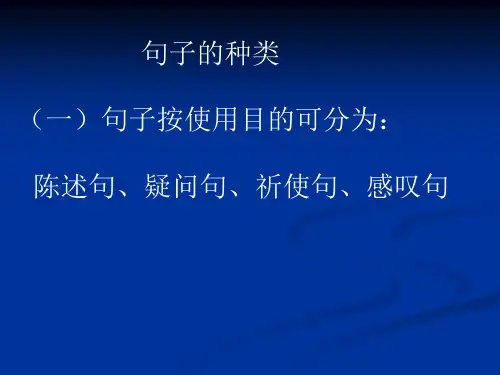
句子按语气分类
陈述句
疑问句一般疑问句特殊疑问句选择疑问句反义疑问句
祈使句
感叹句
感叹句
一、定义:表示说话人惊奇、喜悦、赞美、厌恶或愤怒等情绪。
二、结构:
1.How + 形容词/副词+(主+谓)!
e.g How cold the day is ! / How quickly he runs !
2.What +形容词+名词复数/不可数名词+(主+谓)!
e.g What beautiful flowers!/What bad weather (it is )!
3.What+a/an+形容词+名词+(主+谓)!
e.g What an interesting story (it is)!
三、注意:
在口语中what/how引起的感叹句常可省略主语、谓语或其它句子成分。
一、用what/how 填空
1. ________ a heavy box !
2. ________ heavy the box is !
3. ________ hard work !
4. ________ hard the work is !
5. ________ wonderful the film is !
6. ________ a wonderful film !
二、句型转换
1 .What a heavy rain ! _____ _____ the rain is !
2. How interesting the boy is ! _____ _____ interesting boy!
用How , What (a / an) 填空
1. _________delicious food it is !
2. _________interesting film!
3. _________bad weather !
4. _________good day !
5. _________tall the boy is !
6. _________good news it is !
7. _________beautiful clothes they are ! 8. _________nice teacher he is !
9. _________nice Tom is ! 10._________beautiful flowers they are !
11._________hard work ! 12._________hard job !
反意疑问句
反意疑问句构成:由陈述句+简短问句
简短问句构成
助动词/ be动词/ 情态动词+ 人称代词
1、前肯后否,前否后肯的原则。
即当陈述句为肯定句时,简短问句为否定形式。
当陈述句为否定句时,简短问句为肯定形式。
2、句中含有no , never , hardly , few , little , nothing , nobody , seldom等否定意义的词时,后面用肯定形式。
如:There is little water in the bottle , is there?
He can hardly speak English , can he ?
3、简短问句部分的主语应用人称代词。
4、陈述句的主语为no one,none , nobody ,everyone , someone , somebody , everybody等时,其附加部分的主语要用they,但强调个体时,常用he。
如:Everyone has got a book , aren’t they ?
Someone is calling you , isn't he ?
5、陈述句的主语为everything , anything , something , nothing等时,附加部分的主语为it 。
如:Everything is OK, isn't it ?
6、祈使句(无论否定还是肯定),反意疑问部分一律用will you。
如:
Please let us open the door , will you ?
Don’t look out of the window , will you ?
注意:
Let’s …开头的句子,则用shall we。
如:
Let’s read the text together , shall we ?
7、主从复合句的反意问句以主句为主。
如:
She thinks she can work it out , doesn’t she ?
He told you we would have an English exam ,
didn’t he ?
注意:
当主句是“I think / I suppose / I believe/ I don’t
think …”时,要以从句为主。
如:I think he is wrong this time , isn’t he ?
I don’t believe he will come tomorrow ,will he ?
8、反意疑问句的回答。
1、当陈述句部分是肯定时,yes表示是;no表示不。
如:--You are a Chinese , aren’t you ?你是一个中国人,是吗?
--Yes, I am . / No, I am not .是的,我是。
/ 不,我不是。
2.当陈述句部分是否定时,yes表示不;no表示是。
如:-- You have never been to Beijing , have you ?你从没去过北京,是吗?
-- Yes, I have . I went there last summer. 不,我去过。
我去年去的。
1. There is some milk in the bottle ,___________?
2. There is little orange , _____________?
3. Tom is good at English, ____________?
4. He has few friends here , ____________?
5. They finished the work , ______________?
6. LiLei can hardly speak Japanese ,_________?
7. Your parents can swim ,______________?
8. He could see nobody in the room ,___________?
9. Mr. Green teaches you English , ____________?
10.Please try them on , _________________?
11.Don’t turn on the TV,_____________?
12.Let’s go shopping , _____________?。