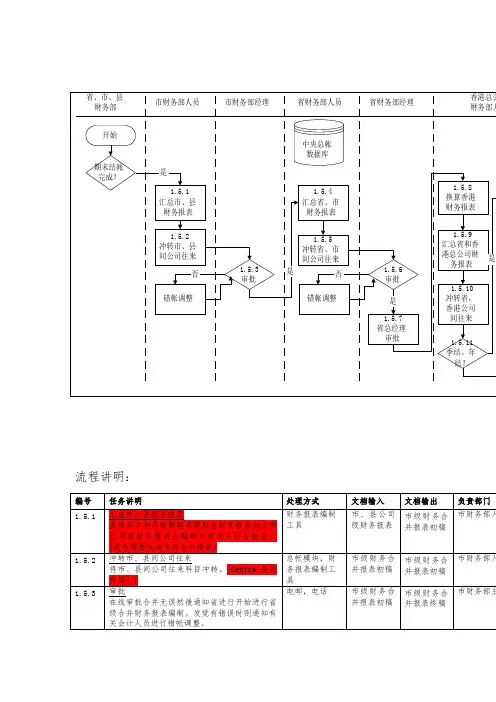
合并财务报表流程
- 格式:doc
- 大小:38.63 KB
- 文档页数:5
合并财务报表流程
Financial statement consolidation is a crucial process for businesses,
especially those with multiple subsidiaries or business units. It
involves combining the financial information from each separate
entity within a larger corporate structure to present a comprehensive
view of the group's financial health. This process is essential for
stakeholders, such as investors, creditors, and regulators, to
understand the overall performance and position of the company as
a whole. Without accurate and timely consolidation of financial
statements, decision-making could be compromised, leading to
potential financial risks and regulatory compliance issues.
财务报表合并是企业至关重要的流程,特别是对于拥有多个子公司或业务部门的企业。它涉及将来自较大企业架构中的每个独立实体的财务信息进行整合,以展示集团的财务状况全貌。这一过程对于利益相关方,如投资者、债权人和监管机构,了解公司整体绩效和地位至关重要。如果没有准确和及时的财务报表合并,决策可能会受到威胁,可能导致潜在的财务风险和监管合规问题。
One of the key challenges in the financial statement consolidation
process is dealing with the differences in accounting standards,
policies, and practices across various entities. Each subsidiary may
have its own set of rules and procedures for recording and reporting
financial information, which can make it difficult to reconcile and
consolidate the data accurately. Companies must harmonize these
diverse accounting practices and ensure that the financial statements
are prepared in accordance with a common set of standards, such as
International Financial Reporting Standards (IFRS) or Generally
Accepted Accounting Principles (GAAP), to facilitate the
consolidation process.
在财务报表合并流程中的一个关键挑战是应对各个实体之间会计准则、政策和实践上的差异。每个子公司可能都有自己记录和报告财务信息的一套规则和程序,这可能会使数据的协调和合并变得困难。公司必须协调这些不同的会计实践,并确保财务报表按照一套共同的标准准备,例如国际财务报告准则(IFRS)或普遍公认会计准则(GAAP),以促进合并流程的进行。
Furthermore, the consolidation process requires a thorough
understanding of the intercompany transactions and balances
among the entities. Intercompany transactions refer to the buying and selling of goods, services, or assets between affiliated companies
within the same corporate group. These transactions must be
eliminated during the consolidation process to avoid double
counting and ensure that the financial statements reflect the group's
economic reality accurately. Companies need to have robust internal
controls and reporting mechanisms in place to identify and eliminate
intercompany transactions effectively.
此外,合并流程需要对实体之间的公司内交易和余额有透彻的了解。公司间交易是指同一公司集团内附属公司之间购买和出售商品、服务或资产的情况。这些交易在合并过程中必须予以消除,以避免重复计算,并确保财务报表准确反映集团的经济实际情况。公司需要建立健全的内部控制和报告机制,以有效识别和消除公司间交易。
In addition, the consolidation process involves the translation of
financial information from different currencies into a common
reporting currency. Subsidiaries operating in different countries often
have financial statements denominated in local currencies, which
need to be converted into the group's reporting currency for
consolidation purposes. Exchange rate fluctuations can impact the
accuracy of financial statement consolidation and may introduce additional complexities to the process. Companies must carefully
manage foreign currency translation adjustments to ensure the
integrity and reliability of the consolidated financial statements.
此外,合并过程涉及将来自不同货币区的财务信息转换为一个通用报告货币。在不同国家运营的子公司往往以本地货币计价,这些数据需要将其转换为合并目的的公司报告货币。汇率波动可能会影响财务报表合并的准确性,并可能为流程引入额外的复杂性。公司必须仔细管理外币转换调整项,以确保合并财务报表的完整性和可靠性。
Moreover, technology plays a vital role in streamlining the financial
statement consolidation process and enhancing its efficiency.
Advanced consolidation software and enterprise resource planning
(ERP) systems can automate data collection, elimination of
intercompany transactions, currency translation, and financial
reporting. These tools provide real-time visibility into the
consolidation process, improve data accuracy, and reduce the risk of
errors associated with manual consolidation. By leveraging
technology, companies can expedite the consolidation process,
reduce administrative burdens, and allocate more time and resources
to analysis and decision-making.
此外,技术在简化财务报表合并流程和提高效率方面发挥着至关重要的作用。先进的合并软件和企业资源规划(ERP)系统可以自动化数据收集、消除公司间交易、货币转换和财务报告。这些工具为合并流程提供实时可见性,提高数据准确性,并降低与手动合并相关的错误风险。通过利用技术,公司可以加快合并流程,减少行政负担,并将更多时间和资源用于分析和决策。