国际象棋英语专业术语
- 格式:docx
- 大小:37.09 KB
- 文档页数:2
国际象棋英语专业术语
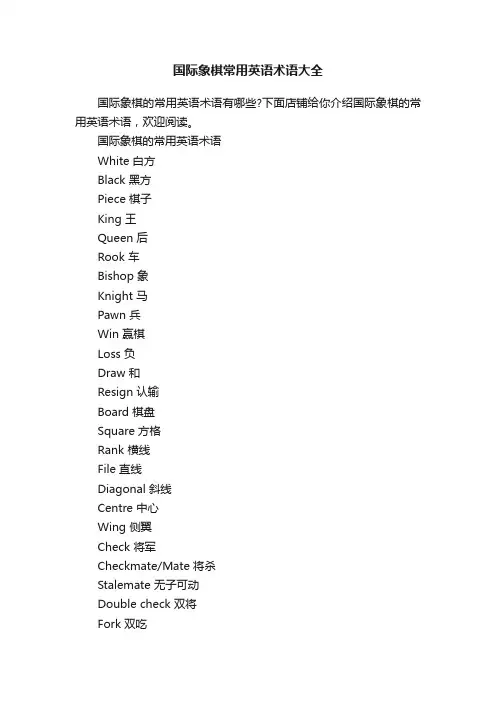
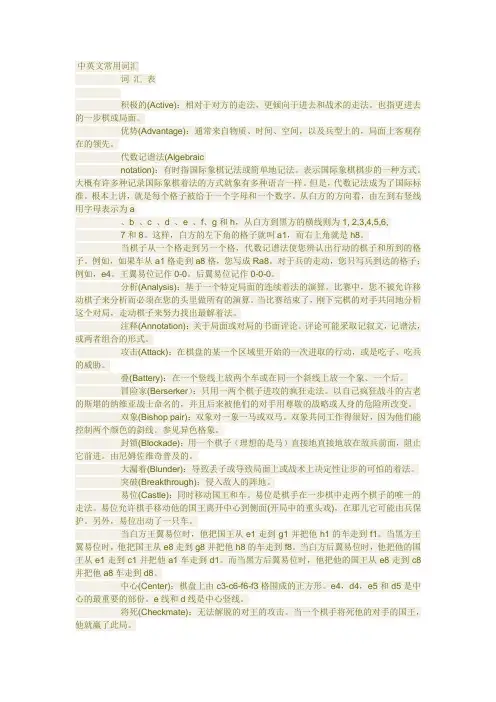
The chessboard is a battleground of intellect and
strategy, where each piece has its role and every move has a
name. In the realm of international chess, the terminology is
rich with history and nuance, reflecting the game's
complexity and the precision required to discuss it.
At the heart of the game are the pieces themselves, each
with its own set of moves and strategic implications. The
"Pawn" is the foot soldier, advancing one square at a time
but with the potential to become any other piece (except King
or Queen) upon reaching the opponent's back rank. The
"Knight" leaps in an L-shape, a versatile piece that can jump
over others, making it a formidable defender and attacker.
The "Bishop" moves diagonally across the board, a long-range piece that can control large swaths of the board. The
"Rook" traverses the ranks and files with power, a
cornerstone of many strategies due to its ability to castle
with the King. The "Queen" is the most potent piece on the
board, combining the moves of the Rook and Bishop, and a
central figure in both offense and defense.
The "King" is the ultimate target, and while not as
mobile as the other pieces, it is the focus of the game. The
King's safety is paramount, and the term "check" is used when
the King is under threat. If the King cannot escape from
"checkmate," the game is lost.
Tactical terms like "fork," "pin," and "skewer" describe
specific types of attacks where one piece simultaneously
threatens two or more of the opponent's pieces. "Stalemate"
is a unique situation where a player has no legal move and is
not in check, resulting in a draw.
Strategic concepts like "open file," "control of the
center," and "pawn structure" are crucial to understanding
the broader game. An "open file" is a column on the board
that contains no pawns, often a corridor for Rooks to
dominate. Controlling the center—the four central squares on
the board—is a fundamental principle in chess strategy.
Chess notation is another specialized language within the
game. "e4" means the pawn on the e-file has moved two squares
forward. "Nf3" indicates the Knight on the f3 square has
moved to the g5 square.
The language of chess is as intricate as the game itself,
with each term painting a picture of the board's state and
the ideas behind the moves. It's a language that speaks to
the heart of the game, a dialogue between players that
transcends mere competition and delves into the artistic and
intellectual depths of the sport.