
牛津译林版九上9A英语Unit3 Teenage problems task PPT课件
- 格式:ppt
- 大小:1.28 MB
- 文档页数:21
*初中英语精品资源*
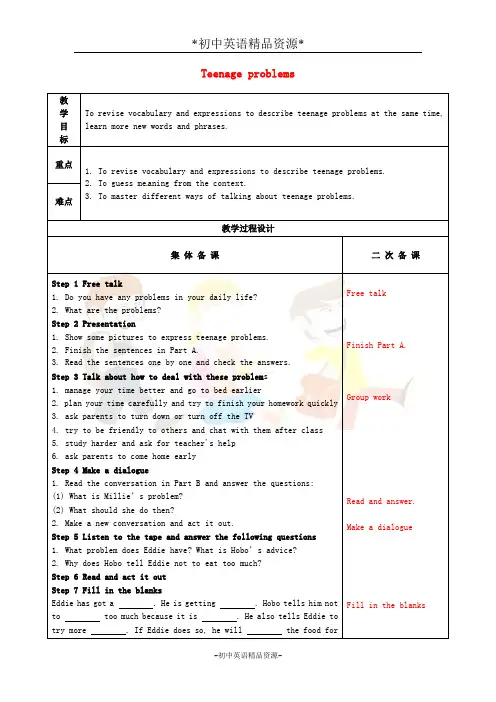
~初中英语精品资源~ Teenage problems
教
学
目
标 To revise vocabulary and expressions to describe teenage problems at the same time,
learn more new words and phrases.
重点 1. To revise vocabulary and expressions to describe teenage problems.
2. To guess meaning from the context.
3. To master different ways of talking about teenage problems. 难点
教学过程设计
集 体 备 课 二 次 备 课
Step 1 Free talk
1. Do you have any problems in your daily life?
2. What are the problems?
Step 2 Presentation
1. Show some pictures to express teenage problems.
2. Finish the sentences in Part A.
3. Read the sentences one by one and check the answers.
Step 3 Talk about how to deal with these problems
1. manage your time better and go to bed earlier
2. plan your time carefully and try to finish your homework quickly
3. ask parents to turn down or turn off the TV

9a unit3 welcome –task 知识点
一,根据中文写出单词及英文解释(书p38)
1. 选择 _____________ ____________________________________
1. 想象 _____________ ____________________________________
1. 怀疑 _____________ ____________________________________
1. 原因 _____________ ____________________________________
1. 严格的 _____________ ____________________________________
1. 培养 _____________ ____________________________________
1. 有价值的 _____________ ____________________________________
二,重点词组
1. 变胖: get fat
2. 吃得太多: eat too much
3. too much: 太多,+ 不可数名词
much too : 实在太----, +形容词
太多的食物: too much food
实在太胖了: much too fat
4. 为何不做某事? why not do sth.? = why don’t you do sth.?
5. 有足够的睡眠: get enough sleep
6. 有足够的时间做某事: have enough time to do sth.

初中-英语-打印版
初中-英语-打印版 Unit3 Teenage problems习题
一. 选择题
( ) 1. “This made me feel angry.” Is a kind of _____ structure.(结构)
A. S + V + O B. S + V + DO
C. S + V + IO + DO D. S + V + DO + OC
( ) 2. The teacher asked Mr. Smith to _____ for a moment.
A. hold up B. hold on C. hold off D. hand in
( ) 3. _____ may not seem very _____.
A. Watch TV; useful B. Watch TV; usefully
C. Watching TV; usefully D. Watching TV; useful
( ) 4. Jim sat _____ to his mother with his eyes half _____ .
A. closed; opened B. close; open
C. closely; opening D. closely; opened
( ) 5. We must be strict _____ ourselves and strict _____ our work.
A. in; with B. with; in C. in; in D. with; with

牛津译林版九年级上册Unit 3《Teenage problems》(Task)说课稿
一. 教材分析
《Teenage problems》是牛津译林版九年级上册Unit 3的一篇课文,主题是关于青少年问题的。通过描述青少年在成长过程中所面临的各种问题,如学习压力、与父母关系、朋友关系等,让学生了解并关注这一年龄段所特有的困惑和挑战。本节课的主要目标是让学生能够理解课文内容,掌握相关的语言知识,提高阅读理解能力。
二. 学情分析
九年级的学生已经具备了一定的英语基础,能够听、说、读、写一些简单的英语句子。但他们在阅读理解方面还存在一定的困难,特别是对于一些长篇的文章。因此,在教学过程中,我们需要关注学生的阅读理解能力,引导他们通过关键词、句子来理解文章的大意。
三. 说教学目标
1. 知识目标:让学生掌握课文中的关键词汇和句型,提高阅读理解能力。
2. 能力目标:培养学生通过关键词、句子来理解文章大意的技巧。
3. 情感目标:让学生认识到青少年时期所面临的问题,引导他们正确面对和处理这些问题。
四. 说教学重难点
1. 重点:课文的理解和相关的语言知识的掌握。
2. 难点:对于一些长篇的文章,学生如何通过关键词、句子来理解文章的大意。
五. 说教学方法与手段
1. 教学方法:采用任务型教学法,让学生在完成任务的过程中,提高阅读理解能力。
2. 教学手段:利用多媒体课件,为学生提供丰富的视觉、听觉材料,激发学生的学习兴趣。
六. 说教学过程
1. 导入:通过提问方式,引导学生谈论青少年时期所面临的问题,激发学生的学习兴趣。
2. 阅读理解:学生自主阅读课文,回答相关问题,教师给予指导。 3. 单词学习:学生通过课文,学习并掌握相关的词汇。
4. 句型练习:学生模仿课文中的句型,进行口语练习。
5. 小组讨论:学生分组讨论,分享自己面临的青少年问题,并尝试寻找解决办法。
6. 总结:教师引导学生总结课文内容,加深对文章主题的理解。