2015年考研英语二真题与答案(完整版)
- 格式:docx
- 大小:52.80 KB
- 文档页数:12
2015 年考研英语二真题及答案(完整版)
Section I Use of English
Directions:
Read the following text. Choose the best word(s) for each numbered blank and mark A,B,C
or D on ANSWER SHEET 1.(10 points)
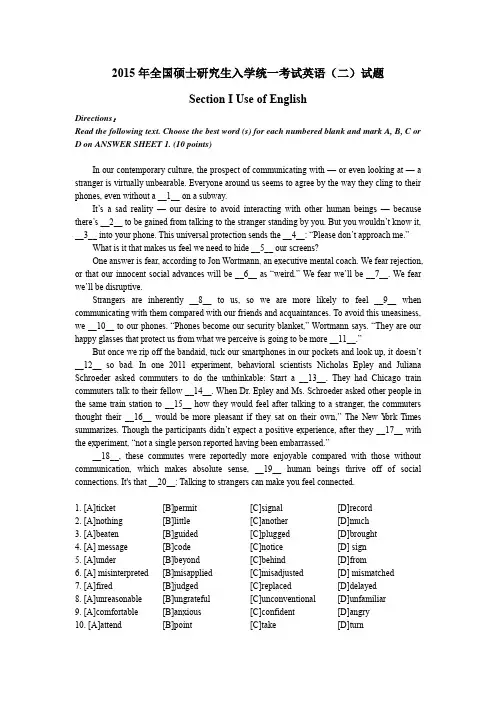
In our contemporary culture, the prospect of communicating with - or even looking at - a
stranger is virtually unbearable. Everyone around us seems to agree by the way they cling to their
phones, even without a 1 on a subway.
It ‘s a sad rea-litoyur desire to avoid interacting with other human beings-because there ‘s 2
to be gained from talking to the stranger standing by you. But you wouldn ‘t know it, 3 in
phone. This universal protection sends the 4 : ―Please don ‘t approach me. ‖
What is it that makes us feel we need to hid 5 our screens?
One answer is fear, according to Jon Wortmann, an executive mental coach. We fear
rejection, or that our innocent social advances will be 6 as ―weird. ‖ We fear we ‘ll
we‘ll be disruptive.
Strangers are inherently 8 to us, so we are more likely to feel 9 when communicating with
them compared with our friends and acquaintances. To avoid this uneasiness, we 10 to turn our
phones. ―Phones become our security blanket, ‖ Wortmann says. ―They are out r happy glasse
protect us from what we perceive is going to be more 11 . ‖
But once we rip off the band-aid, tuck our smartphones in our pockets and look up, it doesn
12 so bad. In one 2011 experiment, behavioral scientists Nicholas Epley and Juliana
Schroeder asked ocmmuters todo the unthinkable: ―Start a 13 . They had Chicago train commuters
talk to their fellow 14 . When Dr. Epley and Ms. Schroeder asked other people in the same train
station to 15 how the would feel after talking to a stranger, the commuters thought their 16 would
be more pleasant if they sat on thier own, ‖ The New York Times summarizes. Though the
participants didn ‘t expect a positive experience, after they 17 with the experiment,
person reported having been embarrassed. ‖
18 these commutes were reportedly more enjoyable compared with those without
communication, which makes absolute sense, 19 human beings thrive off of social connections.
It's that 20 : Talking to strangers can make you feel connected.
1.[A]ticket [B]permit [C]signal [D]record
2.[A]nothing [B]little [C]another [D]much
3.[A]beaten [B]guided [C]plugged [D]brought
4.[A]message [B]code [C]notice [D]sign
5.[A]under [B]beyond [C]behind [D]from
6.[A]misinterpreted [B]misapplied [C]misadjusted [D]mismatched
7.[A]fired [B]judged [C]replaced [D]delayed
8.[A]unreasonable [B]ungrateful [C]unconventional [D]unfamiliar
9.[A]comfortable [B] anxious [C] confident [D]angry
10.[A]attend [B]point [C]take [D]turn
11.[A]dangerous [B] mysterious [C]violent [D]boring
12.[A]hurt [B] resist [C]bend [D]decay
13.[A]lecture [B]conversation [C]debate [D]negotiation
14.[A]trainees [B]employees [C]researchers [D]passengers
15.[A]reveal [B]choose [C]predict [D]design
16.[A]voyage [B]flight [C]walk [D]ride
17.[A]went through [B]did away [C]caught up [D]put up
18.[A]In turn [B]In particular [C]In fact [D]In consequence
19. [A]unless [B]since [C]if [D]whereas
20. [A]funny [B]simple [C]logical [D]rare
Section II Reading Comprehension
Part A
Directions:
Read the following four texts. Answer the questions below each text by choosing A,B,C,or D.
Mark your answers on ANSWER SHEET 1.(40 points)
Text 1
A new study suggests that contrary to most survey,s people are actually more stressed at
home than at work. Researchers measured people ‘s cortisol, we shsi cmh aisrkaesr,trwhile they
were at were work and while they were at home and found it higher at what is supposed to be a
place of refuge.
―Further contradicting conventional wisdom, we found that women as well as men have
lower levels of stress at work than athome.‖Write one of the researchers, Sarah Damaske.In fact
women even say they feel better at work, she notes, ―It is men, not women, who report being
happier at home than at work. ‖ Another surprise is that the findings hold true for both those with
children and without, but more so for nonparents. This is why people who work outside the home
have better health.
What the study doesn ‘t measure is whether people are still doing work when they ‘
whether it is household work or work brought home from the office. For many men, the end of the
workday is a time to kick back. For women who say home, they never get to leave the office. And
for women who work outside the home, they often are playing catch— up— with— household tasks.
With the blurring of roles, and the fact that the home front lags well behind the workplace in
making adjustments for working women, it ‘s not surprising that women are more stressed at