
《教学分析》-M1U3
- 格式:ppt
- 大小:537.50 KB
- 文档页数:44

课时教学设计首页授课时间:年月日课题Module1 Unit3Are you Kitty?课型New第几课时1-2课时教学目标(三维)1.能听说读写字母并掌握字母Ee和Ff的书写;能流利正确地说Are youKitty? Yes,I am. 并能用Are you ….?Yes,I am和No,I am not.来回答。
2. 能正确读写单词boy和girl,会用句型Are you a...? Yes,I am和No,I am not.来问答。
3.欣赏英文短故事The wolf and the sheep,通过故事激发学生学习英语的兴趣。
教学重点与难点Are you ….?Yes,I am和No,I am not. Are you a...? Yes,I am和No,I am not. Guessing game 的操作教学方法与手段情境教学法活动激趣法相关实物、卡片录音机使用教材的构想创设情境,在问答活动中学习句型,开展接龙游戏操练句型;用实物和图片引入新授单词,开展各种形式的活动巩固单词;再能完整朗读句子的基础上,让学生发挥想象配上动作,进行朗读表演活动,启发学生用换词的方法改写儿歌,拓展思维。
第页(总页)补充教师行为学生行为课堂变化及处理主要环节的效果Period 1Step 1 Warming upStep 2 PresentationIntroduce the words boy and girl by looking at the picturesPlay the radio.Step 3 PracticeDivide the class into groups Play the radio.Play the radio again. Play a gameRead the words boy 、 girlListen and repeat the words boy 、 girl .Read the words togetherPractice the sentences:I am a boy. I am a girl.Listen to the radio and read the dialogue following the radio.Work in groups to practice the dialogues.Two groups come to the front to show their dialogues.第页(总页)补充教师行为学生行为课堂变化及处理主要环节的效果Step 4 ExtensionStep 5 HomeworkPlay the game as illustrated on page 11.Do the exercises.1 Read the dialogues to your parents.2 Write the words boy and girl Three times.第页(总页)补充教师行为学生行为课堂变化及处理主要环节的效果Period 2Step 1 Warming upStep 2 PresentationIntroduce: You’re …; Yes; No.Teacher cover the eyes with the scarf, then touch one’s head and guess: ”You’re…”Encourage the students to answer:“Yes, I am. / No, I’m not.”Step 3 PracticeTeach the letters: Ee and FfShow the pictures to teach the words: egg fan Enjoy a story “The wolf and the sheep”S: Yes. / No.Read and circle at page 13.Play the letters game in small groups at the front of the classroom.Students learn the letters Ee and FfStudents look at the pictures and learn the words: egg fan.第页(总页)补充教师行为学生行为课堂变化及处理主要环节的效果Teacher read the letters and words.Step 4 Summarizes and EvaluationStep 5 HomeworkStudents read following the teacher.Students learn to write the letters :A a B b.Ss do the exercises.1.read the story along with the tape.2. Listen to the tape第页(总页)课时教学设计尾页☆补充设计☆板书设计Module1 Unit3Are you Kitty?…作业设计1. Read the story The wolf and the sheep to your parents.2. Write the letters Ee and Ff four times.教学后记第页(总页)。

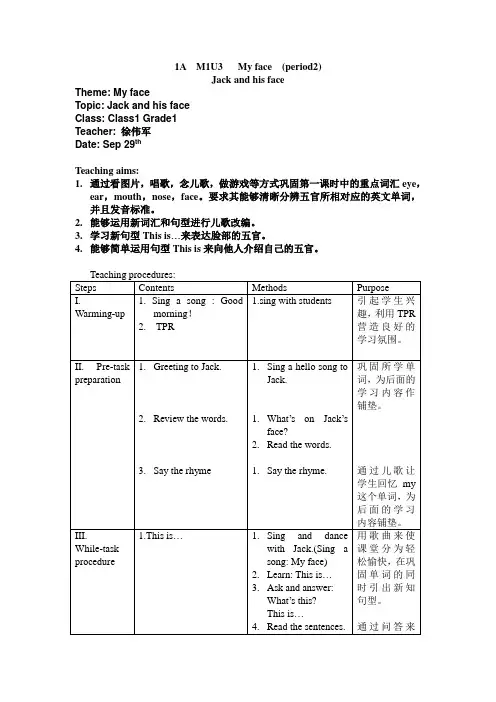
1A M1U3 My face (period2)Jack and his faceTheme: My faceTopic: Jack and his faceClass: Class1 Grade1Teacher: 徐伟军Date: Sep 29thTeaching aims:1.通过看图片,唱歌,念儿歌,做游戏等方式巩固第一课时中的重点词汇eye,ear,mouth,nose,face。
要求其能够清晰分辨五官所相对应的英文单词,并且发音标准。
2.能够运用新词汇和句型进行儿歌改编。
3.学习新句型This is…来表达脸部的五官。
4.能够简单运用句型This is来向他人介绍自己的五官。
反思阐述:(一)童谣是符合儿童年龄特点说唱形式童谣是有韵脚、有意境、有节奏、充满情趣、朗朗上口的一种说唱形式。
说童谣、唱童谣对儿童语言发展所起的作用是不可低估的,在给童谣配以节奏性很强的音乐,这就能使儿童学习语言的更为方便快捷。
在小学英语教学中,使用童谣教授英语,符合小学生的年龄特点,有利于他们学习英语。
首先,童谣的教学可以使课堂更加富有乐趣,生动活泼;其次,有助于学生形成良好的语音、语调,增强节奏感。
经常唱英文童谣、说英文童谣、创英文童谣等形式,能使小学生对英语的重音、节奏有一个初步的认识,久而久之,语感也就慢慢形成了。
最后,童谣在教学中不仅激发学生学习英语的成就感,同时也能学生提高对英语学习的兴趣。
在每次学完同谣后,给时间和机会让同学们上台表演,教师尽可能地给予他们鼓励、表扬,让同学们在表演完后有一种成就感,在以后的英语学习中,他们会表现得更为积极。
(二)童谣是帮助儿童有意识记的诵读形式小学生学习的一个很明显的特点就是直观,因为他们的思维是以形象思维为主,在教学的过程中我们就会发现,要是单独出示单词或中文意思,学生就是读了很多遍,还是记不起来的。
但是要是我们在教学单词的时候能以有节奏、有意义的儿歌童谣,把单词进行诵读,学生就很快在情景中想起来所学过的内容,单词的学习就变得生动,不会单调。