
Chapter5 Motivation
- 格式:ppt
- 大小:1.32 MB
- 文档页数:63

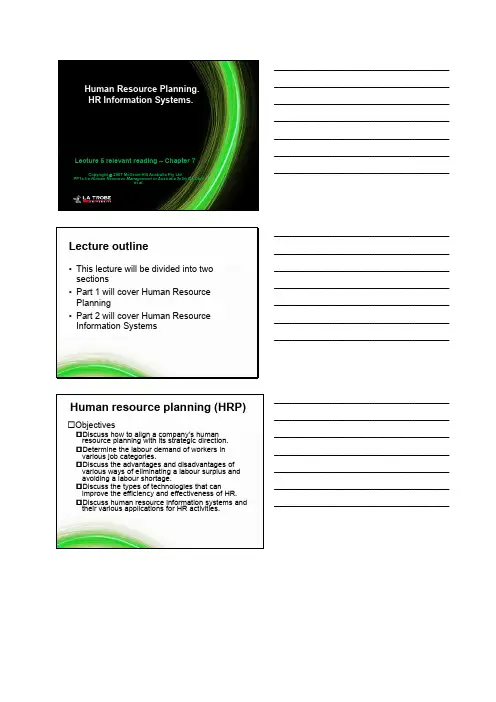
Human Resource Planning.HR Information Systems.Lecture 5 relevant reading –Chapter 7Copyright 2007 McGraw-Hill Australia Pty LtdPPTs t/a Human Resource Management in Australia 3e by De Cieriet al.___________________________________ ___________________________________ ___________________________________ ___________________________________ ___________________________________ ___________________________________Lecture outline•This lecture will be divided into two sections•Part 1 will cover Human Resource Planning•Part 2 will cover Human Resource Information Systems ___________________________________ ___________________________________ ___________________________________ ___________________________________ ___________________________________ ___________________________________ ___________________________________Human resource planning (HRP) ObjectivesDiscuss how to align a company’s humanresource planning with its strategic direction.Determine the labour demand of workers invarious job categories.Discuss the advantages and disadvantages ofvarious ways of eliminating a labour surplus andavoiding a labour shortage.Discuss the types of technologies that canimprove the efficiency and effectiveness of HR.Discuss human resource information systems and their various applications for HR activities.___________________________________ ___________________________________ ___________________________________ ___________________________________ ___________________________________ ___________________________________ ___________________________________What is HRP?•Bridge between strategic HRM and HR functions•A move from STATIC (here, now) to DYNAMIC (predictions of future changes)•Attempt to match future human resources to future needs of organisation •Involves forecasting –risks ___________________________________ ___________________________________ ___________________________________ ___________________________________ ___________________________________ ___________________________________What is HRP? (contin.)•Incorporates knowledge, skills and abilities of human resources –i.e.not justaggregates•Assists several HR activities• A particular challenge in rapid-changeenvironment•Requires knowledge of org’s variousactivities and linkages b/w them•Local (supervisor?) input desirable as well as more strategic input ___________________________________ ___________________________________ ___________________________________ ___________________________________ ___________________________________ ___________________________________ ___________________________________HRP☐The process through which organizational goals are translated into human resource goals, concerned with staffing levels and allocation.☐Human resource planning involves forecasting human resource needs for an organization, and planning the necessary steps to meet these needs.☐‘HRP systematically forecasts an organisation’s future demand for, and supply of, employees’(Werther & Davis, 1989)Strategic, long-term staffing plan covering all HR activities, closely linked to organisationalstrategies and objectives ___________________________________ ___________________________________ ___________________________________ ___________________________________ ___________________________________ ___________________________________ ___________________________________Figure 7.1 Overview of the HRP process_____________________________________________________________________________________________________________________________________________________________________________________________________________________________________________________HRP and strategic organisational planning •Strategic planning involves settingorganisational objectives and plans toachieve them•Part of this involves definition oforganisation’s philosophy, ‘scanning’environment, SWOT analysis, formulation of strategies•HRP uses this to focus closely on labour demand and supply issues atdisaggregated level ___________________________________ ___________________________________ ___________________________________ ___________________________________ ___________________________________ ___________________________________ ___________________________________How widely utilised?•Most (>90%) of Aus orgs develop formalcorporate plans (most with HR input)•Only around 50% develop HR plans•More common among large orgs, those undergoing rapid change, people-focused cultures, orgs indynamic environments•Used more in private sector than public•Most use basic techniques, few use formal supply demand and supply analysis, HRIS ___________________________________ ___________________________________ ___________________________________ ___________________________________ ___________________________________ ___________________________________ ___________________________________Some key features•HR plan is used to guide decisions on recruitment & selection, performance management, training, career structures etc •Linkages with strategy are being increasingly recognised•Integration with strategy is most important element ___________________________________ ___________________________________ ___________________________________ ___________________________________ ___________________________________ ___________________________________ ___________________________________Goal setting and strategic planning•Reducing an expected labor surplus, e.g.–Downsizing–Early retirement programsor•Avoiding an expected labor shortage,e.g.–Employing temporary workers–Outsourcing–Overtime and expanding worker hours ___________________________________ ___________________________________ ___________________________________ ___________________________________ ___________________________________ ___________________________________ ___________________________________Table 7.2 Options for reducing an expected labour surplusOption Speed Human suffering 1Downsizing Fast High2Pay reductions Fast High3Demotions Fast High4Transfers Fast Moderate5Work sharing Fast Moderate6Retirement Slow Low7Natural attrition Slow Low8Retraining Slow LowCopyright 2007 McGraw-Hill Australia Pty LtdPPTs t/a Human Resource Management in Australia 3e by De Cieri et al.7-12_____________________________________________________________________________________________________________________________________________________________________________________________________________________________________________________Table 7.3 Options for avoiding an expected labour shortageOption Speed Revocability 1Overtime Fast High2Temporary employees Fast High3Outsourcing Fast High4Retrained transfers Slow High5Turnover reductions Slow Moderate 6New external recruits Slow Low7Technological innovation Slow LowCopyright 2007 McGraw-Hill Australia Pty LtdPPTs t/a Human Resource Management in Australia 3e by De Cieri et al.7-13_____________________________________________________________________________________________________________________________________________________________________________________________________________________________________________________HR planning process•Phase 1Assessing supply and demand for each type of labour•Start with current situation and forecast likely changes ___________________________________ ___________________________________ ___________________________________ ___________________________________ ___________________________________ ___________________________________ ___________________________________Forecasting•The attempt to determine the supply of and demand for various types of human resources, in order to predict future labor shortages or surpluses in areas within the organization.Labour supply comes from:•Internal•External ___________________________________ ___________________________________ ___________________________________ ___________________________________ ___________________________________ ___________________________________ ___________________________________Labour demand forecasting •Involves predicting numbers and types ofemployees needed in future –challenging!•Can use qualitative and/or qualitativeapproaches•Quantitative can be complex and expensive •Qualitative often less structured –intuition,‘rule of thumb’, Delphi technique (segmentproblem, usespecialists on each component), trend analysis •High costs of poor forecasting e.g.training,capital misallocations ___________________________________ ___________________________________ ___________________________________ ___________________________________ ___________________________________ ___________________________________ ___________________________________Downsizing•The planned elimination of large numbers of personnel designed to enhance organisational effectiveness.–Workforce reduction–Organisational redesign–Systemic change ___________________________________ ___________________________________ ___________________________________ ___________________________________ ___________________________________ ___________________________________ ___________________________________Major reasons for downsizing•Cost reduction•Introduction of new technology •Mergers and acquisitions leading to reduced need for bureaucracy •Globalization and changinglocation of business ___________________________________ ___________________________________ ___________________________________ ___________________________________ ___________________________________ ___________________________________ ___________________________________Major reasons for the failure of downsizing•Initial cost savings but long-term negative effects•Loss of people who are ‘irreplaceableassets’•‘Survivor syndrome’: loss of motivation,self-absorption, risk-aversion•‘Survivors’ seek new employment •Reputational damage ___________________________________ ___________________________________ ___________________________________ ___________________________________ ___________________________________ ___________________________________ ___________________________________Formulating human resource plans•Once labour demand and supply forecasts are made an integrated staffing plan needs to be developed•Aspects include –recruitment, training, development, succession planning, job design etc•Openness to change in dynamic environment•Role of culture ___________________________________ ___________________________________ ___________________________________ ___________________________________ ___________________________________ ___________________________________ ___________________________________HR planning process (contin.)•Phase 2Developing objectives–outcome of organisational strategy and goals. May be broad, far-reaching –e.g. improve morale•Phase 3Programming–develop and implement policies to help match supply and demand for each category of worker ___________________________________ ___________________________________ ___________________________________ ___________________________________ ___________________________________ ___________________________________ ___________________________________HR planning process (contin.)•Phase 4Control and evaluation.•HRIS used to regularly monitor progress. Permits control and evaluation •Prompt remedial action, if necessary •Programs must meet user needs ___________________________________ ___________________________________ ___________________________________ ___________________________________ ___________________________________ ___________________________________Program implementation and evaluation•Accountability•Authority and resources available to accomplish the stated goals •Regular progress reports onimplementation•Evaluation of results ___________________________________ ___________________________________ ___________________________________ ___________________________________ ___________________________________ ___________________________________ ___________________________________Formal HRP is more likely in organisations that:–are larger–have greater overall business planningsophistication–have top management support for humanresource planning–have more involvement of human resource managers in the business planning process –have greater integration across humanresource activities ___________________________________ ___________________________________ ___________________________________ ___________________________________ ___________________________________ ___________________________________ ___________________________________Strategic approach to HRPincludes:top management and HR managers desiringproactive involvement of HRM in the achievement of organizational goalsintegration of employee needs and wishes forcareer development with organizational goalscoordination across HRM activities in light oforganizational strategies and goalsadherence to principles of equal opportunityfocus on planning at the organizational level, notonly at industry or regional level ___________________________________ ___________________________________ ___________________________________ ___________________________________ ___________________________________ ___________________________________Negatives of HRP•Can be difficult, time-consuming •May have long lead times, lags during which environment may change •Culture can be extremely difficult to modify•Vested interest groups may not co-operate ___________________________________ ___________________________________ ___________________________________ ___________________________________ ___________________________________ ___________________________________ ___________________________________Benefits of HRP•Human resources better utilised •Less wastage, bottlenecks leading to improved productivity, profitability •Labour recruited at right time •Morale can be enhanced •Redundancies lessened throughaccurate planning ___________________________________ ___________________________________ ___________________________________ ___________________________________ ___________________________________ ___________________________________ ___________________________________Summary: HRP•When managed well, human resource planning can enhance the success of the organisation, while minimising difficulties resulting from poorly anticipated labour surpluses or shortages.___________________________________ ___________________________________ ___________________________________ ___________________________________ ___________________________________ ___________________________________ ___________________________________Human resource informationsystems (HRIS)•Objectives–Discuss the types of technologiesthat can improve the efficiency andeffectiveness of HR.–Discuss human resource information systems and their variousapplications for HR activities.___________________________________ ___________________________________ ___________________________________ ___________________________________ ___________________________________ ___________________________________ ___________________________________Human resource informationsystems(HRIS)•A system used to acquire, store, manipulate, analyze, retrieve and distribute information related to a company’s human resources.___________________________________ ___________________________________ ___________________________________ ___________________________________ ___________________________________ ___________________________________ ___________________________________HRIS•Note: also known as HRIMS•For recording and processing data •Supports strategic, operational and administrative goals and objectives •Enhanced speed, efficiency, lower administrative costs•New capabilities –data manipulation, estimation etc ___________________________________ ___________________________________ ___________________________________ ___________________________________ ___________________________________ ___________________________________Factors leading to use of moresophisticated HRIS •Development of increasingly complex and comprehensive IT systems •Economic pressures•Increasing demands by government for organizations to collect employee data ___________________________________ ___________________________________ ___________________________________ ___________________________________ ___________________________________ ___________________________________ ___________________________________Three broad functions for HRIS –Transaction processing, reportingand tracking–Decision support systems–Expert systems ___________________________________ ___________________________________ ___________________________________ ___________________________________ ___________________________________ ___________________________________ ___________________________________Technology: advantages or disadvantages?•Employees gain complete control over their training and benefits enrolments (self-service)• A paperless employment office can be created•Streamlining the HR department’s work•Technology can provide knowledge-based decision support•Employees and managers select the type of media they want to use to send and receive information•Work can be completed at any time, any place, day or night•Closer monitoring of employees’ work ___________________________________ ___________________________________ ___________________________________ ___________________________________ ___________________________________ ___________________________________HR technologies •Interactive voice technology •Internet•Networks and client-server architecture •Relational databases•Imaging•Laser disc technology •Groupware, intranets and portals •Global positioning systems ___________________________________ ___________________________________ ___________________________________ ___________________________________ ___________________________________ ___________________________________ ___________________________________HRIS role in HRP•Revolution in storage of data onemployees•Govt legislation has become morecomplex in data requirements –e.g.OH&S, FBT, EEO etc•Advances in computer technologylowered dramatically the costs of storage of complex data•Can be bought ‘off-the-shelf’___________________________________ ___________________________________ ___________________________________ ___________________________________ ___________________________________ ___________________________________ ___________________________________Benefits of HRIS•Faster data processing enhanced communication across org., accuracy of data, decreased costs, improved planning possibilities•Can include data on employees, jobs and work conditions, positions, leave management•Employee self-service (ESS)___________________________________ ___________________________________ ___________________________________ ___________________________________ ___________________________________ ___________________________________HRIS –Types of data•Individual–Name, Personal detail –Previous experience –Conditions of service ___________________________________ ___________________________________ ___________________________________ ___________________________________ ___________________________________ ___________________________________ ___________________________________HRIS –Types of data (cont.)•Collective–Enterprise agreements, contractemployees, skills inventory,vacancies–Recruitment and selection–Career paths and succession plans ___________________________________ ___________________________________ ___________________________________ ___________________________________ ___________________________________ ___________________________________ ___________________________________Linkages with other activities •Benchmarking –within and outside org•Enables tracking of performance data •Aids analysis•Identify patterns…___________________________________ ___________________________________ ___________________________________ ___________________________________ ___________________________________ ___________________________________HRIS: examples of applications for HRM•HR planning•Staffing•Performance management •Learning and career development •Compensation and benefits ___________________________________ ___________________________________ ___________________________________ ___________________________________ ___________________________________ ___________________________________ ___________________________________Some relevant issues•Confidentiality, privacy, access •Safeguards needed to avoid abuse and offer assurance•‘Big brother' perception •Transparency –inform those monitored •Qualitative and quantitative ___________________________________ ___________________________________ ___________________________________ ___________________________________ ___________________________________ ___________________________________ ___________________________________Successful HRIS•Contain accurate employee and job data •Flexibility –adapt to present and future requirements•Dynamic and comprehensive•Clear link with and contribution to HR plans•Modular and integrated•Clear control of HR costs ___________________________________ ___________________________________ ___________________________________ ___________________________________ ___________________________________ ___________________________________Looking ahead…•Increased involvement of employees in design•Easy soft and hardware updates•‘Off-the-shelf’ needs to beflexible/modifies easily for individualorganisation’s needs•Regular review involving all stakeholders ___________________________________ ___________________________________ ___________________________________ ___________________________________ ___________________________________ ___________________________________ ___________________________________Summary: HRIS •Increasingly, organizations depend on more sophisticated HRIS in order to support human resource activities. ___________________________________ ___________________________________ ___________________________________ ___________________________________ ___________________________________ ___________________________________ ___________________________________。
语言学常用术语英汉对照表语言学常用术语英汉对照表Chapter 1 Introduction to Ling uistics语言学简介1、anthropological linguistics 人类语言学2、applied linguistics应用语言学3、arbitrariness任意性4、petence 语言能力5、putational linguistics计算机语言学6、cultural transmission 文化传递性7、descriptive(grammar) 描写(语法)8、descriptive function描写功能9、design features识别特征10、diachronic linguistics历时语言学11、duality二重性12、displacement不受时空限制得特征13、emotive function表情功能14、expressivefunction表达功能15、general linguisitcs 普通语言学16、ideational function概念功能17、interpersonal function人际功能18、langue语言19、linguistics [li?'gwistiks] 语言学20、morphology 形态学21、mathematical linguistics 数理语言学22、metalinguistic function23、neurologicallinguistics 神经语言学24、phonetics语音学25、phonology 音系学26、pragmatics 语用学27、prescriptive(grammar)规定(语法) 28、psycholinguistics心理语言学29、parole言语30、performance语言运用31、productivity能产性32、poetic function诗学功能33、phatic munion 交感性谈话34、referential function所指功能35、semantics语义学36、social function社会功能37、socio-linguistics 社会语言学38、synchroniclinguistics共时语言学39、syntax句法学40、textual function语篇功能41、Traditional Grammar传统语法Chapter 2 Phonology 音系学1、acousticphonetics声学语音学2、articulatory phonetics发音语音学3、affricate破擦音4、allophone音位变体5、alveolar齿龈音6、auditory phonetics听觉语音学7、aspiration送气8、assimilationrules同化现象9、back vowel后元音10、bilabial双唇音11、broad transcription宽式音标12、central vowel中元音13、close vowel闭元音14、plementarydistribution互补分布15、deletion rules省略规则16、dental齿音17、diphthong双元音18、fricative摩擦音19、front vowel前元音20、glide滑音21、glottal声门音22、hard palate硬腭23、InternationalPhonetics Alphabet国际音标24、intonation语调25、labiodental唇齿音26、liquid流音27、manner ofarticulation发音方式28、minimal pair 最小对立体29、minimalset最小对立组30、monophthong单元音31、narrow transcription严式音标32、nasal鼻音33、nasalcavity鼻腔34、open vowel开元音35、oral cavity口腔36、palatal硬腭37、pharyngealcavity咽腔38、place of articulation发音部位39、phone因素40、phoneme音素41、phonemic contrast音位对立42、rounded vowel元唇元音43、semi-close vowel半闭元音44、semi-openvowel半开元音45、sequential rules序列规则46、segment切分成分47、segmentation切分48、soft palate软腭49、stop塞音50、stress重音51、suprasegmentalfeatures超切分特征52、teeth ridge齿龈53、tone声调54、unrounded vowel非圆唇元音55、uvula小舌56、velar软腭音57、velum软腭58、voicing浊音化Chapter 3 Morphology 形态学1、affix词缀2、allomorph语素变体3、base词基4、bound morpheme黏着语素5、lexicon词汇6、closed classwords封闭词类7、pound words 合成词8、derivation派生;派生过程9、derivational morphem派生语素10、free morpheme自由语素11、inflectionalmorpheme屈折语素12、infinitive marker不定式标记13、morph形素14、morphological rules形态规则15、open classwords开放词类16、root词根17、stem词干Chapter 4Syntax 句法学1、auxiliary助动词2、category范畴3、plement补足语;补充成分4、plement clause补足分句5、coordinationrule并列规则6、coordinate structure并列结构7、deep structure深层结构8、determiner限定词9、head中心词10、head movement中心词移位11、insertion插入12、inversion倒装13、majorlexical categories主要词汇范畴14、matrix clause主句15、minor lexical categories次要词汇范畴16、phrase structure短语结构17、modifier修饰成分18、qualifier后置修饰成分19、specifier标志语20、subcategorization次范畴化21、surface structure表层结构22、syntactic category句法范畴23、trace语迹24、transformation转换Chapter5Semantics语义学1、antonymy反义现象2、argument谓元;变元3、behaviorism行为主义4、co-hyponym并列下义词5、collocationalsynonym搭配同义词6、plementaryantonym互补反义词7、pletehomonym完全同形异义词8、ponential analysis成分分析9、conceptualist view概念论10、contextualism语境主义11、contradition自相矛盾得说法12、dialectal synonym方言同义词13、emotive meaning情感意义14、entailment蕴含15、evaluative meaning评价意义16、gradable antonym层级反义词17、homograph同形异义词18、homonymy同音同形异义关系19、homophone同音异义词20、hyponym下义词21、hyponymy下义关系22、inconsistency自相矛盾23、polysemy多义关系24、polysymous word多义词25、presupposition预设26、predication analysis述谓分析27、predicate谓词28、namingtheory命名论29、no-place predicaiton空位述谓解耦股30、one-placepredication一位述谓结构31、reference(所指)语义32、referent所指物;所指对象33、relational opposite关系反义词34、semantic triangle语义三角35、sense意义36、stylistic synonym语体同义词37、superordinate上坐标词38、symbol符号39、synonym同义词40、synonymy同义关系41、two-place predicaiton二位述谓结构42、three-place predication三位述谓结构Chapter6 Pragmatics语用学1、missives承诺类2、CooperativePrinciple合作原则3、constatives述事话语4、context语境5、conventional implicature规约含义6、declarations宣告类7、directives指令类8、expressives表情类9、illocutionaryact言外功能10、illocutionary point言外之得11、implicature蕴含;含义;会话含义;言外之意12、indirectspeech act间接言语行为13、locutionary act言内行为14、maximofrelation关系准则15、maximof manner方式准则16、maxim of quality质准则17、maximofquantity量准则18、particularized conversational implicature特殊会话含义19、perfomatives行事话语20、perlocutionaryact言后行为21、presupposition前提22、primaryspeechact 主要言语行为23、representatives表述类24、secondary speechact次要言语行为25、sentence meaning句子意义26、speechacttheory言语行为理论27、utterance meaning话语意义Chapter 7 LanguageChange语言变化1、acronyms词首字母缩略词2、back-formation 逆成法3、blending混成法4、borrowing借词5、clipped words截略词6、coinage创新词7、functionalshift功能性变化8、historical linguistics历史语言学9、MiddleEnglish中世纪英语10、Modern English现代英语11、morphologicalchange形态变化12、negation rule否定规则13、Old English古英语14、phonological change音位变化15、semantic change语义变化16、semanticshift语义转移17、syntactic change句法变化Chapter 8 Languageand society语言与社会1、bilingualism双语制2、Black English黑人英语3、creole克里奥尔语4、diglossia双语;双言制5、ethnic dialect种族变体6、field of discourse语场7、gender性别8、idiolect个人变体9、mode ofdiscourse语式10、multilingualism多语制11、pidgin洋泾浜语12、regionaldialect地域方言13、register语域14、sociolect社会变体15、speechmunity言语社团16、speech variety言语变体17、tenor of discourse语旨Chapter 9Language andculture语言与社会1、acculturation 同化过程2、amalgamation混合3、assimilation同化(现象);同化(作用)4、connotativemeaning内涵意义5、colour words颜色词6、culturaloverlap文化重叠7、culturalimperialism文化帝国主义8、denotative meaning外延意义9、linguistic relativity语言相对性10、metaphor隐喻11、Sapir-Whorf Hypothesis萨丕尔——沃尔夫假说12、socialization社会化13、taboo禁忌语14、intercultural munication跨文化交际15、linguisticimperialism语言学中得帝国主义16、linguisticnationalism语言学中得民族主义Chapter 10 Language acquisition语言习得1、aphasia失语症2、behaviorist 行为主义者3、caretaker talk保姆式语言4、cognitivelinguistics认知语言学5、content word实词6、Critical PeriodHypothesis临界期假说7、dysgraphia书写困难8、dyslexia失读症9、feedback反馈10、function element起功能作用成分11、hearing impairment听力受损12、innatist语法天生主义者13、interactionist互动主义者14、LanguageAcquisition Device语言习得机制15、lexicalcontrast词汇对比16、mental retardation智障17、motherese保姆式语言18、over-extension过度扩展19、prototype theory原型理论20、recast修正性重复21、stuttering口吃22、telegraphic speech电报式言语23、under-extension扩展不足24、Universal Grammar普遍语法Chapter 11Second languageacquisition第二语言习得1、affect/social strategies社会策略2、ageofacquisition习得年龄3、cognitivestrategies认知策略4、prehensibleinput可理解性输入5、Constrastive Analysis对比分析6、cross-association互相联想7、Error Analysis错误分析8、foreign language外语9、foreigner talk外国人谈话10、fossilization语言石化(现象)11、Input Hypothesis输入假说12、instrumental motivation工具动机13、intake 纳入14、integrativemotivation综合动机15、interference干扰16、interlanguage中介语17、interlingual errors语际错误;受母语影响得错误18、Intralingual error语内错误19、intrinsic motivation内在动机20、intuition知觉;语感21、learnerlanguage学习者语言22、learning strategies学习策略23、language aptitude语言能力24、languagetransfer语言迁移25、metacognitive strategies元认知策略26、motivation动机27、modified input修改后得输入28、modified interaction变化性得互动29、negative transfer消极迁移;负迁移30、overgeneralization概括过头31、personality人格;性格;个性32、positive transfer积极迁移;正迁移33、resultativemotivation结果动机34、secondlanguage第二语言35、secondlanguage acquisition第二语言习得36、teacher talk教师谈话37、target language目标语Chapter 12Language and the brain 语言与大脑1、acquired dysgraphia习得性书写障碍2、acquired dyslexia习得性失读症3、angular gyrus隅骨4、autopsy studies尸检研究5、brain stem脑干6、Broca’s aphasia布罗卡失语症7、Broca’s area布罗卡区8、bottom-up processing自下而上处理过程cerebrum大脑9、central sulcus中央沟10、cerebellum小脑脑向背侧突出得一个较大得部分,尤与肌肉得共济运动与维持身体平衡有关11、cerebral hemisphere大脑半球12、cohort model交股模型13、putarized Axial Tomography计算机化轴向层面X射线摄影法14、corpus(语言)素材15、corpuscallosum胼胝体16、cortex大脑皮层17、deep dyslexia深层诵读困难18、Dichotic listening studies双耳分听实验19、event-related potential experiment20、eye movementexperiment眼动实验21、fissure裂缝;裂隙22、fluent aphasia流利性失语症23、frontal lobe额叶(大脑半球得前部,其下部位于颅前窝,后界中央沟24、Functional MRI功能磁共振成像25、garden path sentence花园路径句26、global aphasia整体性失语症27、gyrus回28、hierarchical structure层级结构29、late closure principle后封闭原则;晚封闭原则30、lateral fissure侧脑裂31、lateralization侧化32、lesion损害33、lexicaldecision词汇判断;词汇确定法34、lobes叶,身体器官得由表面得沟裂分出得部分35、longitudinalfissure纵裂36、MagneticResonance Imaging磁共振成像37、neuron神经细胞,神经元38、minimalattachment principle最低限度结合原则39、module模块;组块40、non-fluent aphasia失语症41、occipital lobe枕叶大脑半球得后叶,呈三面得锥形, 与前方得顶叶与下方得颞叶没有明显得界限42、parietal lobe顶叶Positron emission Tomogra phy正电子发射X射线层析照相术;计算机辅助正电子发射断层扫描技术43、phologicaldyslexia拼音性失读症44、priming启动45、priming effect启动效应46、priming experiment启动实验47、right earadvantage右耳优势;右耳听力强48、selectional restriction选择限制49、sentenceambiguity句子歧义50、“Sodium Amystal“Test阿米妥纳实验Spoone rism斯本内现象51、splitbrain studies裂脑研究52、sulcus沟53、surface dyslexia浅层诵读困难54、syntactic parser句法处理器55、temporallobe颞叶56、timed-reading experiment限时阅读实验57、top-down processing自上而下处理过程58、Wernicke’s aphasia韦尼克失语症。