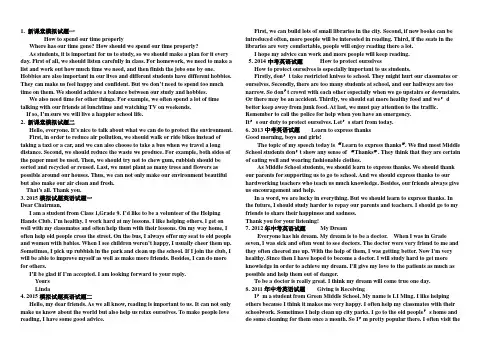
2014中考英语预测作文
- 格式:docx
- 大小:37.28 KB
- 文档页数:3
2014中考英语预测作文
As we approach the 2014 middle school English exam, students
and educators alike are speculating on the possible topics
and formats that may be included in the test. Based on recent
trends and educational directives, here are some predictions
for the upcoming exam:
1. Emphasis on Reading Comprehension: The exam is likely to
place a significant focus on reading comprehension, with
passages that cover a range of topics from literature to
current events. Students should expect questions that test
their ability to infer meaning, summarize information, and
understand the author's perspective.
2. Writing Skills: The essay section may require students to
write on a variety of topics, including personal narratives,
persuasive essays, and expository texts. It's predicted that
the exam will assess not only the students' ability to
construct grammatically correct sentences but also their
capacity to develop a coherent argument or tell a compelling
story.
3. Vocabulary and Grammar: As always, a solid understanding
of vocabulary and grammar is expected. The test might include
sections where students need to identify the correct usage of
words in context, as well as questions that test their
knowledge of verb tenses, sentence structure, and parts of
speech.
4. Listening Comprehension: With the increasing importance of
all language skills, a listening comprehension section could
be part of the exam. This might involve listening to short
dialogues or monologues and answering questions based on the
content, requiring students to demonstrate their ability to
understand spoken English.
5. Cultural and Global Awareness: The exam may include
questions or passages that reflect an international
perspective, encouraging students to think about English as a
global language and to consider cultural differences and
global issues.
6. Practical Language Use: There might be a section that
tests the students' ability to use English in practical,
real-world scenarios, such as understanding signs,
instructions, or engaging in everyday conversations.
7. Innovation in Exam Format: To keep the exam engaging and
to encourage diverse learning, there could be innovative
elements introduced, such as multimedia components or tasks
that require the use of technology.
8. Focus on Critical Thinking: The exam is likely to include
questions that require students to think critically about the
material they have read or listened to, rather than simply
recalling facts.
9. Integration of Skills: Rather than testing reading,
writing, listening, and grammar in isolation, the exam may integrate these skills, reflecting the interconnected nature
of language use.
10. Personal Expression: There may be an increased focus on
allowing students to express themselves in their own words,
encouraging creativity and personal voice within the
constraints of the language.
As with any prediction, these are speculative and meant to
guide preparation rather than guarantee the content of the
exam. It's essential for students to have a well-rounded
study plan that covers all aspects of language learning and
to stay adaptable to whatever the exam presents.