英国议会制辩论 简介
- 格式:docx
- 大小:16.17 KB
- 文档页数:5
英国议会制辩论 简介
英文回答:
The British parliamentary debating system is a form of
debate that is used in the British Parliament and other
Commonwealth parliaments. It is a two-sided debate, with
one side proposing a motion and the other side opposing it.
The debate is conducted in a formal manner, with each side
taking turns to speak. The side that proposes the motion is
called the government, and the side that opposes it is
called the opposition.
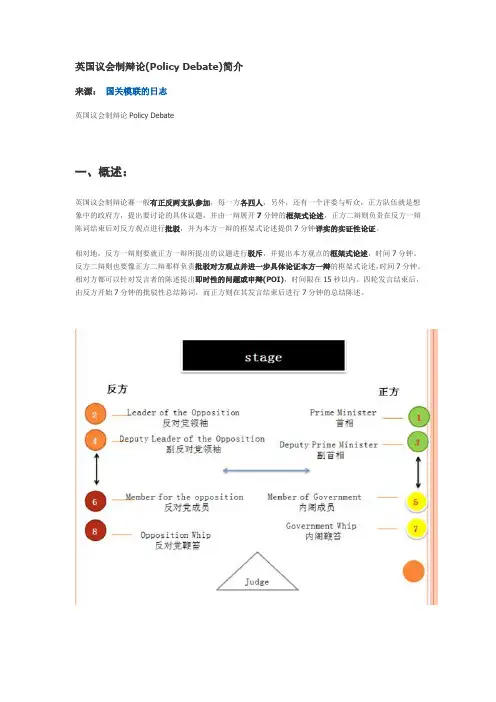
The debate is divided into three stages: the opening
speeches, the main speeches, and the closing speeches. In
the opening speeches, the government and opposition each
make a case for their side. The main speeches are then
given by backbench MPs, who are not members of the
government or opposition front benches. The closing
speeches are then given by the government and opposition
front benches.
The debate is then voted on by the House of Commons.
The motion is passed if it receives a majority of votes.
The British parliamentary debating system is a unique
and important part of the British political system. It
allows for a full and open debate on important issues, and
it helps to ensure that the government is held to account.
Here is an example of a British parliamentary debate:
Government: "I move that this House approves the
government's plans to introduce a new tax on sugary
drinks."
Opposition: "I oppose this motion. The government's
plans are unfair and will hurt low-income families."
Backbencher 1: "I support the government's plans.
Obesity is a major problem in this country, and we need to
do something to tackle it."
Backbencher 2: "I oppose the government's plans. This
tax is nothing more than a money-making exercise. It will
not do anything to reduce obesity."
Government frontbencher: "The opposition's arguments
are scaremongering. This tax is a necessary measure to
protect the health of our nation."
Opposition frontbencher: "The government's plans are a
disgrace. They are putting the interests of big business
ahead of the interests of the people of this country."
The debate would then be voted on by the House of
Commons. The motion would be passed if it received a
majority of votes.
中文回答:
英国议会辩论制度是英国议会和其他英联邦议会中使用的一种辩论形式。这是一种两方辩论,一方提出议案,另一方反对议案。辩论以正式的方式进行,双方轮流发言。提出议案的一方称为政府,反对议案的一方称为反对派。
这场辩论分为三个阶段,开场陈述、主要陈述和总结陈述。在开场陈述中,政府和反对派各自为自己的立场辩护。然后,主要陈述由并非政府或反对派前座议员的后座议员提出。然后由政府和反对派前座议员发表结束语。
然后,下议院对该辩论进行投票。如果动议获得多数票,则通过。
英国议会辩论制度是英国政治制度中独特而重要的组成部分。它允许对重要问题进行全面而公开的辩论,并有助于确保政府对自己的行为负责。
以下是一个英国议会辩论的示例:
政府,“我提议本院批准政府对含糖饮料征收新税的计划。”。
反对派,“我反对这一动议。政府的计划不公平,会伤害低收入家庭。”。
后座议员 1,“我支持政府的计划。肥胖症是我们国家的一个主要问题,我们需要采取措施来解决它。”。
后座议员 2,“我反对政府的计划。这项税收只不过是一项创收手段。它不会对减少肥胖产生任何作用。”。
政府前座议员,“反对派的论点是危言耸听。这项税收是保护我们国家健康的必要措施。”。
反对派前座议员,“政府的计划是可耻的。他们把大企业的利益置于本国人民的利益之上。”。
然后,下议院对该辩论进行投票。如果得到多数票,动议将被通过。