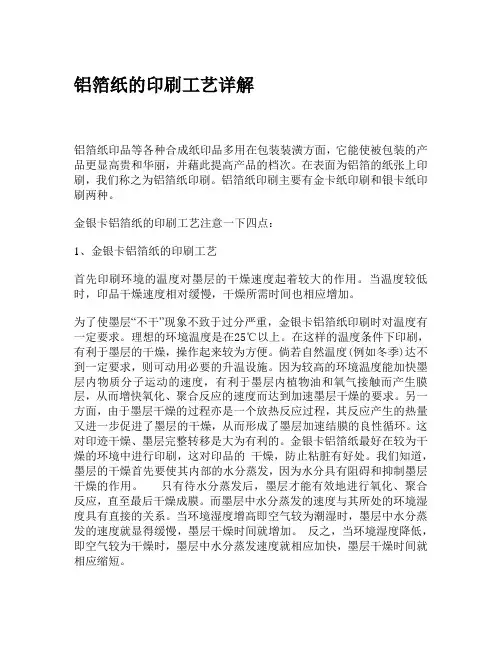
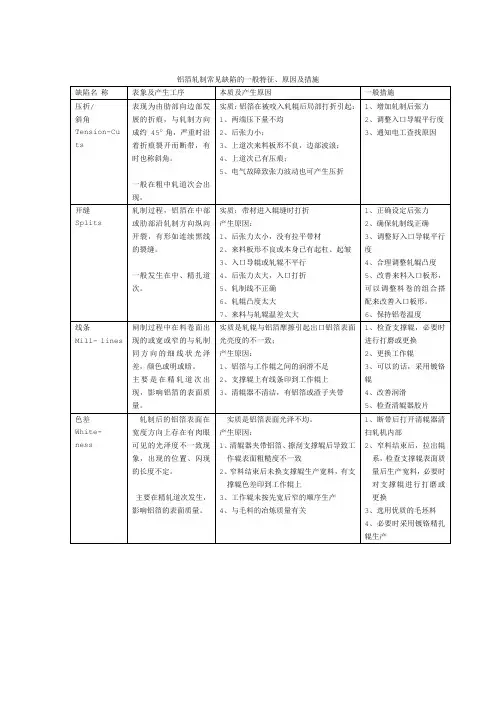
铝箔轧制常见缺陷的一般特征、原因及措施在轧辊的表面与机体中形成高微裂纹的铬层。
这种高高微裂纹的网状结构有利于轧制油吸附在轧辊表面,以便润滑。
网状结构的铬层可以承受轧制力高达2000吨以上的的压力。
以下是其与传统镀铬的金相结构图的比较对照表:轧辊镀铬的铬层硬度是随着镀铬的技术条件变化而变化的。
科德工作辊服务集团的镀铬层硬度通过其技术的创新可以达到900-1100VICKERS PN。
这么高的硬度值就是所谓的“镀硬铬”技术。
通过这样的硬度值来增加轧辊的耐磨性能。
它的硬度要比通常的铸铁或者热处理的锻钢工作辊的硬度还要高。
镀铬层的摩擦系数更低,以下是一些金属表面的摩擦系数表:铝箔轧辊的镀铬对铝箔的生产带来了较好的效果。
工作辊—所有机架(粗轧→中轧)冷轧镀铬辊的所有绩效在铝箔轧辊上都能体现出来,此外,还具备以下优点:(1)、能够成倍减缓随通过量轧制速度下降的趋势从而获得稳定的轧制速度;(2)、能够从窄到宽的变规格轧制;(3)、大幅度改善润滑状态减少了不明断带;(4)、获得稳定一致的板型和表面质量。
在生产10—30um的箔材中,由于支撑辊的原因常常损坏工作辊。
而对支撑辊的镀铬可以改善工作辊的损伤,减少氧化物的产生和线条的产生。
在铝箔精轧中,使用镀铬工作辊可以获得更稳定均匀的表面质量,延缓线条产生。
抑制原料带来色差的倾向。
分切常见缺陷及调整措施工艺参数与铝箔质量产量的关系COMALCOFOIL DIVISIONDEFECT CATALOGUEDanyang Training VisitMay 1992Comalco Aluminium Ltd SMP 7479.00Yennora Words Page 1 of xxxFoil Division Date 9.9.91Standard Metallurgical Practices Prepared by: C. Cleary Foil Division Defect CatalogueScopeThis S.M.P. is for all foil personnel and covers the description and classification of various defects found in the Foil Division. It describes defects which occur during rolling, slitting and annealing.This catalogue describes the defect, why it occurs and when possible, tells you how to eliminate it.The numbering system follows the Comalco Claim System used site wide for categorizing claims from external customers (see page 2 and 3 for a full listing).This S.M.P. covers the following defects:0.1 Stickiness0.1.1 Orange Peel0.1.2 Exploded Areas0.2 Wettability1.6.1 Hot Spots1.9 Tension Cuts2.1 Water Stain2.2.1 Herringbone2.2.2 Line of Holes2.2.3 Roll Holes2.2.4 Chatter2.2.5 Mill Lines2.2.6 Bruised coil2.2.7 Indents2.2.8 Splits2.5.1 Dross2.5.2 Staining2.6.1 Chicken Tracks2.7 Broken Matte2.7.1 Streaky Matte6.3 Step Outs6.4 Telescoping6.5 Out of Round6.7.1 Edge Cracks6.7.2 Laminations6.10 BridgingFULL LISTING OF SITE WIDE DEFECTS0.0 Annealing 0.1 Stickiness 0.1.1 Orange Peel 0.1.2 Exploded Areas 0.2 Wettability1.0 Dimensional 1.1 Gauge1.2 Width1.3 Lateral Bow1.4 Length1.6 Flatness 1.6.1 Hot Spots1.6.2 Creasing1.7 Edge Burr1.8 Mass1.9 Tension Crease2.0 Surface 2.1 Water Stain2.2 Metal Surface 2.2.1 Herringbone2.2.2 Line of Holes2.2.3 Roll Holes2.2.4 Chatter2.2.5 Mill Lines2.2.6 Bruised Coil2.2.7 Indents2.2.8 Splits2.3 Surface Condition2.4 Applied Coating2.5 Surface Contamination 2.5.1 Dross2.5.2 Staining2.6 Blade Marks 2.6.1 Chicken Tracking 2.7 Broken Matte 2.7.1 Streaky Matt3.0 Metallurgy 3.1 Alloy3.2 Mechanical Properties3.3 Earing3.4 Inclusion3.5 Failure To Form Cans4.0 Document 4.1 Specification4.2 Planning4.3 Sales5.0 Packaging 5.15.2 Identification6.0 Coil Cond n 6.1 Loose Wraps6.2 Broken Welds6.3 Step Outs6.4 Telescope6.5 Out of Round6.6 Coil Size6.7 Broken Edge 6.7.1 Edge Cracks 6.7.2 Laminations 6.8 Edge Damage6.9 Handling Damage6.10 Bridging7.0 Transport 7.1 Seafreight7.2 Road/Rail8.0 Acc Reject9.0 No Defect 9.1 BU/CP Wrecks0.1 StickinessWhat is stickiness?Stickiness is a measure of how difficult it is to pull a single layer of foil from the coil. This defect can cause problems, especially when it occurs in light gauge foils such as insulation and flexible packaging metal.When does stickiness occur?When the annealing process is out of specification or the wrong annealing cycle has been used for a particular product if the metal is kept at the incorrect temperature.Why does stickiness occur?* incorrect conditions in the annealing furnace:-any residual rolling oil left from the rolling process can polymerise and form weak bonds with the meta.What can you do about it?* monitor the annealing cycle closely and watch the:-heat up rate-soak time-temperature-cool down rate;* report any furnace problems-e.g. burner failure;* keep excess coolant carryover to a minimum.STICKY COILIT REQUIRES FORCE TO PULL THESINGLE SHEET FROM THE COIL FREE UNWIND COILTHE METAL SHEET EASILY FALLS AWAYFROM THE COIL UNDER ITS OWN WEIGHT0.1.1 Orange Peel EffectWhat is orange peel effect?Orange peel effect is a change in the surface of the metal. It becomes mottled, like the surface of an orange peel. This defect is always associated with high stickiness levels (see 0.1).When does orange peel effect occur?This defect mainly occurs on medium gauge coils (30 to 70 microns) and of a soft alloy and O Temper.Why does orange peel effect occur?* too much coolant left on the coil:-during annealing, the excess coolant between the foil layers forms a vapour.-the pressure from the vapour deforms the foil in localized pockets.What can you do about it?Minimize the amount of coolant left on the coil:* always use the splash guard when rolling the final. pass on No. 1 foil mill; * make sure the air wiper system is working properly;* check the amount of residual coolant on the metal when it is on the slitter -if the level is high, make a note of this on the lot ticket.0.1.2 Exploded AreasWhat are exploded areas?Exploded areas are small blister-like bubbles that occur between layers of light gauge foil after it has been annealed. You will find this defect mainly on annealed household foil coil.When do exploded areas occur?When light gauge foil is annealed.Why do exploded areas occur?* too much coolant left on the coil:-as the foil is annealed, the excess coolant between the foil layers forms a vapour-the foil is deformed by pressure from the vapour in localized pockets, this causes an exploded blistered effect.* incorrect anneal practice-too high an annealing temperature will also cause exploded areas.What can you do about them?* keep the amount of the coolant left on the coil to a minimum: -make sure the mill air wiper system is working properly,-check the amount of residual coolant on the metal when it is on the slitter.Make a note on the lot ticket if the level is high.* make sure the metal is annealed correctly and check:-heat up rate-soak time-temperature-cool down rate0.2 WettabilityWhat is wettability?Wettability is a measure of the amount of rolling lubricant left on the foil strip after annealing. If there is too much, it can interfere when plastics and inks are applied to the metal at the customers plant.When does wettability occur?When there is too much rolling lubricant left on the metal after it has been anneal.Why does wettability occur?* excess coolant carryover on the mill;* incorrect conditions in the annealing furnace.Why can you do about it?* monitor the annealing cycle closely and watch the:-heat up rate-soak time-temperature-cool down rate;* report any furnace problems-e.g. burner failure;* keep excess coolant carryover to a minimum.A GRADE WETTABILITYWHEN WATER IS APPLIED TO A SHEET OF FOILIT STAYS ON THE FOIL e.g. IT WETS THE SURFACEB BRADE WETTABILITYWHEN WATER IS APPLIED TO A SHEET OF FOILIT DOES NOT STAY ON THE FOIL SURFACE1.6.1 Hot SpotsWhat are hot spots?Hot spots are a continuous buckle (or belly) anywhere on the width of the exit strip. Provided the exit tension is not too high, hot spots are very easy to see when you are rolling. The buckled area is a lower gauge and longer than the rest of the strip. As a result it ‘puckers’.When do hot spots occur?When excess heat builds up in a section of a work roll or backup roll, the roll expands more in this area. The metal which comes into contact with this area is rolled to a lower gauge than the rest of the strip.Why do hot spots occur?Excess heat in a localized section of a work roll or backup roll is caused by: * foreign objects rubbing against the roll;* too mach wiper pressure in one area of the roll;* a blocked coolant spray;* coolant sprays which are not correctly aligned;* too much thermal crown;* local hard or soft spots on the roll;* disturbed oxide layer in the area of the buckle.What can you do about them?* check for foreign objects and remove any you find;* check the pressure on the wiper and alter it if uneven or too high;* unblocked any blocked coolant sprays;* make sure the coolant sprays are correctly aligned;* check the coolant pressure and increase it if necessary;* change the work rolls.Hot Spot \ Shape Defect Description1.9 Tension CutsWhat are tension cuts?Tension cuts are stretched bands of broken metal on the edges of the strip. They point towards the centre of the strip and spread out as they reach the edges. This defect is very easy to identify during rolling.When do tension cuts occur?When the strip wrinkles or folds over as it enters the mill bite.Why do tension cuts occur?* if the unwind tension is too low to hold the strip flat as it enters the work roll bite, the strip edges can wavy and wrinkle;* if the bridle is uneven or out of alignment, it may not hold the strip flat.What can you do about them?* increase the unwind tension until you can’t see any more fractures;* make sure the bridle is correctly aligned and the strip is flat as it enters the mill bite.2.1 Water stainsWhat are water stains?Water stains are a white or grey discolouration on the surface of the metal. Water reacts with the metal, causing surface oxidation and the formation of a metal oxide. This oxide stain is harder than the rest of the strip. When it passes through the mill bite, it can cause the strip to break.When do water stains occur?When the metal comes into contact with water.Why do water stains occur?* direct exposure to water;* condensation caused by rapid temperature changes in the metal:* when water is trapped between two closely packed metal surfaces there is no air circulating and the metal surface reacts with the water, this is known as surface oxidation.What can you do about them?* keep water away from the aluminium at all time- store away from roof leaks or keep the metal covered- keep the metal off the floor;* make the wooden boxes have low moisture content when you pack coils in them; * make sure the coils are cool before you pack them;* cover coils when transporting them from No. 1 to No. 2 mill on an overcast day.How to determine where the water staining occurredUsing a Scanning Electron Microscope, a good understanding of where the staining occurred can be achieved. With this type of microscope the stain can be studied, and other elements other than Aluminium can be detected. These will give you a rough estimate of the nature of the stain.* If Sodium or Chlorine are detected, then the stain is probably from sea water. * If Sulphur is detected, then the stain could be caused by acid rain.* If Calcium or Iron is detected, then the water source could possibly be unclean tap water.These generalizations can only be used as a rough guide when determining where the water staining has occurred..01 5.12 KeV Typical SEM Trace for a salt water caused “Waterstain”.2.2.1 HerringboneWhat is Herringbone?Herringbone is a surface marking along the strip which resembles a string of corpo ral’s stripes or the backbone of a fish.When does herringbone occur?There are a number of possible reasons:* the coolant may not be lubricating the strip well enough under the extreme pressure of the mill bite;* the strip may have a poor shape either from a previous pass or the present one; * the gauge reduction may be too great;* an earlier annealing treatment may have been missed* work roll finish may be incorrectly ground.What can you do about it?Herringbone is probably not the fault of your rolling technique, so you should follow or report on these matters:* check the composition of the coolant to ensure it has the correct levels of additives to give lubrication. The Rolling Superintendent or Foil Metallurgist keeps records of coolant additive levels;* check the previous rolling and annealing history of the coil from the Lot Ticket - report any ways in which this differs from the process schedule;* check the Roll Grind Requisition form, ensuring that the rolls have had the correct grinding performed on them.2.2.2 Lines of HolesWhat is lines of holes?Lines of holes are a continuous line of little holes in the metal. It varies in severity and can sometimes occur consistently throughout a coil. Lines of holes often cause strip break during the last single and the final doubling passes.When does lines of holes occur?This defect occurs when the metal has been scratched at any stage of processing or when a source of pick-up is introduced to the roll bite.Why do lines of holes occur?When the surface of the strip has been broken, by:* mechanical failure, for example- pulling the strip over a seized roll- a scratch on the work roll surface;* careless handling of the metal;* the work rolls have been ground with no relief on the ends. This results in small pieces of work roll surface breaking off and being forced through the bite.What can you do about it?Try to protect the metal throughout the process:* check and maintain a high level of cleanliness on the mill regularly;* when you detect lines of holes, the coil should be isolated and put on hold. The coil should not be processed any further;* check the work rolls for signs of spoiling.2.2.3 Roll HolesWhat are roll holes?Roll holes are small marks or holes that repeat at a regular interval along the metal strip. This defect is very difficult to see during rolling.When do roll holes occur?When a roll work become damaged and the damaged portion imprints a mark onto the metal surface.Why do roll holes occur?The work rolls can be damaged by a number of things:* grit;* dirt;* dust;* an inclusion in the strip.What can you do about them?* make sure the mill is cleaned thoroughly- after a PM- after a strip break;* make sure the metal stays off the ground;* wear clean gloves when you handle the metal;* remove one wrap from the feed coil if it has been standing for a long time; * if the holes are repeating at an interval of about 1 metre when you measure them along the length of the strip, then the mark is caused by your work rolls - change the rolls;* if the holes are about 2 metres apart, they were caused before you received the coil- there is nothing you can do about them.2.2.4 ChatterWhat is chatter?Chatter is evenly spaced, two tone lines which run across the width of the strip. If you could see the edge of the strip magnified, it would look similar to the edge of a piece of corrugated iron. You will hear chatter occurring before see it.When does chatter occur?Chatter often occurs during mill acceleration and deceleration, for short periods only. Only when this occurs at longer periods of times does the defect become a problem.Why does it occur?Chatter is caused by machine resonance. Machine resonance can occur under the following condition:* the coolant is out of specification;* the feed strip is a hard alloy;* the pass line is incorrect;* the drive transfer box is worn;* the drive couplings are worn.What can you do about it?* if you want to finish the coil, try altering the mill speed and unwind tension,then stop rolling and look for the problem;* make sure the coolant is within specification at all times - if it is not, stop the mill until you can correct it;* change the product or program until someone alters the mill; * if the pass line is wrong, check the mill shims;* change the work rolls.THE LINES ON THE STRIP IF MAGNIFIEDWOULD SHOW VARIATIONS OF GAUGE WHICH WOULD GIVETHE CROSS SECTION A CORRUGATED EFFECT AS SHOWN ABOVE 2.2.5 Mill LinesWhat are mill lines?Mill lines are very narrow stripes which run along the strip in the rolling direction. To see them clearly, you need to straight down onto the strip.When do mill lines occur?When the work rolls or backup rolls are damaged.Why do mill lines occur?There are a number of reasons:* there is a scratch on the work roll;* the oxide layer on the work roll is uneven;* there are lines on the work roll caused by the damaged backup roll - the backup roll can be damaged by a worn wiper.What can you do about them?* if the defect is present in the following products, you must do a roll change - R No. 62715 Leigh Mardon .040mm x 592mm- R No. 62780 Leigh Mardon .040mm x 674mm- R No. 62576 Leigh Mardon .050mm x 675mm- R No. 62303 Leigh Mardon .040mm x 643mm* if there are lines on the backup roll, there is no point in changing the work rolls because the damaged backup roll will mark the new rolls- remove the mark from the backup roll with emery paper or a fine grinding wheel - if you can not remove the lines, change the backup roll;* if only the work roll is damaged, change the work rolls.2.2.6 Bruised CoilWhat is a bruised coil?A bruised coil is an area of discolouration which repeats along the metal strip at regular interval.When does a bruised coil occur?When a work roll has an impact placed upon it. The bruise can occur at any upstream process and can manifest itself upon further reductions as a discolouration on the metal or shape problems with the coil.Why does a bruised coil occur?* when the tail of a coil passes through the roll bite and damages the work rolls. This mark is then transferred onto the strip.- this occurs most often on heavier gauges and when you roll hard alloys (e.g.3003 and 3004 alloys).What can you do about it?* when you are rolling a breakdown pass, stop the mill before the tail of the strip passes through the mill bite;* cut the tail in an arc, reduce the load and pull the tail through;* when programming semi-rigid container metal on No. 1 Mill, always programme 8001 and other soft alloys before 3003 and 3004 alloys. The 3003 and 3004 alloys are harder than the 8001 alloy and are therefore less susceptible to the effect of bruising the work rolls.2.2.7 IndentsWhat are indents?Indents are small depressions that appear on the surface of the metal as the coil unwinds.When do indents occur?This defect mainly occurs on medium gauge coils (30 to 70 microns). It is most obvious on O-Temper metal.Why do indents occur?* small particles of dust, dirt and grit get trapped between the metal layers as the coil is slit- the problem gets worse when the metal is annealed because the metal is softer and more prone to mark.What can you do about them?* clean the slitter thoroughly before you use it- this is especially important if the slitter has not been used for a while; * keep the metal off the floor;* handle the metal with clean gloves;* when slitting metal on the 755 slitter always use rotary blades, as razer blades tend to produce a larger amount of swarf which then deposits on the metal strip.2.2.8 SplitsWhat are splits?Splits are very thin creases which have been rolled into the metal. These creases weaken the metal and will easily break apart during rolling. When you are rolling, a split looks like a continuous black line, usually on the centre of the rewinding coil, but sometimes on other side. Take care you don’t confuse this defect with mill lines which look very similar.When do splits occur?When you roll a fold or crease into the strip.Why do splits occur?There are a number of reasons:* incorrect pass line- if the pass line is wrong, the strip will not be level when it enters the mill bite;* the unwind tension is too high, cause a crease in the unwinding strip - this occurs mainly in light gauge strips;* the entry bridle is not correctly aligned.* the backup roll has recently been changed and the work roll camber has not been change to accommodate this change.* the work roll finish may be incorrectly ground.What can you do about them?* carry out a pass line check whenever you change the top backup roll;* make sure the pass line is correct;* make sure the unwind tension is correct;* make sure the correct shims are inserted at every work roll change;* check that the entry bridle is correctly aligned.* ensure that the correct work roll camber is used after the backup rolls have been change.2.5.1 DrossWhat is dross?Dross is a mark or hole in the strip. In very severe cases, it ban lead to web break.When does dross occur?True dross is very rare. It occurs when the metal has not been sufficiently drossed off during casting. Many other defects are mistakenly reported as dross.Why does dross occur?* oxidational impurities form in the metal during casting and hard oxide particlesbecome embedded in the aluminium;* during rolling the oxide particles do not deform as readily as the aluminium and can damage the work rolls;* this leads to marks and holes in the strip and finer gauge strips may disintegrate.What can you do about it?* there is nothing you can do about true dross because the defect is already in the metal before you receive it;* by keeping the metal clean, you can avoid defects which show similar characteristics, but are not in reality dross.2.5.2 StainingWhat is staining?Staining is a black or brown mark which appears or the coil after annealing.When does staining occur?When there are organic compounds left on the strip during annealing, they burn on and cause staining.Why does staining occur?Staining can occur on different parts of the coil:* on the side- if the staining compound was deposited during rolling;* on the side, but only near a join- if the compound was left when the coil was being joined or welded;* on the outside wraps- if the compound came into contact with the metal inside the furnace;* if there is ‘wet lube’ on the furna ce tree when it enters the furnace, the lube evaporates, concentrates and burns on the coil- this could come from a side arm tree that has had container coils on it.What can you do about it?* make sure the coils do not have excess coolant left on them- use the splash guards during the final pass on No. 1 foil mill;* make sure the side arm trees do not have any wet lube on them before you place a coil on them for annealing;* make sure the mill air wiper system is working properly;* check that there is no tape or other foreign matter on the coil before you anneal it.* always ensure that furnace exhaust vents are working properly.2.6.1 Chicken trackingWhat is chicken tracking?Chicken tracking is a slit defect that looks like lines on the edge of a slit coil which radiate from the centre to the outside.When does chicken tracking occur?This defect is a result of slitter blade flutter.Why does chicken tracking occur?Slitter blade flutter can be caused by following:* a damaged female knife roll:* a loose knife;* badly shaped feed metal.What can you do about it?* make sure the knives are firm;* make sure the female knife roll is in good condition.2.7 Broken MatteWhat is broken matte?Broken matte are shiny spots scattered over the dull, matte side of the metal.When does broken matte occur?Broken matte occurs when you are doubling strips and the two strips weld together in spots. As the strips are separated, the welded areas break leaving shiny spots.Why does broken matte occur?There are a number of possible reasons:* not enough inter lap solvent used;* too much speed when rolling;* uneven roll grind;* the two entry strips have different surface textures;* in some alloys, broken matte can occur if the inter lap solvent has a higher lubrication capability than the coolant (e.g. alloy 1145).What can you about it?* make sure you use enough inter lap solvent;* make sure the mill speed is correct;* change the work rolls if you suspect the roll grind is mismatched.2.7.1 Streaky MatteWhat is streaky matte?Streaky matte is also known as no matte and is exactly as the name suggests, a section of the metal strip on the matte surface where there is no matte.When does streaky matte occur?When you are doubling two strips and the solvent application is not consistent you get varied lubrication characteristics in different areas of the strip.Why does streaky matte occur?* there is not adequate inter lap solvent being deposited across the whole strip of foil.What can you do about it?* use plenty of inter lap solvent;* ensure that none of the inter lap sprays have become blocked;* if you increase the mill speed during doubling, then ensure that the inter lap sprays are accordingly adjusted to a greater outflow.6.3 Step OutsWhat are step outs?Step outs are uneven wraps in the coil that have deviated from the normally smooth end face of the coil.When do step outs occur?When you alter variables such as steering or tension during rolling or slitting.Why do step outs occur?* when you alter variables such as steering or tension during rolling or slitting. What can you do about them?* if you need to change any variables when the metal is either being slit or rolled, then do so gradually and smoothly. Any quick changes could result in step outs.6.4 TelescopingWhat is telescoping?The wraps of the coil slip out sideways and result in a telescoped effect.When does telescoping occur?Telescoping generally occurs when there are steerage problems on the slitter or mill.Why does telescoping occur?* incorrect steerage on the slitter- because of badly shaped feed metal;* insufficient tension during rolling/slitting can result in a loose coil, that may slip to one side during coil handling.What can you do about it?* increase the ironing roll pressure on the side of the coil that the telescoping is steering away from;* increase the unwind tension on the side of the coil that the telescoping is steering towards.LATERAL MOVEMENT OF FOIL LAYERS RELATIVE TOEACH OTHER HAS CAUSED THE COIL TO GELESCOPE6.5 Out of RoundWhat is out of round?This term describes a coil which is not perfectly round. To measure the extent of the defect, find the maximum distance between the core and the outside diameter (shown by the bottom arrow in the diagram) and from this, take the minimum distance (shown by the top arrow in the diagram).maximum distance – minimum distance = extent of defectNote: this diagram has been exaggeratedNORMAL SLIT COILTELESCOPING OF SLIT COILWhen does out of round occur?Out of round generally occurs on insulation coils and wide flexible packaging coils.Why does out of round occur?* the bulk of the metal sags to the bottom of the coil during annealing - the cool down rate is particularly important, if the cooldown rate is too high it creates a thermal gradient in the coil. This defect is minised by using 152mm cores.What can you do about it?* make sure the cool down rate is within specification.6.7.1 Edge CracksWhat are edge cracks?Edge cracks are cracks or small splits along the edge of the strip. They are generally 0.2 to 0.3 mm long. Edge cracks are particularly a problem in hard alloys and can make it difficult, Sometimes impossible to roll the final pass.When do edge cracks occur?When the coolant composition, the pass schedule or the condition of the strip are out of specification.Why do edge cracks occur?There are a number of reasons:* too much friction during rolling;* the gauge reduction may be too great;* the edges of the strip may be shorter than the body of the strip, putting more tension on the edges.What can you do about them?* bend the edges of the coil, to do this:- turn positive bending off- increase negative bending to -2- increase the load;。