
basic concepts of logic
- 格式:ppt
- 大小:251.00 KB
- 文档页数:28


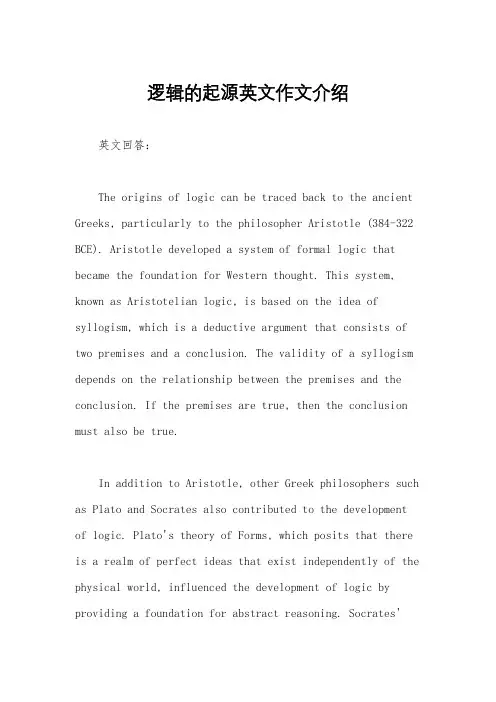
逻辑的起源英文作文介绍英文回答:The origins of logic can be traced back to the ancient Greeks, particularly to the philosopher Aristotle (384-322 BCE). Aristotle developed a system of formal logic that became the foundation for Western thought. This system, known as Aristotelian logic, is based on the idea of syllogism, which is a deductive argument that consists of two premises and a conclusion. The validity of a syllogism depends on the relationship between the premises and the conclusion. If the premises are true, then the conclusion must also be true.In addition to Aristotle, other Greek philosophers such as Plato and Socrates also contributed to the development of logic. Plato's theory of Forms, which posits that there is a realm of perfect ideas that exist independently of the physical world, influenced the development of logic by providing a foundation for abstract reasoning. Socrates'method of questioning, known as the Socratic method, also played a role in the development of logic by encouraging critical thinking and the search for truth.The development of logic continued in the Middle Ages, particularly in the work of Islamic philosophers such as Avicenna (980-1037) and Averroes (1126-1198). These philosophers translated Aristotle's works into Arabic and developed their own commentaries on them. This work helpedto preserve and spread Aristotle's ideas throughout the Islamic world and eventually into Europe.In the Renaissance, the study of logic was revived in Europe, particularly in the work of scholars such as Peter Abelard (1079-1142) and William of Ockham (c. 1285-1349). These scholars developed new logical techniques and applied them to the study of theology and other subjects.The development of logic continued in the modern period, with the work of philosophers such as René Descartes(1596-1650), Gottfried Leibniz (1646-1716), and GeorgeBoole (1815-1864). These philosophers developed new systemsof logic that were more powerful and expressive than Aristotelian logic.In the 20th century, logic underwent a major transformation with the development of mathematical logic. This new field of logic, which is based on the use of mathematical symbols and techniques, has revolutionized the study of logic and has led to the development of newlogical systems that are more powerful and expressive than ever before.中文回答:逻辑的起源。


初三英语哲学思考问题单选题40题1. When we think about the nature of reality, which of the following statements is correct?A. Reality is only what we can see.B. Reality is determined by our thoughts.C. Reality is independent of human perception.D. Reality changes based on our feelings.答案:C。
本题主要考查对现实本质的哲学理解。
选项A 过于局限,现实不仅仅是我们能看到的。
选项B 是主观唯心主义观点,不符合客观事实。
选项C 符合唯物主义观点,现实是独立于人类感知而存在的。
选项D 现实不会仅仅因为我们的感受而改变。
2. What is the essence of philosophy according to the basic concepts?A. The study of history.B. The exploration of science.C. The reflection on fundamental questions of life and existence.D. The analysis of language.答案:C。
哲学的本质是对生命和存在的基本问题进行反思。
选项 A 历史研究并非哲学的本质。
选项 B 科学探索也不是哲学的本质核心。
选项D 语言分析只是哲学的一个方面,而非本质。
3. In the philosophical view, which one is true about truth?A. Truth is relative and changes over time.B. Truth is absolute and never changes.C. Truth depends on personal belief.D. Truth is something that cannot be known.答案:A。