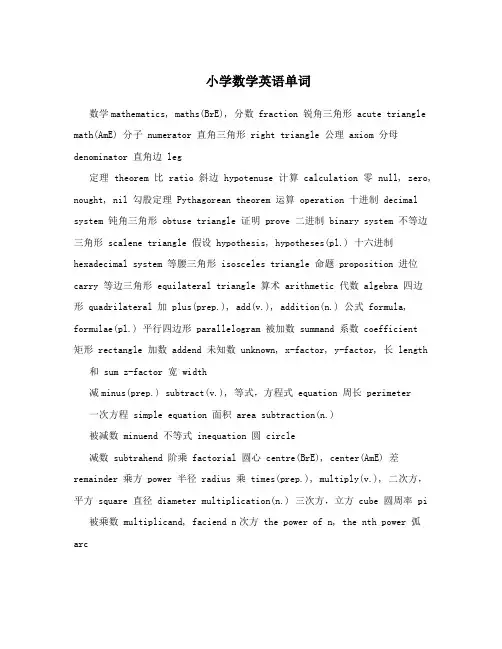
数学常用英语单词
- 格式:docx
- 大小:36.78 KB
- 文档页数:2
数学常用英语单词
Mathematics is a universal language, and its vocabulary
is essential for anyone delving into the subject. From basic
operations like addition and subtraction to more complex
concepts such as algebra and calculus, the right terminology
is key to understanding and communication.
At the core of math is the set of numbers: integers,
fractions, and decimals, which form the foundation for all
calculations. Understanding these basic terms is crucial for
progressing to more advanced topics.
Geometry introduces a new set of vocabulary, such as
angles, triangles, and polygons. These terms help us describe
shapes and their properties, allowing us to solve problems
related to space and form.
Algebra extends our mathematical vocabulary with terms
like variables, equations, and functions. These concepts
allow us to express relationships between numbers and solve
for unknowns in a systematic way.
Calculus, the study of change, introduces terms like
derivatives and integrals. These are used to analyze rates of
change and accumulation of quantities over time, essential
for understanding motion and growth.
Probability and statistics add another layer to our mathematical vocabulary, with terms like mean, median, and
standard deviation. These terms help us summarize and
interpret data, making informed decisions based on numerical
evidence.
Trigonometry, the study of triangles, introduces sine,
cosine, and tangent, which are fundamental in solving
problems involving angles and lengths in right-angled
triangles.
Finally, the vocabulary of set theory, including terms
like union, intersection, and complement, helps us understand
the relationships between different groups of elements, a
fundamental concept in many areas of mathematics.
Mastering these mathematical terms not only enhances
one's ability to solve problems but also opens the door to a
deeper appreciation of the beauty and logic inherent in the
world of numbers.