
5-FAM SE_92557-80-7_DataSheet_MedChemExpress
- 格式:pdf
- 大小:63.45 KB
- 文档页数:1


Endotoxin Removal Solution Catalog Number E4274Product DescriptionEndotoxins are lipopolysaccharides (LPS), a major component of the Gram-negative bacterial cell wall, and are commonly found as contaminants in plasmid DNA preparations from E. coli. Endotoxins are large, negatively charged molecules that co-purify with DNA on ion exchange and size exclusion columns and in CsCl banding. Endotoxins are extremely potent stimulators of the mammalian immune system and are toxic to primary cells and to animals. The endotoxin toxicity is an obstacle to in vitro and in vivo transfection experiments.Non-ionic detergents, traditionally used for separation of integral membrane proteins,1 can be utilized for removal of endotoxins from DNA solutions by phase separation.2The solubility behavior of a detergent in a dilute, aqueous solution at physiological salt and pH conditions is strongly dependent upon the temperature of the solution. At low temperatures, the detergent forms a clear, micellar solution, but above the cloud point temperature, the micelles form larger, turbid aggregates and ultimately fuse to form a separate phase. The lower phase is detergent-enriched and the detergent-depleted upper phase contains detergent at a concentration slightly above the critical micellar concentration (CMC). Amphiphilic and hydrophobic molecules associated with the micelles of the detergent will aggregate within the detergent-enriched phase, while the soluble, hydrophilic molecules will remain in the detergent-depleted upper phase.Extraction of endotoxin contaminated DNA solutions with the appropriate non-ionic detergent will separate the hydrophilic DNA from the amphiphilic endotoxin. The amphiphilic endotoxin will associate with the lower phase, while the DNA will remain in the upper, detergent-depleted phase.2Reagents and equipment required, but not provided • Water, Molecular Biology Reagent, Catalog Number W4502• E-TOXATE® Water, Catalog Number 2107, or Tris-EDTA (TE) buffer 100×, Catalog NumberT9285• DNA solution (0.5 ml), ~ 1 mg/ml in E-TOXATE®Water or TE buffer• 3 M sodium acetate solution, pH 7.5.• 2-Propanol, Catalog Number I9516, or Ethanol, 190 proof, Catalog Number E7148; 200 proof, CatalogNumber E7023• 70% Ethanol• E-TOXATE®reagents Kits, Catalog Numbers 210A1, 210B1 or 210C1• Ice bucket• Heat block or incubator at 37 °C• Microcentrifuge at room temperature• 1.5 or 2 ml sterile microcentrifuge tubes• Endotoxin-free pipet tips (40-200 µl, 200-1000 µl) Precautions and DisclaimerThis product is for R&D use only, not for drug, household, or other uses. Please consult the Material Safety Data Sheet for information regarding hazards and safe handling practices.StorageStore at room temperature.Note: Removal of endotoxins from DNA preparations can be performed either during the final stage of DNApreparation, or during an earlier stage.Procedures for Endotoxin RemovalDuring the final stage of DNA preparationNote: The procedure described below was performed on plasmid DNA produced in E. coli DH5α cells.• Losses of up to 50% of the DNA are expected. • Use of a DNA concentration above therecommended 1 mg/ml reduces the efficiency ofthe procedure.1. Pipette 500 µl of the DNA solution into a sterilemicrocentrifuge tube.2. Add 50 µl of the 3 M sodium acetate solution to theDNA sample.3. Incubate on ice for 5 minutes.4. Add 100 µl of cold Endotoxin Removal Solution.5. Mix thoroughly and incubate on ice for 10 minutes.The solution should be light blue and clear.6. Incubate the tube at 37 °C for 20 to 30 minutes oruntil the phases separate.7. Spin for 5 minutes at 3000 x g in themicrocentrifuge. The upper phase is colorless and clear, while the lower phase is blue.8. Carefully transfer the upper phase containing theDNA to a clean microcentrifuge tube.9. Repeat steps 4 through 8 twice.10. Add 0.6× volume of 2-propanol. Mix by inversion atroom temperature and centrifuge at 15,000 x g for30 minutes at 4 °C. Alternatively, add2.5× volumes of ethanol. Incubate overnight at –20°C or 20 minutes at –70 °C and centrifuge at15,000 x g for 30 minutes at 4 °C.11. Carefully remove the supernatant12. Wash the DNA pellet twice with cold 70% ethanol.Remove the supernatant.13. Air-dry the pellet.14. Suspend the DNA in 100 µl of endotoxin free wateror TE buffer.15. Determine DNA concentration and endotoxin levelsusing endotoxin assay reagents and compare tothe starting material. During an earlier stage of DNA preparationThis procedure is based on the alkaline lysis of E. coli DH5α cells.3 The endotoxins are removed immediately after alkaline cell lysis, neutralization, and a clarification step. The resulting high salt solution is suitable for the endotoxin removal step. It is performed under “endotoxin free” conditions. The plasticware used is either sterile and disposable, or NaOH-treated. The buffers are prepared with endotoxin free water.1. Add the Endotoxin Removal Solution (0.2× volume)to the cold, crude DNA solution.2. Incubate on ice and mix occasionally by inversionto obtain a homogenous, clear blue solution3. Incubate at 37 °C for 20 to 30 minutes until thephase separation is obvious.4. Spin for 5 minutes at low speed (3000 x g) at roomtemperature.5. Transfer the upper aqueous phase to an endotoxinfree container.6. Proceed with the DNA purification by any method.Use endotoxin-free buffers and containers. References1. Bordier, C., J. Biol. Chem., 256, 1604-1607, (1981).2. Cotten, M. et al., Gene Therapy, 1, 239-246,(1994).3. Sambrook et al., Molecular Cloning, a LaboratoryManual, 2nd Ed. p. 1.38RK,PHC 09/05-1Sigma brand products are sold through Sigma-Aldrich, Inc.Sigma-Aldrich, Inc. warrants that its products conform to the information contained in this and other Sigma-Aldrich publications. Purchaser must determine the suitability of the product(s) for their particular use. Additional terms and conditions may apply. Please see reverse side ofthe invoice or packing slip.。

Product Information MINIMUM ESSENTIAL MEDIUM EAGLED-VALINE MODIFICATIONProduct Number M7395Storage Temperature 2-8°CProduct DescriptionMinimum Essential Medium (MEM), developed by Harry Eagle, is one of the most widely used of all synthetic cell culture media. Early attempts to cultivate normal mammalian fibroblasts and certain subtypes of HeLa cells revealed that they had specific nutritional requirements that could not be met by Eagle’s Basal Medium (BME). Subsequent studies using these and other cells in culture indicated that additions to BME could be made to aid growth of a wider variety of fastidious cells. MEM, which incorporates these modifications, includes higher concentrations of amino acids. MEM has been used for cultivation of a wide variety of cells grown in monolayers. Optional supplementation of non-essential amino acids to the formulations that incorporate either Hanks’ or Earle’s salts has broadened the usefulness of this medium. The formulation has been further modified by optional elimination of calcium to permit growth of cells in suspension culture.MINIMUM ESSENTIAL MEDIUM EAGLE, Product No. M 7395 is one of the cell culture media available from Sigma. The selection of a nutrient medium is strongly influenced by 1] type of cell, 2] type of culture [monolayer, suspension, clonal] and 3] degree of chemical definition necessary. It is important to review the literature for recommendations concerning medium, supplementation and physiological parameters required for a specific cell line.Components g/L Calcium Chloride•2H2O0.265 Magnesium Sulfate (anhydrous)0.09767 Potassium Chloride0.4 Sodium Chloride 6.8 Sodium Phosphate Monobasic0.122 (anhydrous)L-Arginine•HCl0.126L-Cystine•2HCl0.0313 L-Glutamine0.292L-Histidine•HCl•H2O0.042L-Isoleucine0.052L-Leucine0.052L-Lysine•HCl0.0725 L-Methionine0.015L-Phenylalanine0.032L-Threonine0.048L-Tryptophan0.01L-Tyrosine•2Na•2H2O0.0519D-Valine0.092 Choline Chloride0.001Folic Acid0.001myo-Inositol0.002 Niacinamide0.001D-Pantothenic Acid (hemicalcium)0.001 Pyridoxal•HCl0.001 Riboflavin0.0001 Thiamine•HCl0.001 Glucose 1.0 Phenol Red•Na0.011Precautions and DisclaimerREAGENTFor In Vitro Diagnostic UsePreparation InstructionsPowdered media are extremely hygroscopic and should be protected from atmospheric moisture. The entire contents of each package should be used immediately after opening. Preparing a concentrated solution of medium is not recommended as precipitates may form. Supplements can be added prior to filtration or introduced aseptically to sterile medium. The nature of the supplement may affect storage conditions and shelf life of the medium.1.Measure out 90% of final required volume ofwater. Water temperature should be 15-20°C.2.While gently stirring the water, add thepowdered medium. Stir until dissolved. Do NOTheat.3.Rinse original package with a small amount ofwater to remove all traces of powder. Add tosolution in step 2.4.To the solution in step 3, add 2.2 g sodiumbicarbonate or 29.3 ml of sodium bicarbonatesolution [7.5%w/v] for each liter of final volumeof medium being prepared. Stir until dissolved.5.While stirring, adjust the pH of the medium to0.1-0.3 pH units below the desired pH since itmay rise during filtration. The use of 1N HCl or1N NaOH is recommended.6.Add additional water to bring the solution tofinal volume.7.Sterilize immediately by filtration using amembrane with a porosity of 0.22 microns.8.Aseptically dispense medium into sterilecontainer.Storage/StabilityStore the dry powdered medium at 2-8°C under dry conditions and liquid medium at 2-8°C in the dark. Deterioration of the powdered medium may be recognized by any or all of the following: [1] color change, [2] granulation/clumping, [3] insolubility. Deterioration of the liquid medium may be recognized by any or all of the following: [1] pH change, [2] precipitate or particulate matter throughout the solution, [3] cloudy appearance [4] color change. The nature of supplements added may affect storage conditions and shelf life of the medium. Product label bears expiration date.ProcedureWater for tissue culture use [W-3500]Sodium Bicarbonate [S-5761] orSodium Bicarbonate Solution, 7.5% [S-8761]1N Hydrochloric Acid [H-9892]1N Sodium Hydroxide [S-2770]Medium additives as requiredProduct ProfileAppearance off-white powder Moisture content 2.0% Solubility clear solution at 1x concentrationpH at room temperature 5.8 ± 0.3 [without sodium bicarbonate]pH at room temperature 7.5 ± 0.3 [with sodium bicarbonate]Osmolality250 mOsm/kg H2O ± 5% [without sodium bicarbonate]Osmolality290 mOsm/kg H2O ± 5% [with sodium bicarbonate]Amino Acid Analysis Analysis has confirmedby HPLC that amino acids are present atconcentrations consistent withthe formula.Key Element Analysis Analysis has confirmed that by ICAP key elements are present atconcentrations consistent withthe formula.BIOLOGICAL PERFORMANCE CHARACTERISTICS Biological performance is assessed using an appropriate cell line(s). Growth studies are carried through 2 subculture generations. Cells are counted and growth is plotted as a logarithmic function of time in culture. Seeding efficiencies, doubling time, and final cell densities are determined. During the testing period cultures are examined microscopically for atypical morphology and evidence of cytotoxicity. Test results are available upon request.References1.Eagle, H. et al (1956) myo-Inositol as anEssential Growth Factor for Normal andMalignant Human Cells in Tissue Culture.J.Biol. Chem. 214, 845-847.2.Eagle, H.(1976) Media for Animal Cell Culture.Tissue Culture Association Manual. 3, 517-520.3.Eagle, H. (1959). Amino Acid Metabolism inMammalian Cell Cultures. Science. 130, 432-437.4.Eagle, H. (1955) Nutrition Needs of MammalianCells in Culture. Science. 122, 501.5.Gilbert, S.F. and Migeon, B.R. (1975) D-valineas a selective agent for normal human androdent epithelial cells in culture. Cell. 5, 11-17.7H027Sigma brand products are sold through Sigma-Aldrich, Inc.Sigma-Aldrich, Inc. warrants that its products conform to the information contained in this and other Sigma-Aldrich publications. Purchaser must determine the suitability of the product(s) for their particular use. Additional terms and conditions may apply. Please see reverse side ofthe invoice or packing slip.。

北京聚合美生物科技有限公司 Mei5 Biotechnology, Co., Ltd
北京市昌平区回龙观龙域北街10号院1号楼四层422-1室(创集合大楼) 热线电话:(86)************
M5 鲑鱼精DNA 10mg/ml 使用说明书
产品名称 单位 货号 M5 鲑鱼精DNA 10mg/ml 1 ml MF475-01 M5 鲑鱼精DNA 10mg/ml 5x1 ml MF475-05
【储存条件】
-20℃保存,有效期2年。
【产品简介】
鲑鱼精DNA 溶液(10mg/ml )是经过酚氯仿抽提,超声和热变性处理的短片段的单链DNA 溶液,可直接用于Southern 、Northern 等核酸杂交中。
【操作步骤】
本产品鲑鱼精DNA 的浓度为10mg/ml ,使用时按实验具体要求操作,稀释至所需工作浓度即可。
【注意事项】
1. 如果每次的使用量很小,可以适当分装后再使用,避免反复冻融。
2. 为了您的安全和健康,请穿实验服并戴手套操作。
【备注】
本产品仅供科研使用。
在确认产品质量出现问题时,本公司承诺为客户免费更换等量的质量合格产品。
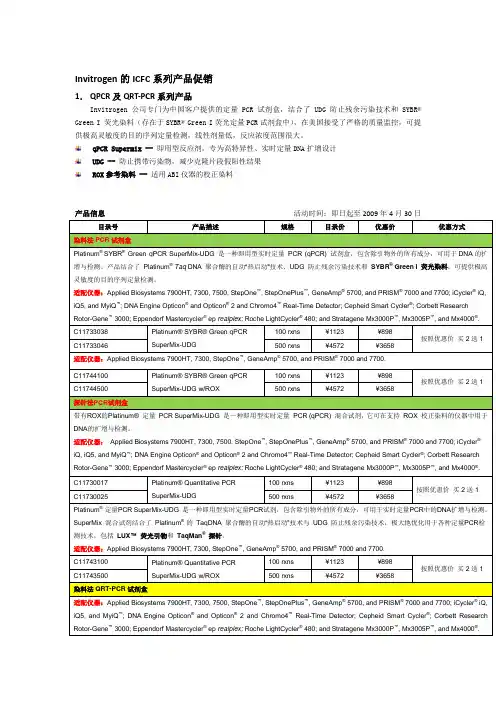
Invitrogen的ICFC系列产品促销1.QPCR及QRT-PCR系列产品Invitrogen公司专门为中国客户提供的定量PCR试剂盒,结合了 UDG 防止残余污染技术和SYBR® Green I 荧光染料(存在于SYBR® Green I荧光定量PCR试剂盒中),在美国接受了严格的质量监控,可提供极高灵敏度的目的序列定量检测,线性剂量低,反应浓度范围很大。
qPCR Supermix-- 即用型反应剂,专为高特异性、实时定量DNA扩增设计UDG-- 防止携带污染物,减少克隆片段假阳性结果ROX参考染料-- 适用ABI仪器的校正染料产品信息活动时间:即日起至2009年4月30日2.Gibco南美胎牛血清即日起凡优惠价¥1780购买Gibco胎牛血清500ml(目录号:C2027050)即可获赠送价值¥250现金抵用券。
您可以凭现金抵用券在英韦创津公司购买任何商品,此券有效期至2009年5月31日。
产品信息活动时间:即日起至2009年4月30日独特的采集方式:GIBCO采用无菌心脏穿刺的方式采血原装直送,避免污染:原产地采集、加工、检测、包装。
完善的质控:采集、处理、检测、运输等环节都有文件和证书。
3.Invitrogen TA Cloning克隆产品专门用于克隆Taq聚合酶扩增的PCR产物。
采用pCR载体,能产生80%以上的重组产物,90%以上重组产物都包含插入片段。
产品信息活动时间:即日起至2009年5月31日附:pCR载体优点及图谱:3’-T突出端可直接连接Taq扩增的PCR产物可选择T7或T7和Sp6启动子进行体外RNA转录和测序侧向EcoRⅠ位点的通用多接头位点方便了插入片段的切离可以选择卡那霉素或氨苄青霉素进行筛选非常简便的蓝/白克隆筛选具有M13正向和反向引物位点,方便测序4.GIBCO液体培养基系列产品创立近50年的历史,品质优秀,产品种类丰富;为了中国用户利益,特建立国内生产线;所有产品,从原材料到生产全部按照GIBCO质量标准进行,每批均送抵美国公司总部质检合格后,才在国内销售。