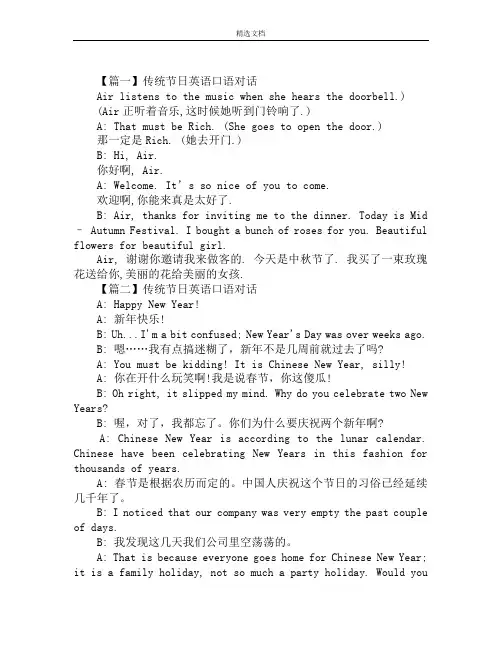
关于传统节日的英语口语
- 格式:doc
- 大小:15.78 KB
- 文档页数:4
关于传统节日的英语口语
Talking about Traditional Festivals.
Festivals: A Window to Our Cultural Heritage.
Festivals are the vibrant tapestry of our cultural
heritage, rich in color, texture, and meaning. They are not
just days marked on the calendar but are celebrations of
our shared values, traditions, and beliefs. From the deep
roots of ancient customs to the blooming flowers of modern
celebrations, festivals are a continuous thread that binds
us together.
The Rhythm of the Seasons.
Many traditional festivals are tied to the natural
cycle of the year, marking significant changes in the
seasons. The Spring Festival, for instance, in many
cultures, symbolizes the renewal of life and the beginning
of a new cycle. It's a time for family reunions, feasting, and the exchange of gifts. In some cultures, the Spring
Festival also marks the end of winter and the coming of
warmer weather, a time for planting and new beginnings.
The Harvest Festival, on the other hand, is a
celebration of the bounty of the year's crop. It's a time
to give thanks for the fruits of labor and to share the
harvest with the community. This festival often involves
feasting, dancing, and singing, symbolizing the joy and
fulfillment that come from hard work.
Cultural Expressions.
Festivals are also a platform for cultural expression.
They are a showcase for traditions, arts, and crafts.
During festivals, people often wear traditional clothing,
decorate their homes with symbols of good luck and
prosperity, and engage in specific activities like dragon
dance, lion dance, or fireworks displays. These activities
not only entertain but also educate, passing down cultural
knowledge and values from generation to generation.
Social Bonding.
Beyond cultural expression, festivals are also a time
for social bonding. They are occasions for families and
communities to come together, to share meals, stories, and
laughter. In many cultures, the festival is the most
important social event of the year, providing an
opportunity for people to connect and reconnect with their
roots and their community.
Modern Interpretations.
While the core values and traditions of traditional
festivals remain unchanged, their celebration often evolves
with time. Modern interpretations blend traditional
elements with contemporary practices, making the festivals
relevant and appealing to younger generations. For instance,
some festivals now include concerts, cultural exhibitions,
or even parades, attracting a wider audience and keeping
the tradition alive.
The Global Stage.
With the increasing globalization of culture,
traditional festivals are also becoming more visible on the
global stage. People from different cultures celebrate each
other's festivals, learning about different traditions and
sharing their own. This exchange not only enriches the
festival experience but also promotes cultural
understanding and respect.
In conclusion, traditional festivals are not just about
food, gifts, or entertainment. They are about connecting
with our past, understanding our culture, and building
stronger communities. They are a bridge between the old and
the new, the familiar and the foreign, the local and the
global. As we celebrate these festivals, we not only honor
our ancestors but also shape the future of our cultural
heritage.