din913
- 格式:docx
- 大小:10.86 KB
- 文档页数:2
DIN913
1. Introduction
DIN 913 is a standard for metric flat point set screws. Set screws are typically
used to secure an object into place by exerting pressure against a surface. DIN 913
specifies the dimensions, tolerances, and requirements for flat point set screws in
various sizes. This document provides an overview of the DIN 913 standard and its
key features.
2. Scope
The scope of DIN 913 covers flat point set screws with various thread sizes,
lengths, and materials. These set screws are designed to be used in applications
requiring a flush surface without any protrusions. They are commonly used in
machinery, automotive, and engineering industries.
3. Dimensions and Tolerances
3.1 Thread Size
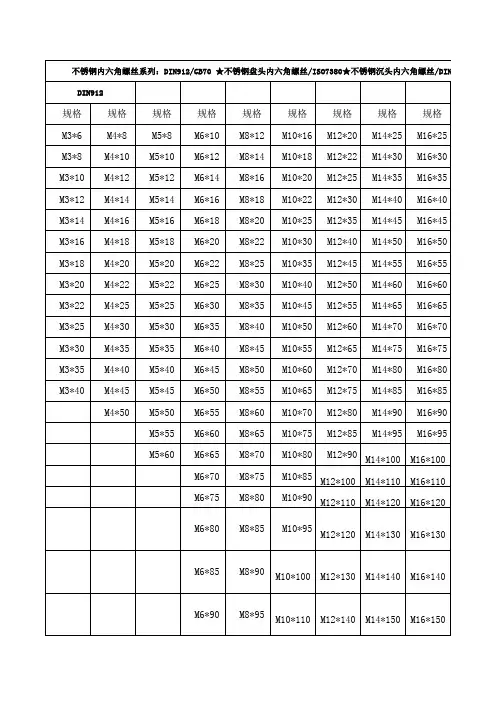
DIN 913 specifies a range of thread sizes for flat point set screws, including M1.6,
M2.5, M3, M4, M5, M6, M8, M10, M12, M16, M20, and M24. The thread size
determines the compatibility of the set screw with the corresponding threaded hole.
3.2 Length
The length of the flat point set screw is measured from the bottom of the flat
point to the end of the screw. DIN 913 provides standard lengths ranging from 6mm
to 60mm, with increments of 1mm. The appropriate length should be selected based
on the specific application and requirements.
3.3 Material
DIN 913 set screws can be manufactured from various materials such as
stainless steel, carbon steel, and alloy steel. The choice of material depends on
factors such as the application environment, required strength, and corrosion
resistance.
3.4 Tolerances
The tolerances for DIN 913 set screws are specified in accordance with DIN ISO
965-1 and DIN ISO 965-2 standards. These tolerances ensure the interchangeability
and compatibility of set screws with corresponding components. 4. Requirements
4.1 Strength
DIN 913 requires set screws to meet certain strength requirements in order to
ensure reliable and secure fastening. The strength of set screws is determined by
factors such as the material used, thread size, and length.
4.2 Flat Point
The flat point of the set screw is a critical feature as it ensures a flush contact
against a surface without any protrusions. DIN 913 specifies the dimensions and
tolerances for the flat point to ensure proper fit and performance.
4.3 Surface Finish
The surface of DIN 913 set screws must be smooth and free from any defects
that could affect their performance. The standard specifies the acceptable surface
finish requirements to ensure the desired functionality and appearance.
5. Marking and Packaging
DIN 913 set screws should be marked with relevant information such as the
manufacturer’s name or logo, thread size, material grade, and other pertinent
details. This marking helps in identification and traceability. The set screws are
typically packaged in boxes or bags with appropriate labeling for easy storage and
handling.
6. Conclusion
The DIN 913 standard provides essential guidelines for the manufacturing and
use of metric flat point set screws. By defining the dimensions, tolerances, and
requirements, DIN 913 ensures the consistent quality and compatibility of these set
screws across different applications and industries. Adhering to this standard helps
to guarantee the desired performance and safety of the fastening solution.