
B2U4
- 格式:pptx
- 大小:424.03 KB
- 文档页数:31
Unit 4The Virtual World一、授课时间:秋季学期二、授课班级:非英语专业本科生三、授课内容:新编大学英语综合教程2 第4单元四、课程类型:阅读课五、教学目的:1理解课文的主题,掌握其写作结构2 掌握课文中出现的语言点和语法现象3 通过与课文主题相关的一系列的听、说、读、写活动,提高学生的英语综合能力。
八、教学重点:课文的理解和语言点的掌握和应用。
九、教学方法:最大限度利用网络教学资源,展开以学生参与为主的课堂教学活动,并通过督促检查等手段使学生课下继续学习。
十、主要参考书目:季佩英,吴晓真,2001,《全新版大学英语综合教程2-教师用书》上海:上海外语教育出版社柯彦玢,张砚秋,2002,《全新版大学英语阅读教程2-教师用书》上海:上海外语教育出版社朱万忠,2002,《大学英语阅读进阶2》重庆:重庆大学出版社Unit 4 The Virtual WorldObjectives:1) Understand the main idea and structure of the text.2) Learn some rules of interpreting new vocabulary and usage related to computers and the Internet in English.3) Grasp the key language points and grammatical structures in the text.4) Conduct a series of reading, speaking and writing activities related to the theme of the unit. Time Allocation and Course Arrangement:Pre-reading Tasks: (50 minutes)1. Warming-up exercise: Deliver handout about the introduction of Internet and ask concerned questions for Ss to discuss first and then answer them. (15’)2. Do the pre-reading task on pp.100. (10’)3. Listen to the recording twice and then discuss the following questions with your partner. (15’)1) Is the hero a student or an employee?2) What was he doing when the boss came in?3) How did he act in front of his boss?4. Ask Ss to find antonyms of “virtual world” and “virtual life” in the text. (10’)While-reading Tasks: (40 minutes)1. Ss are asked to skim the text and then do the Text Organization Exercise on page 107. (15’)2. Detail ed Reading: Ss discuss the following questions and report to the class (30’)1) Question for Paragraph 1What does the author feel after too long on the Net?2) Questions for Paragraph 2-3What did the author do three years ago and what is she doing now?How does the author manage her daily life?3) Questions for Paragraph 4-10What are the symptoms shared by people who live a virtual life?How does the author behave when she is suddenly confronted with real live humans?How does the author behave on line? Why?4) Questions for Paragraph 11-12What does the author do in order to return to the real world?Does she feel happy doing so?5) Question for paragraph 13When dissatisfied with the real world, what does the author do?Homework:1. Deliver handouts about language points and ask Ss to review them after class.2. Finish exercises of unit 1.3. Finish reading Text B.4. Ss prepare for follow-up discussion: The pros and cons of InternetAfter-reading Tasks: (90 minutes)1. Group discussion on the pros and cons of Internet. (30’)2. The presentation of each group. (20’)3. Check on Ss’ homework. (20’)4. Test of Unit 3. (10’)II. Language Study1. virtual: 1) created and existing only in a computerExamples: I can visit a virtual store and put what I want in my basket at the click of a mouse button.Some people spend too much time escaping from reality into the virtual worldconjured up on their computer screens.2) being or acting as what is described, but not accepted as such in name or officially Examples: Our deputy manager is the virtual head of the business.Now that the talks have broken down, war in the region looks like a virtual certainty.2. interpret: 1) understand (sth. said, ordered, or done)Examples: They are worried that the students might interpret the new regulation as a restriction of their rights.She interprets the dream as an unconscious desire to be young again.2) give or provide the meaning of, explainExamples: How do you interpret his refusal to see us?This dream can be interpreted in several different ways.3) translate what is said in one language into anotherExamples: I am terribly sorry, but I don't understand a word. Could you interpret for me?No one in the tour group spoke Spanish so we had to ask the guide to interpret.3. tone: a particular quality or intonation of the voiceExamples: From the tone of her voice I could tell she was very angry.Suddenly he laughed again, but this time with a cold, sharp tone.4. stretch: (cause to) become longer, wider, etc. without breakingExamples: My working day stretches from seven in the morning to eight at night.The child stretched the rubber band to its full extent.5. submit: give (sth.) to sb. so that it may be formally considered (followed by to)Examples: You should submit your reports to the committee.I am going to submit an application for that job in Microsoft.Peter submitted his plans for the new town square to the local government.6. edit: revise or correctExamples: Jack is busy editing Shakespeare's plays for use in schools.John didn't finish editing the annual report until the end of last month.7. email: electronic mailExamples: Young people like to keep in touch with their friends via email.I received an email from my student yesterday.vt. send an email toExamples: I will email you the instant I get the news.She'll email me a question before she calls so I can think it over in advance.8. communicate: contact sb. in any way, esp. by speaking to them, writing to them or callingthem (followed by with)Examples: Some young people depend heavily on email to communicate with each other.They have been divorced for years and never communicated with each other.9. the Internet: the worldwide network of computer links which allows computer users to connectwith computers all over the world, and which carries electronic mail Examples: Whether we like it or not, the Internet is an ever-growing part of our lives.You can take online courses and earn your degree via the Internet whenever andwherever you want to.It's believed the Internet was born in 1969 when two computers at the Universityof California, Los Angles were connected by a 15 foot cable.10. relationship: state of being connectedExamples: What is the relationship between language and thought?The scientist had a good working relationship with his American colleagues. 11. at times: sometimesExamples: She has been away from her home for about a year. At times she wishes she hadnever left.He went on listening to her, at times impatient and at times fascinated.12. take in: absorb (sth.) into the body by breathing or swallowingExamples: The earth takes in heat and light from the sun.Fish take in oxygen through their gills.13. data: information, usu. in the form of facts or statistics that you can analyzeExamples: This data is stored on the network and can be accessed by anybody.The data is still being analyzed, so I can't tell you the results.14. spit: send (liquid, food, etc.) out from the mouth (used in the pattern: spit sth. (out) (at/on/ontosb./sth.))Examples: The baby spat its food out on the table.He took one sip of the wine and spat it out.15. on line: connected to or controlled by a computer (network)Examples: Our system is on line to the main computer.The largest online institution is the University of Phoenix, with some 1000 studentstoday and hopes of reaching 200,000 students in 10 years.16. symptom: 1) sign of the existence of sth. badExamples: High interest rates are a symptom of a weak economy.They regard the increase in crime as a symptom of a more general decline in moralstandards.2) change in the body that indicates an illnessExamples: A cold, fever and headache are the usual symptoms of flu.If the symptoms persist, it is important to go to your doctor.17. nightmare: a terrifying dreamExamples: Tom didn't eat fish because it gives him nightmares.Watching horror films gives me nightmares.I had a nightmare about falling off the skyscraper.18. conversely: in a way that is opposite to sth.Examples: $1 will buy 100 yen worth of Japanese goods. Conversely, 100 yen will buy $1 worth of American goods.You can add the fluid to the powder or, conversely, the powder to the fluid.19. but then: yet at the same timeExamples: The failure of China's soccer team looks inevitable. But then, anything can happen in football.Mary performed better than the others in the final exam; but then, she spent muchlonger on it than they did.20. jar: have a harsh or an unpleasant effect (used in the pattern: jar sth., jar on sb./sth.)Examples: You shouldn't have too many colors in a small space as the effect can jar.The loud bang jarred my nerves.Her squeaky voice jarred on me.21. suck in: (usu. passive) involve (sb.) in an activity, an argument, etc., usu. against their will(used in the pattern: suck sb. in/into sth.; suck in )Examples: I don't want to get sucked into the debate about school reform.Some teenagers don't want to get involved with gangs, but they find themselvesgetting sucked in.22. keep up with: learn about or be aware of (the news, etc.)Examples: Carrie likes to keep up with the latest fashions.He didn't bother to keep up with the news. His only concern was to study.23. Work moves into the background: Work becomes secondary to me.24. in sight: 1)visibleExamples: It was early in the morning and there wasn't anyone in sight on campus.As the train pulled into the station my parents standing on the platform were soonin sight.2) likely to come soonExamples: Two months passed, and victory was not yet in sight. ,The end of the economic nightmare is still nowhere in sight.A solution to the problem of environmental pollution now seems in sight.25. remark: thing said or written as a commentExamples: The principal of the school made some remarks about educational reform at the meeting.Mr. Smith approached us and made a couple of remarks about the weather.His rude remark about my book jarred on me.26. emotional: 1) of the emotionsExamples: She is grateful to him for his emotional support while she was in trouble.It's quite difficult to handle emotional problems.2) having emotions that are easily excitedExamples: Marie got very emotional when we parted, and started to cry.It's said that the Italians are more emotional than we are.27. cue: anything that serves as a signal about what to do or say (followed by to/for)Examples: When he started to talk about the finances, that was our cue to get up quietly and leave.When I nod my head, that's your cue to give flowers to him.Mr. Clinton's excitement was the cue for a campaign.28. I say a line: I type a line on the screen.29. routine: a fixed and regular way of doing things (often adjectival)Examples: The job is really just a dull series of fairly routine tasks. I don't think you'll take it.He established a new routine after retirement.30. rely on/upon: depend confidently on, put trust inExamples: Nowadays we rely increasingly on computers to control the flow of traffic.Some children relied heavily on the advice of their parents.31. abuse: wrong or bad use or treatment of sth./sb.Examples: The World Health Organization (WHO) has published a report on drug abuse and addiction.The policemen are making an investigation of child abuse.32. restore: bring back to a former condition (used in the pattern: restore sth.; restore sb. to sth.)Examples: Law and order will be quickly restored after the incident.Winning three games restored their confidence.Doing sports every day restored the old man to good health.The deposed king was restored to power.33. arrange: prepare or plan (used in the pattern: arrange sth.; arrange to do sth.; arrange for sb./sth. to do sth.)Example: Her marriage was arranged by her parents.Let% arrange to have a dinner together some time before we graduate.I have arranged for a taxi to pick us up at 8:00 a.m.I could arrange for you to come along with us if you like.34. flee: run away (from) (used in the pattern: flee from/to; flee someplace)Examples: The customers fled from the bank when the alarm sounded.During the war, thousands upon thousands of Afghans fled the country.Up to five million political refugees have fled to other countries.35. interview: 1) a meeting at which a journalist asks sb. questions in order to find out their newsExamples: In an exclusive interview with our reporter, the film star revealed some of his personal affairs.Radio interviews are generally more relaxed than television ones.2) a formal meeting at which sb. applying for a job is asked questions, as a way ofjudging how suitable they areExamples: I have been asked to go for an interview for a project I applied for at Harvard University.She has had a couple of job interviews, but no offers.v.Examples: As a journalist, he interviewed many government officials.After the press conference, the journalist interviewed the UN Secretary Generalabout the Israeli-Palestinian conflict.I will be interviewed next week for the Chief Executive's job.36. appointment: an arrangement to meet or visit sb. at a particular time (followed by with)Examples: You can't see the president of the university unless you make an appointment.I've made an appointment to see my tutor tomorrow.37. click: press or release a mouse button rapidly, as to select an icon (followed by on)Example: When shopping online, you just click the mouse and order what you want to buy.38. tune: a series of musical notes that is pleasant and easy to rememberExamples: She whistled a happy tune all the way home.He was humming a merry tune while cooking.. Homework:1.Recite the words and phrases of this unit.2.Finish doing the exercises.3.Preview Unit 5。
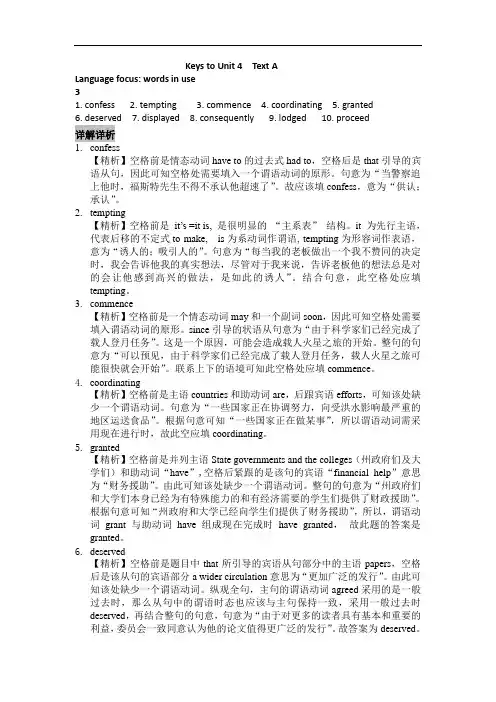
Keys to Unit 4 Text ALanguage focus: words in use31. confess2. tempting3. commence4. coordinating5. granted6. deserved7. displayed8. consequently9. lodged 10. proceed详解详析1.confess【精析】空格前是情态动词have to的过去式had to,空格后是that引导的宾语从句,因此可知空格处需要填入一个谓语动词的原形。
句意为“当警察追上他时,福斯特先生不得不承认他超速了”。
故应该填confess,意为“供认;承认”。
2.tempting【精析】空格前是it’s =it is,是很明显的“主系表”结构。
it为先行主语,代表后移的不定式to make, is为系动词作谓语, tempting为形容词作表语,意为“诱人的;吸引人的”。
句意为“每当我的老板做出一个我不赞同的决定时,我会告诉他我的真实想法,尽管对于我来说,告诉老板他的想法总是对的会让他感到高兴的做法,是如此的诱人”。
结合句意,此空格处应填tempting。
3.c ommence【精析】空格前是一个情态动词m ay和一个副词soon,因此可知空格处需要填入谓语动词的原形。
since引导的状语从句意为“由于科学家们已经完成了载人登月任务”。
这是一个原因,可能会造成载人火星之旅的开始。
整句的句意为“可以预见,由于科学家们已经完成了载人登月任务,载人火星之旅可能很快就会开始”。
联系上下的语境可知此空格处应填commence。
4.coordinating【精析】空格前是主语countries和助动词are,后跟宾语efforts,可知该处缺少一个谓语动词。
句意为“一些国家正在协调努力,向受洪水影响最严重的地区运送食品”。
根据句意可知“一些国家正在做某事”,所以谓语动词需采用现在进行时,故此空应填coordinating。

Book 1 Unit 1 Wildlife ProtectionPeriod One: Warming up and speakingⅠ. Instructional objectives:1. Get to know some basic information about the endangered animals and wildlife situation and protection.2. Think and express their attitude towards the wildlife and the wildlife protection..Ⅱ. Teaching important & difficult points:let students master the pronunciation of the new words and phrases.2.To let students grasp the structure of the text.Ⅲ. Teaching methods:1. Task-based teaching2. BrainstormingⅣ. Teaching resources:1. The textbook2. MultimediaⅤ. Teaching procedures:Step1. Leading-in1. Show some pictures of some endangered animals and let the students name them. (polar bear, milu deer, rhino, tiger, crocodile, leopard, koala, pan da, dolphin, giraffe…)Questions: (1). Do you often see these animals?(2). What problems are some animals facing nowadays? Why?Wild plants and animals have to look after themselves. They need food, a good environment and safety. If their habitat is threatened or they cannot find enough food, their numbers may decrease. As a result, these endangered animals may even die out. They need help. This is what wildlife protection is all about. Step 2. Warming UpCooperative learning. Discuss the questions with the partners.1. Why are the animals in danger?(1). Don’t have enough food;(2). Being hunted and killed;(3). The bad environment;2. What measures should be taken to protect the endangered animals?(1) Treat the animals as our friends;(2) We s houldn’t kill them.(3) We should protect the environment around us.(4) We should collect money to protect animals.)Step 3.What should we do to protect the wildlife?1. Protect the environment.2. Help animals return to nature.3. Reduce hunting, and treat them as our friends4. Never buy endangered animals’ products and tell your friends no to do so too!5. Laws should be passed to prevent people from killing or hunting them.6. The governments should educate people to love nature and protect itⅥ. Summary and assignment:1. Protecting wildlife is protecting ourselves!2. Animals are our friends.3. No animals, no human beings!VII. Design on the blackboard:VIII. Reflection:Period Two :ReadingⅠ. Instructional objectives:1. To learn about the importance of protecting wildlife2. To know about some endangered wildlifeⅡ. Teaching important & difficult points:1.Talk about the ways to protect wildlife.2.Review the Present Progressive Passive V oiceⅢ. Teaching methods:1. Task-based teaching2. BrainstormingⅣ. Teaching resources:1. The textbook2. MultimediaⅤ. Teaching procedures:UpGet the students to talk about some endangered animals to lead them to this unit’s topic.T: Morning, everyone! Look at the screen, please. I will show you pictures of some animals.Show them the pictures of some endangered animals.Step2. Scanning1. What three places has she been to?2. What problems do the animals face?3. What endangered animals are they?Get the students to look through the text. Later ask someone to give the answer.Step3. ConclusionIf their habitat is threatened or they cannot find enough food, their numbers may decrease. As a result these endangered animals may even die out.Step 4.DiscussingHelp the students discuss what they have learned today and encourage them to talk about the importance of wildlife protection.Examples:T: What did we learn today?S: Endangered wildlife.S: What their problems are?S: What have been done to them…?T: Animals are our friends. We live depend on each other. We should protect them. How do you think about this?S: Animals are our friends. It’s a shame that man killed wildlife for their fur. We don’t have the right to kill them.S: I’ll talk with people around me seriously. I’ll tell them that I’m so sorry that so many animals are in danger now. The problem is that if man doesn’t realize the dangerous situation, many of the animals will die out soon. We should try to protect endangere d animals. I’ll collect some information about wildlife protection and shows the information to people around us.Ⅵ. Summary and assignment:information of endangered wildlife, especially Tibetan Antelope, about why they are in danger of disappearing;2. Preview the next part—Reading on page 26.VII. Design on the blackboard:VIII. Reflection:Period Three & Four: Important language pointsⅠ. Instructional objectives:1. Words: endanger, species, habitat, threaten, extinction, unexpected, disappearance, faithfully, etc.2. Expressions: die out, in peace, in danger of, protect... from, pay attention to, come into being, no longer, in relief, burst into laughter, according to, so that.3. Sentence structures: Our fur is being used to make sweaters for people like you. P26Ⅱ. Teaching important & difficult points:1. Let students learn the usages of the important expressions.2. Get students to understand some difficult and long sentences.Ⅲ. Teaching methods:1. Task-based teaching2. BrainstormingⅣ. Teaching resources:1. The textbook2. MultimediaⅤ. Teaching procedures:Step 1. Warming Upthe Students’ assignment2. DictationStep with language points:1.Daisy had always longed to help endangered species of wildlife. (翻译)戴茜一直都渴望帮助那些濒临灭绝的野生动植物。

新编大学英语(第四版)视听说教程2教学课件B2U4本教学课件旨在介绍《新编大学英语(第四版)视听说教程2教学课件B2U4》课程的背景和目标。
课程名称: 新编大学英语(第四版)视听说教程2教学课件B2U4教材内容: 本课件使用《新编大学英语(第四版)视听说教程2》作为教材基础。
课程内容主要包括听力、口语和阅读三个方面的训练。
背景介绍: 本课程是为具有一定英语基础的大学生设计的。
通过本课程的研究,学生将能够进一步提高听力、口语和阅读能力,培养自主研究和跨文化交流的能力。
课程目标:提高学生对英语听力的理解能力。
增强学生的口语表达能力。
培养学生的阅读理解能力。
培养学生的自主研究和跨文化交流能力。
通过本课程的研究,学生将能够有效扩展词汇量、提高语法运用能力、加强语音和发音训练,并能够运用所学知识进行简单的口头表达和书面表达。
欢迎大家研究《新编大学英语(第四版)视听说教程2教学课件B2U4》,希望能给大家带来愉快和有效的研究体验!第二部分: 教学内容本教学课件主要包括以下内容:课文内容:介绍B2U4单元的主要主题和文化背景,讲解课文中的重点词汇和语法结构,并进行相关的阅读理解练。
听力练:提供与课文内容相关的听力材料,并设计相应的听力练,帮助学生提高听力技能和理解能力。
口语活动:针对课文内容和听力材料进行口语训练,通过问答、角色扮演等活动,激发学生的口语表达能力和交流能力。
教学课件将以简洁明了的方式呈现以上教学内容,帮助学生更好地理解和掌握B2U4单元的相关知识。
本部分将介绍在教授《新编大学英语(第四版)视听说教程2教学课件B2U4》课程时可以采用的教学方法和策略。
以下是几种常用的教学方法:互动式教学:在课堂上鼓励学生积极参与,通过提问、回答问题、小组讨论等方式激发学生的兴趣和参与度。
通过互动式教学,学生更容易理解和掌握课程内容。
小组合作研究:安排学生分成小组,通过小组合作研究来完成课程任务。
这种方法可以培养学生的合作能力和团队精神,同时也能增加学生对课程的深度理解。