
英语教学法教案共71页文档
- 格式:ppt
- 大小:9.10 MB
- 文档页数:71

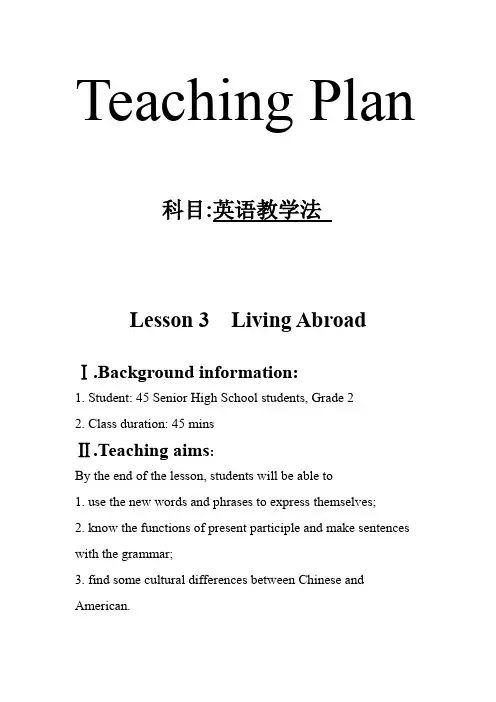
Teaching Plan科目:英语教学法Lesson 3 Living AbroadⅠ.Background information:1. Student:45 Senior High School students, Grade 22. Class duration: 45 minsⅡ.Teaching aims:By the end of the lesson, students will be able to1. use the new words and phrases to express themselves;2. know the functions of present participle and make sentences with the grammar;3. find some cultural differences between Chinese and American.Ⅲ.Teaching contents:1. vocabulary and phrases that help to express cultural differences, such as embarrassed, embarrassing, exchange, host, hospitable, appetite, modest, stare at, have a difficult time doing sth. insist / keep on doing sth. notice / hear / see sb. doing sth.2. functions of present participle:⑴ hear sb. doing sth. (object complement)⑵ an embarrassing experience (attribute)⑵ What he did is amazing. (predicate)⑵ I went back to the room closing the door. (adverbial)3. some cultural differences between Chinese and American in three different situations.Ⅳ.Teaching aids:PPT, pictures, paper.Ⅴ.Teaching procedures:Step 1. Lead- inT: Good morning, everyone!Ss: Good morning, teacher!T: Today we will learn Lesson 3 Living Abroad. First, let us look at two pictures. (Present the pictures.) The American mouse and the Chinese mouse reply differently when they are praised, one in a confident way while the other in a modest way. So we willfind some other cultural differences between American and Chinese through the lesson.Step 2. Learn the new words and phrasesT: Before the text, let us learn the new words. Oh, the first two words are embarrassing. Do not worry! Now, we only need to recognize them. “embarrassed” means feeling shy and stupid, and we say sb. feel embarrassed. “embarrassing” refers to making sb. feel shy and stupid, and we say sth. is embarrassing. The subject is different, and you can compare them with “interested” and “interesting”. Understand?Ss: Yes!T: Ok! Next, the word “change” means “交换”,while “exchange” refers to“交换或交流”. For example, “cultural exchange” means — (Ask students to translate it.)Ss: 文化交流.T: Yes! Then, when foreign friends come to China, we Chinese, as the host or hostess,should be hospitable. (Point at the PPT and say “friendly and generous”.) Appetite---When the host or hostess is hospitable, the guest may feel delighted and have a good appetite (Point at the PPT and say “desire for food”.) Now, the last two words. (Point at the PPT.) Most Chinese are modest. (Point at the PPT and say “talking little about one’s own abilityand achievement) “stare at” means looking at for a long time without moving. Read after me —“embarrassed”.Ss: embarrassed.(Read after me: embarrassing, exchange, host, hospitable, appetite, modest, stare at)T: Do you know how to use the new words in phrases? Let us learn them together. (Next PPT.) No strange words in the phrases, so we start directly. Xxx, the meaning of the first one, please.Student A: 度过一段困难时期T: Yes, sit down please. This phrase is similar to “have difficulty doing sth.” Xxx, the second one, please.Student B:有一次尴尬经历T: Right! Sit down, please. “look embarrassed” means “看起来尴尬”. And what about the fourth one?Ss: 胃口好,有食欲.T: Good! Then, both “insist on” and “keep on” mean “继续”. The last one! “notice / hear / see + sb. + doing sth.” means “注意到/听到/看到+某人+正在做某事”. (Show the sentences.) Xxx, could you translate the sentences into Chinese for us? Student C: 我听见她正在唱歌和我听到过她唱歌。

英语教学法教程教案Teaching PlanⅠ.Background information:●Analysis of the teaching material:This reading material is from Unit10,Section A I’m Going to be a Basketball Player. The topic of the lesson is talking about occupation. This topic is attractive and interesting because it is close to Students’ daily life. But some new words and expressions are difficult for students to understand.●Analysis of the students:The students are in junior high school, Grade 2.They have mastered a basic knowledge of English, but they may be unaware of some new words and expressions . Besides, they may have different ideas of what they are going to be in the future and they are curious about some jobs.Ⅱ. Teaching objectives1.Knowledge objectives:Students can learn some important words and expressions: professional, pilot, programmer, engineer,dream job, grow up, move to, exhibition, resolutions, get good grades, get a part-time job, make more friends2.Ability objectives1)students can understand the words and expression of future intensions2)students can understand the dialogue about future intensions3) students can talk with other students about their future intensions usingthe structure pattern “be going to”3..Affective objectivesEveryone has their own dreams and plans for the future and look forward to the future career. People often talk about their ideas, so this part can stimulate the students' learning initiativeand interest in learning.Ⅲ. Key points and difficult points.1.key point1)vocabulary: professional, pilot, programmer, engineer, exhibition, resolutions……2) sentence pattern: --What are you going to be…--I’m going to be….--How are you going to do……--I’m going to ……2. Difficult point and solutions一般将来时be going to 中be 的具体形式和后面接动词原形的用法学生容易混淆. 学生根据自己喜欢的职业,运用所学知识谈论自己打算怎样做来实现目标则既是难点,又是能力训练点。

英语教学法教程教案英语教学法教程教案A Course in English Language Teaching教材:《英语教学法教程》主编:王蔷出版社:高等教育出版社陇南师范高等专科学校外语系2008年6月22日Introduction1.The name of this course.1)Methodology of English Teaching2)Methodology of English teaching at middle school/secondary school3)Teaching English as a Foreign Language/TEFL & TESL4) English, Teach it Better2.The nature of language teaching1) What's methodology?English teaching methodology is a set of methods used for study or action in English teaching. It is the science to research the Teaching rules at middle school, which will guide our teaching to develop the students' communicative competence.2) The definition of teaching.Teaching is an attempt to help someone acquire, or change some skills, attitude),knowledge, ideal, or appreciation. In other words, the teacher's task is to create or influence desirable changes in behavior, or in tendencies toward behavior, in his students.3) The purpose of English teachinga. To improve their four skills.b. To cultivate their communicative competence.c. To show them the way to study themselves.3.The significance of learning this course.1) Teaching is a highly demanded art.(4 skills & sing, play, draw and make)2) Teacher's qualificationsa. subject matter competenceb. professional competencec. personal attitude.3)The aims of this course.a)to provide you with the rationale of English teaching at middle school, which will be proved necessary and advantageous to the reform of English teaching.b)to help you to clear the importance as well as the aims of English teaching at middle school in present China.c)to provide you with chances to familiarize with the graded contents of the textbooks in the junior section, analysis of the textbook and to learn the syllabus for middle school English.d)to introduce some commonly used techniques and methods adopted in teaching pronunciation, grammar, vocabulary and the cultivation of the students' 4 skills.e)to help you so solve some problems concerning the classroom instruction.f)to make some preparations for the coming teaching practice.4.How to present this course.1) lectures2) readings3) discussions4) watch video demonstrations5) mini-teaching6) practice writing teaching plan and peer teaching.5.The relationship between methodology of English and the other subjects. linguistics, psychology, pedagogy, philosophy, Question:1.What qualifications, in your opinion, should a teacher of English possess?2.Do you think you will perform well in your future teaching? What qualifications have you obtained now? What will you do if you haven't got the required qualifications?3.Who was your admirable teacher of English at junior school?What do you think of him/her?Unit 1 Language and Learning1.Teaching Aims:To discuss some general matters about language learning and teaching, such as common views on language and language learning, qualities of a good language teacher.2.Teaching Content:How do we learn language?Views on languageViews on language learningWhat is good language teacher?How can one become a good language teacher?An overview of the book3. Teaching Hours: 4 periods4. Teaching materials:TextbookHandout5.Teaching Methods:1) Lecture ( Computer-aided Instruction)2)Demonstration6. Teaching Procedures:1) Information about language and language learningThree views about the nature of language: There are many possible theoretical positions about the nature of language. Here are three different views which explicitly or implicitly is reflected in current approaches to language learning.A. The structural view of languageThe structural view of language is that language is a system of structurally related elements for the transmission of meaning.a. These elements are usually described as phonological units (phonemes) grammatical units (phrases, clauses, sentences) grammatical operations (adding, shifting, joining or transforming elements)lexical items (function words and structure words)b. Target of language learningThe target of language learning, in the structural view, is the mastery of elements of this system.c. Methods based on this viewSome of the language learning methods based on this view of language are:the Audiolingual methodTotal Physical Responsethe Silent WayB. The communicative view of languageThe communicative, or functional view of language is the view that language is a vehicle for the expression of functional meaning. The semantic and communicative dimensions of language are more emphasized than the grammatical characteristics, although these are also included.a. Here are some of the areas of research in this view of language: sociolinguistics ; pragmatics ; semanticsb. Target of language learning : The target of language learning is to learn to express communication functions and categories of meaningc. Approaches and methods based on this viewSome of the language learning approaches and methods based on this view of language are: communicative approaches functional-notional syllabusesThe Natural ApproachC. The interactional view of languageThe interactional view of language sees language primarily as the means for establishing and maintaining interpersonal relationships and for performing social transactions between individuals.a. Here are some of the areas of research in this view of language:interactional analysisconversational analysisethnomethodologyb. Target of language learning: The target of language learning in the interactional view is learning to initiate and maintain conversations with other people.c. Approaches and methods based on this viewSome of the language learning approaches and methods based on this view of language are:Strategic interactioncommunicative approaches2) Teaching Methods in the Language Classroom:FL teachers must provide students with adequate teachingmethodology and time, as well as appropriate vocabulary and learning activities that will allow for the development of verbal skills.There is no single "BEST WAY" to teach. The question teachers must address is which methods are best employed during the different stages of the teaching and learning process and then design curriculum to meet their final objectives/goals.a. Grammar Translation:The Grammar Translation method started around the time of Erasmus (1466-1536). Its primary focus is on memorization of verb paradigms, grammar rules, and vocabulary. Application of this knowledge was directed on translation of literary texts--focusing of developing students' appreciation of the target language's literature as well as teaching the language. Activities utilized in today's classrooms include: questions that follow a reading passage; translating literary passages from one language to another; memorizing grammar rules; memorizing native-language equivalents of target language vocabulary. (Highly structured class work with the teacher controlling all activities.)b. Direct Method:The Direct Method was introduced by the German educator Wilhelm Vi?tor in the early 1800's. Focusing on oral language, it requires that all instruction be conducted in the target language with no recourse to translation. Reading and writing are taught from the beginning, although speaking and listening skills are emphasized--grammar is learned inductively. It has a balanced, four-skill emphasis.c. The Silent Way:The teacher is active in setting up classroom situations while the students do most of the talking and interaction amongthemselves. All four skills (listening, speaking, reading & writing) are taught from the beginning. Student errors are expected as a normal part of learning; the teacher's silence helps to foster self-reliance and student initiative.d. Community Language Learning:Teachers recognize that learning can be threatening and by understanding and accepting students' fears, they help their students feel secure and overcome their fears of language learning--ultimately providing students with positive energy directed at language learning. Students choose what they want to learn in the class and the syllabus is learner-generated.e. Natural Approach:Introduced by Gottlieb Henese and Dr. L. Sauveur in Boston around 1866. The Natural Approach is similar to the Direct Method, concentrating on active demonstrations to convey meaning by associating words and phrases with objects and actions. Associations are achieved via mime, paraphrase and the use of manipulatives. Terrell (1977) focused on the principles of meaningful communication, comprehension before production, and indirect error correction. Krashen's (1980) input hypothesis is applied in the Naturale. Reading Method:The reading method was prominent in the U.S. following the Committee of Twelve in 1900 and following the Modern Foreign Language Study in 1928. The earlier method was similar to the traditional Grammar/Translation method and emphasized the transference of linguistic understanding to English. Presently, the reading method focuses more on silent reading for comprehension purposes.f. ASTP and the Audiolingual Method:This approach is based on the behaviorist belief that language learning is theacquisition of a set of correct language habits. The learner repeats patterns and phrases in the language laboratory until able to reproduce them spontaneously. ASTP (Army Specialized Training Program) was an intensive, specialized approach to language instruction used in during the 1940's. In the postwar years, the civilian version of ASTP and the audiolingual method featured memorization of dialogues, pattern drills, and emphasis on pronunciation.g. Cognitive Methods:Cognitive methods of language teaching are based on meaningful acquisition of grammar structures followed by meaningful practice.h. Communicative Methods:The goal of communicative language approaches is to create a realistic context for language acquisition in the classroom. The focus is on functional language usage and the ability to learners to express their own ideas, feelings, attitudes, desires and needs. Open ended questioning and problem-solving activities and exchanges of personal information are utilized as the primary means of communication. Students usually work with authentic materials (authentic realia) in small groups on communication activities, during which they receive practice in negotiating meaning.i. Total Physical Response Method:This approach to second language teaching is based on the belief that listening comprehension should be fully developed before any active oralparticipation from students is expected (just as it is withchildren when theyare learning their native language) .James Ashers' Total Physical Response:Skills in second language acquisition can be more rapidly assimilated if the teacher appeals to the students' kinesthetic-sensory system. Asher believes that understanding of the spoken language must be developed in advance of speaking.Understanding and retention is best achieved through movement (total movement of the student's bodies) in response to command sequences. Asher believes that the imperative form of language is a powerful tool that can be used to guide them to understanding as it manipulates their behavior--many of the gramatical structures of the target language can be learned through the use of the imperative.Never force students to speak before they are ready. Asher believes that as the target language is internalized, speaking will automatically emerge (you must decide, as the teacher, when YOU will encourage your students to participate orally in the classroom).7.Homework:What are difference between learning the first language and a foreign language? What are the qualities of a good language teacher? T o what extent have you got these qualities? What do you think you should do so as to become a good teacher in the future?What are the qualities of good language learner? What do they suggest to language teaching?8.Self-assessment:Because students are not familiar with these theroy on the language and view of thelanguage, it is very difficult to help Ss understand it. So it requires T explain it in details with the help of clare illustration and examples by using vediotapes. To get students read more on linguistics and schools of language methors is also necessary.。

英语教学法教案与讲义模板一、引言1. 课程目标:通过本课程的学习,使学生了解和掌握英语教学的基本方法和技巧,提高英语教学效果。
2. 课程内容:本课程将介绍英语教学法的基本概念、教学技巧、课堂管理、教学评价等方面的内容。
3. 教学方法:采用讲授、讨论、实践相结合的方式进行教学。
二、英语教学法的基本概念1. 直接法(Direct Method)定义:直接法是一种以目标语言作为唯一教学媒介的教学方法,强调听、说、读、写的技能的综合运用。
特点:真实、自然、直观、实践性强。
2. 交际法(Communicative Approach)定义:交际法是一种以语言功能为纲,培养学生在实际语境中运用语言的能力的教学方法。
特点:注重实际应用、强调师生互动、学生主体。
三、教学技巧1. 启发式教学(Heuristic Teaching)定义:启发式教学是一种以学生为中心,引导学生主动探索、发现和解决问题的教学方法。
方法:提问、讨论、案例分析等。
2. 任务型教学(Task-Based Language Teaching)定义:任务型教学是一种以完成实际任务为目标,培养学生综合语言运用能力的方法。
方法:小组讨论、角色扮演、项目研究等。
四、课堂管理方法:尊重学生、关心学生、公平对待学生。
2. 课堂纪律管理3. 小组合作学习方法:合理分组、明确任务、引导学生积极参与。
五、教学评价1. 形成性评价(Formative Assessment)定义:形成性评价是在教学过程中对学生的学习进展和教师的教学效果进行评价的方法。
方法:课堂提问、作业批改、学生反馈等。
2. 终结性评价(Summative Assessment)定义:终结性评价是在教学活动结束后对学生的学习成果和教师的教学效果进行评价的方法。
方法:考试、测验、课程报告等。
六、教学活动的设计1. 热身活动(Warm-up Activities)目的:激发学生的学习兴趣,调动课堂气氛。