高二英语构词法-前缀(1)
- 格式:pdf
- 大小:1017.13 KB
- 文档页数:8
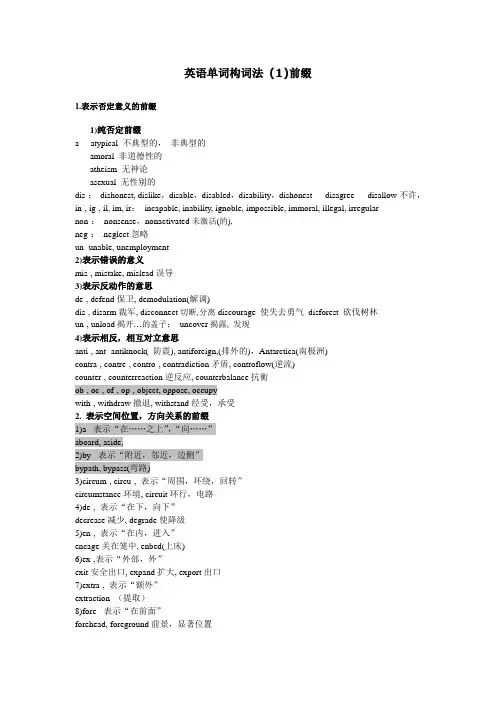
英语单词构词法(1)前缀1.表示否定意义的前缀1)纯否定前缀a- atypical 不典型的,非典型的amoral 非道德性的atheism 无神论asexual 无性别的dis-:dishonest, dislike,disable,disabled,disability,dishonest disagree disallow不许,in-, ig-, il, im, ir:incapable, inability, ignoble, impossible, immoral, illegal, irregularnon-:nonsense,nonactivated未激活(的),neg-:neglect忽略un- unable, unemployment2)表示错误的意义mis-, mistake, mislead误导3)表示反动作的意思de-, defend保卫, demodulation(解调)dis-, disarm裁军, disconnect切断,分离discourage 使失去勇气disforest 砍伐树林un-, unload揭开…的盖子;uncover揭露, 发现4)表示相反,相互对立意思anti-, ant- antiknock( 防震), antiforeign,(排外的),Antarctica(南极洲)contra-, contre-, contro-, contradiction矛盾, controflow(逆流)counter-, counterreaction逆反应, counterbalance抗衡ob-, oc-, of-, op-, object, oppose, occupywith-, withdraw撤退, withstand经受,承受2. 表示空间位置,方向关系的前缀1)a- 表示“在……之上”,“向……”aboard, aside,2)by- 表示“附近,邻近,边侧”bypath, bypass(弯路)3)circum-, circu-, 表示“周围,环绕,回转”circumstance环境, circuit环行,电路4)de-, 表示“在下,向下”decrease减少, degrade使降级5)en-, 表示“在内,进入”encage关在笼中, enbed(上床)6)ex-,表示“外部,外”exit安全出口, expand扩大, export出口7)extra-, 表示“额外”extraction (提取)8)fore- 表示“在前面”forehead, foreground前景,显著位置9)in-, il-, im-, ir-, 表示“向内,在内,背于”inland内地的, invade侵略, inside, import进口10)inter-, intel-, 表示“在……间,相互”international国际的, interaction配合, internet因特网12) mid-, 表示“中,中间”midday,midnight ,midposition中点13)out-, 表示“在上面,在外部,在外”outline, outside, outward,outdoor outport outflowoutward outroot outgas outsize outwear outgrowoutgo outlive outnumber14)over-, 表示“在上面,在外部,向上”overlook, overhead, overboard overweigh overpraiseoverbrige overseas overturn overthrow15)post-, 表示"向后,在后边,次”postscript(附言),post-war post-liberation postgraduate研究生的16)pre-, 表示"在前”在前面”prefix前缀, preface前言, preposition介词precondition 前提prewar战前17)pro-, 表示“在前,向前”progress, proceed,18)sub-, suc-, suf-, sug-, sum-, sup-, sur-, sus-, 表示“在下面,下”subway地铁, submarine潜艇, suffix后缀, suppress镇压19)super-, sur-, 表示“在…..之上”superficial, surface, superstructure20)trans-, 表示“移上,转上,在那一边”translate, transform, transoceanic21)under-, 表示“在…..下面,下的”underline, underground, underwater22)up-, 表示“向上,向上面,在上”upward, uphold, uphill(上坡)3. 表示时间,序列关系的前缀1)ante-, anti-, 表示“先前,早于,预先”antecedent, anticipate,2)ex-, 表示“先,故,旧”expresident, exhusband3)fore-, 表示“在前面,先前,前面”foreward, dorecast, foretell(预言)4)mid-, medi-, 表示“中,中间”midnight, midsummer5)post-"表示“在后,后”postwar,6)pre-, pri-, 表示“在前,事先,预先”preheat, prewar, prehistory7)pro-, 表示“在前,先,前”prologue(序幕),prophet(预言家)8)re-, 表示“再一次,重新”retell, rewrite4. 表示比较程度差别关系的前缀1)by-, 表示“副,次要的”byproduct, bywork(副业)2)extra-,表示“超越,额外”extraordinary,3)hyper- 表示“超过,极度”hypersonic(超声波), hypertesion(高血压)4)out-,表示“超过,过分”outdo(超过), outbid(出价过高的人)5)over-,表示“超过,过度,太”overeat, overdress, oversleep6) sub-, suc-, sur-, ??表示“低,次,副,亚”subeditor, subordinate, subtropical(亚热带)7)super-, sur- 表示“超过”supernature, superpower, surplus, surpass8)under-,表示“低劣,低下”undersize, undergrown, underproduction(生产不足)9)vice- 表示“副,次”vicepresident, vicechairman5. 表示共同,相等意思的前缀1)com-, cop-, con-, cor-, co- 表示“共同,一起”。
英语词汇常见构词法
说明:英语词汇的构词规律一般可分为三种。
一是转换法(conversion),即由一种词类转换为另一种词类;如:walk(名词),也可用作walk(动词)。
二是合成法(composition),即由两个或两个以上的词合在一起构成的词,如:basketball,airport,go-between,brunch,Eurasia,Motel 等。
三是派生法(derivation),又叫词缀法(affixation),即在某些单词前或后加上前缀(prefix)或后缀(suffix)来构成新词。
其中,第三种方法比较普遍,掌握这些构词规律对于我们学习英语和理解记忆英语单词非常有帮助。
一、前缀(Prefix,一般改变词义)
1.表范围和程度
2.表方位、方向和态度
3.表否定
4.表逆反
5.表数字
6.表贬义
7.其他
二、后缀(Suffix,一般改变词性)
1.名词后缀
2.形容词后缀
3.动词后缀
4.副词后缀。
1、【派生法】英语构词法中在词根前面加前缀或在词根后面加后缀,从而构成一个与原单词意义相近或截然相反的新词的方法叫作派生法;1.1、前缀:除少数英语前缀外,前缀一般改变单词的意义,不改变词性;(1)表示否定意义的前缀:常用的有:dis-, il-, im-, in-, ir-, mis-, non-, un-等,在单词的前面加这类前缀常构成与该词意义相反的新词;例如: agree同意→disagree不同意fair公平的→unfair不公平的possible可能的→impossible不可能的understand理解→misunderstand误解(2)表示其他意义的前缀:常用的有:a-(多构成表语形容词), anti- (反对;抵抗), auto- (自动), co- (共同), en- (使), inter- (互相), re- (再;又),sub- (下面的;次;小), tele- (强调距离)等;例如: co-worker 同事,帮手enlarge 使变大cooperate 合作 rewrite 重写subway 地铁1.2、后缀:给单词加后缀也是英语构词的一种重要方法;后缀通常会改变单词的词性,构成意义相近的其他词;少数后缀还会改变词义,变为与原来词义相反的新词;(1)构成名词的后缀:常用的有:-ence,-(e)r/ -or (从事某事的人),-ese (某地人),-ess (雌性),-ian (精通……的人),-ist (专业人员),-ment (性质;状态),-ness (性质;状态),-tion(动作;过程)等;例如: differ不同于→difference区别write写→writer作家China中国→Chinese中国人act表演→actress女演员music音乐→musician音乐家(2)构成动词的后缀:常用的有:-(e)n (多用于形容词之后),-fy (使……化),-ize (使……成为);1例如:wide→widen加宽beauty→beautify美化pure→purify提纯 real→realize意识到organ→organize组织sharp→sharpen使变锋利(3)构成形容词的后缀:常用的有:-al,-able (有能力的),-(a)n(某国人的),-en (多用于表示材料的名词后),-ern (方向的),-ese(某国人的),-ful,-(ic)al,-ish,-ive,-less (表示否定),-like (像……的),-ly,-ous,-some,-y (表示天气)等;例如:nature自然→natural自然的reason道理→reasonable有道理的gold金子→golden金的east东→eastern东方的snow雪→snowy雪的child孩子→childish孩子气的 America美国→American美国的China中国→Chinese中国人的(4)构成副词的后缀:常用的有:-ly (主要用于形容词之后表示方式或程度),-ward(s) (主要用于表示方位的词之后表示方向);例如: angry生气的→angrily生气地to到→towards朝……,向……east东方→eastward向东(5)构成数词的后缀:常用的有:-teen (十几),-ty (几十),-th (构成序数词);例如: six六→sixteen十六→sixteenth第十六four四→forty四十→fortieth第四十2、【合成法/复合法】英语构词法中把两个单词连在一起合成一个新词,前一个词修饰或限定后一个词,这样的方法就是合成法;2.1、合成名词:名词+名词→名词:week+end→weekend周末名词+动词→名词:day+break→daybreak黎明名词+动名词→名词:hand+writing→handwriting书法名词+及物动词+er/or→名词: pain+kill+er→pain-killer止痛药名词+介词+名词→名词:sister+in+law→sister-in-law嫂子代词+名词→名词:she+wolf→she-wolf母狼2动词+名词→名词:type+writer→typewriter打字机动名词+名词→名词:reading+room→reading-room阅览室现在分词+名词→名词:flying+fish→flying-fish飞鱼形容词+名词→新名词freshman大一新生副词+动词→名词:out+look→outlook景色,风光介词+名词→名词:after+brain→afterbrain后脑2.2、合成形容词:名词+形容词→形容词:blood+red→bloodred血红的名词+现在分词→形容词:French+speaking→French-speaking讲法语的动词+副词→形容词:one+off→one-off 一次性的形容词+名词→形容词:high+quality→high-quality高质量的名词+过去分词→形容词:man+made→man-made人造的数词+名词→形容词:one+way→one-way单行道的副词+形容词→形容词:ever+green→ever-green常青的副词+现在分词→形容词:hard+working→hard-working辛勤的副词+过去分词→形容词:well+known→well-known著名的介词+名词→形容词:in+door→indoor室内的数词+名词+形容词→形容词:three+year+old→three-year-old三岁的数词+名词+ed→形容词:ten+storey+ed→ ten-storeyed十层的形容词+名词+ed→形容词:noble+mind+ed→noble-minded高尚的形容词+形容词→形容词:light+green→light-green浅绿色的名词+to+名词→形容词:one+to+one→one-to-one一对一的形容词+现在分词→形容词:ordinary+looking→ordinary-looking相貌一般的副词+名词→形容词:fast+food→fast-food专门提供快餐服务的2.3、合成动词:3名词+动词→动词:sleep+walk→sleep-walk梦游形容词+动词→动词:white+wash→white-wash粉刷副词+动词→动词:over+whelm→overwhelm压倒,制服2.4、合成副词:形容词+名词→副词:hot+foot→hotfoot匆忙地形容词+副词→副词:every+where→everywhere到处副词+副词→副词:how+ever→however尽管如此介词+名词→副词:before+hand→beforehand事先介词+副词→副词:for+ever→forever永远2.5、合成代词:代词宾格+self→代词:her+self→herself 她自己物主代词+self→代词:my+self→myself 我自己形容词+名词→代词:any+thing→anything 一切2.6、合成介词:副词+名词→介词:out+side→outside在……外面介词+副词→介词:with+in→within在……之内副词+介词→介词:in+to→into进入3、【转化法】英语构词法中把一种词性用作另一种词性而词形不变的方法叫作转化法;有的名词可以作动词,有的形容词可以作副词或动词;3.1、动词转化为名词:(1)意思没有变化:talk→talk谈话、交谈;例如:I think we'd better finish the talk now.我想我们的谈话最好现在结束。