
英语正式与非正式打招呼(greetings)
- 格式:ppt
- 大小:886.00 KB
- 文档页数:23

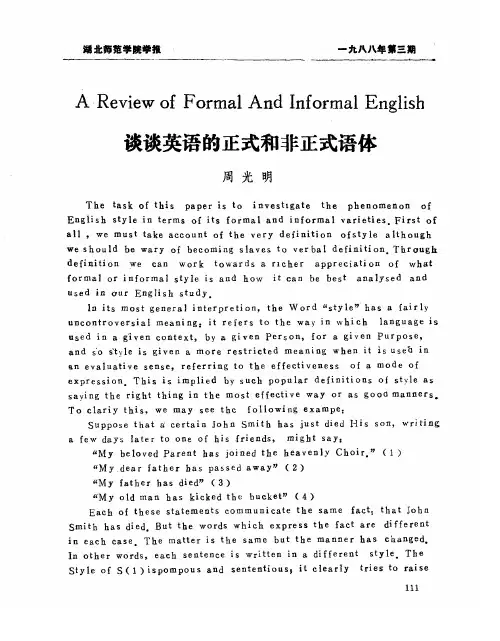
湖北师范学院学报一九八八年第三期
卜目,.甲洲叫,.,~~一
一一一一一`一~一曰一一-.
ARev
ie
wo
fFor
rn几
1An
dIn
for
ma
lEn
glis
h
谈谈英语的正式和非正式语体
周光明
Thetas
kofthispaper
15to
i仓vestlgatethepheno
menonof
Englis
hstyle
inter
mso
fits
for
ma
lan
din
for
ma
lvar
ieties
Firsto
f
a
11,
we
mustta
keaeeounto
ftheveryde
fin
itiono
fstylea
lthough
we5
hou
ldbewaryofbeeomings
lavestover
ba
lde
finition
Tilroug丘
de
fin
itionweeanwor
ktowar
dsarieherappreeiationo
fwhat
for
ma
lor
in
for
ma
lstyle
15an
dhowitean
be
bestana
l了se
dan
d
use
dinour
Englis
hstu
dy
In
its
mostgenera
linterpretion,
the
Wor
d,’style”
hasa
fa
ir
ly
uneontrovers
ia
lmean
ing:
itre
ferstothewayinwhie
hlanguage
15
use
dinag’
iveneontext,
byagiven
Person,
foragiven
Purpo、e,
an
ds’
0gtyle
15givena
morerestr
iete
dmean
ingwhenit15use石in
毯neva
luativesense,re
ferr
ingtothee
ffeetivenesso
fa
mo
deo
f
express
ion
This
15
implie
dbysue
hpopu
lar
de
fin
itionso
fstyleas
sav
ingther
ightthinginthe
moste
ffeetive
wayorasgoodmanners。
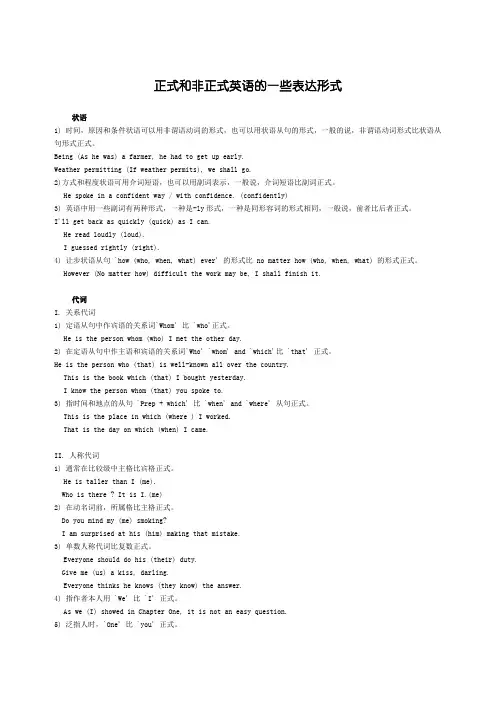
正式和非正式英语的一些表达形式
状语
1) 时间,原因和条件状语可以用非谓语动词的形式,也可以用状语从句的形式,一般的说,非谓语动词形式比状语从句形式正式。
Being (As he was) a farmer, he had to get up early.
Weather permitting (If weather permits), we shall go.
2)方式和程度状语可用介词短语,也可以用副词表示,一般说,介词短语比副词正式。
He spoke in a confident way / with confidence. (confidently)
3) 英语中用一些副词有两种形式,一种是-ly形式,一种是同形容词的形式相同,一般说,前者比后者正式。
I'll get back as quickly (quick) as I can.
He read loudly (loud).
I guessed rightly (right).
4) 让步状语从句 `how (who, when, what) ever' 的形式比 no matter how (who, when, what) 的形式正式。
However (No matter how) difficult the work may be, I shall finish it.
代词
I. 关系代词
1) 定语从句中作宾语的关系词`Whom' 比 `who'正式。
He is the person whom (who) I met the other day.
2) 在定语从句中作主语和宾语的关系词`Who' `whom' and `which'比 `that' 正式。
He is the person who (that) is well-known all over the country.

英语email 问候语简写
Email问候语简写
英语中,email是一种常见的书面交流方式。在书写email时,我们需要使用适当的问候语来表示礼貌和友好。有时,电子邮件问候语可能会变得冗长,特别是在处理大量邮件时。因此,使用简写的email问候语可以帮助我们更高效地书写邮件,并在表达礼貌的同时节省时间。以下是一些常见的英语email问候语简写。
1. Hi
"Hi"是非常常见的email问候语简写,可以作为一种友善和轻松的问候方式。通常使用于熟人、朋友或同事之间的邮件交流中。
2. Hello
和"Hi"类似,"Hello"也是常见的email问候语简写之一。它可以用于正式或非正式的场合,和不同身份和地位的人之间的邮件交流中。
3. Hey
"Hey"是另一种常见的email问候语简写,多数时候用于亲近的关系和熟悉的朋友之间的邮件交流。
4. Dear
"Dear"是一种正式的email问候语简写,通常用于商业或正式场合。它可以用于写给客户、老板或其他重要人物的邮件中。
5. Greetings
"Greetings"是以“问候”为意思的email问候语简写,用于正式和非正式的场合都适用。它可以用于和不同关系的人在邮件中表达礼貌和友好。
6. Morning/Afternoon/Evening 根据时间段,我们可以使用简写的问候语来表示问候。比如,"Morning"表示早上的问候,"Afternoon"表示下午的问候,"Evening"表示晚上的问候。
7. How are you?
"How are you?"是一种常见的email问候语简写,用于询问对方的近况。它可以用于和熟人、朋友或同事交流的邮件中。
8. Hope you're well
"Hope you're well"是一种常用的email问候语简写,表示对对方的祝福和关心。它通常用于和不同身份和身份地位的人之间的邮件交流中。
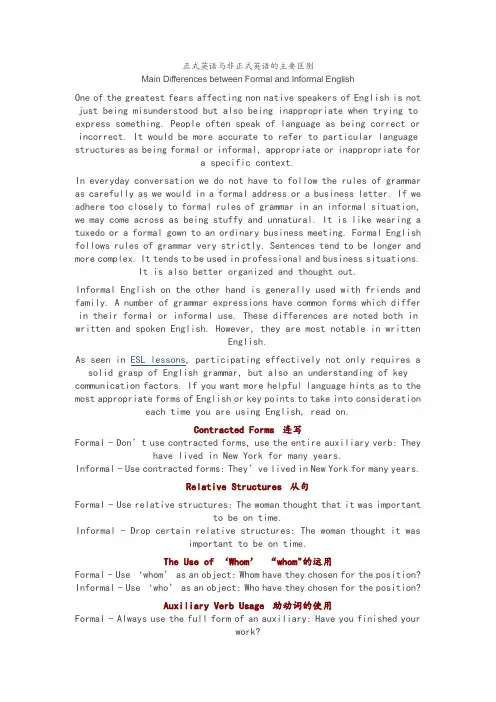
正式英语与非正式英语的主要区别
Main Differences between Formal and Informal English
One of the greatest fears affecting non native speakers of English is not
just being misunderstood but also being inappropriate when trying to
express something. People often speak of language as being correct or
incorrect. It would be more accurate to refer to particular language
structures as being formal or informal, appropriate or inappropriate for
a specific context.
In everyday conversation we do not have to follow the rules of grammar
as carefully as we would in a formal address or a business letter. If we
adhere too closely to formal rules of grammar in an informal situation,
we may come across as being stuffy and unnatural. It is like wearing a
tuxedo or a formal gown to an ordinary business meeting. Formal English
follows rules of grammar very strictly. Sentences tend to be longer and