
线性表-静态顺序表的实现
- 格式:ppt
- 大小:193.50 KB
- 文档页数:28


实验1:线性表(顺序表的实现)一、实验项目名称顺序表基本操作的实现二、实验目的掌握线性表的基本操作在顺序存储结构上的实现。
三、实验基本原理顺序表是由地址连续的的向量实现的,便于实现随机访问。
顺序表进行插入和删除运算时,平均需要移动表中大约一半的数据元素,容量难以扩充四、主要仪器设备及耗材Window 11、Dev-C++5.11五、实验步骤1.导入库和一些预定义:2.定义顺序表:3.初始化:4.插入元素:5.查询元素:6.删除元素:7.销毁顺序表:8.清空顺序表:9.顺序表长度:10.判空:11.定位满足大小关系的元素(默认小于):12.查询前驱:13.查询后继:14.输出顺序表15.归并顺序表16.写测试程序以及主函数对顺序表的每一个操作写一个测试函数,然后在主函数用while+switch-case的方式实现一个带菜单的简易测试程序,代码见“实验完整代码”。
实验完整代码:#include <bits/stdc++.h>using namespace std;#define error 0#define overflow -2#define initSize 100#define addSize 10#define compareTo <=typedef int ElemType;struct List{ElemType *elem;int len;int listsize;}L;void init(List &L){L.elem = (ElemType *) malloc(initSize * sizeof(ElemType)); if(!L.elem){cout << "分配内存失败!";exit(overflow);}L.len = 0;L.listsize = initSize;}void destroy(List &L){free(L.elem);L.len = L.listsize = 0;}void clear(List &L){L.len = 0;}bool empty(List L){if(L.len == 0) return true;else return false;}int length(List L){return L.len;}ElemType getElem(List L,int i){if(i < 1 || i > L.len + 1){cout << "下标越界!";exit(error);}return L.elem[i - 1];}bool compare(ElemType a,ElemType b) {return a compareTo b;}int locateElem(List L,ElemType e) {for(int i = 0;i < L.len;i++){if(compare(L.elem[i],e))return i;}return -1;}int check1(List L,ElemType e){int idx = -1;for(int i = 0;i < L.len;i++)if(L.elem[i] == e)idx = i;return idx;}bool check2(List L,ElemType e){int idx = -1;for(int i = L.len - 1;i >= 0;i--)if(L.elem[i] == e)idx = i;return idx;}int priorElem(List L,ElemType cur_e,ElemType pre_e[]) {int idx = check1(L,cur_e);if(idx == 0 || idx == -1){string str = "";str = idx == 0 ? "无前驱结点" : "不存在该元素";cout << str;exit(error);}int cnt = 0;for(int i = 1;i < L.len;i++){if(L.elem[i] == cur_e){pre_e[cnt ++] = L.elem[i - 1];}}return cnt;}int nextElem(List L,ElemType cur_e,ElemType next_e[]){int idx = check2(L,cur_e);if(idx == L.len - 1 || idx == - 1){string str = "";str = idx == -1 ? "不存在该元素" : "无后驱结点";cout << str;exit(error);}int cnt = 0;for(int i = 0;i < L.len - 1;i++){if(L.elem[i] == cur_e){next_e[cnt ++] = L.elem[i + 1];}}return cnt;}void insert(List &L,int i,ElemType e){if(i < 1 || i > L.len + 1){cout << "下标越界!";exit(error);}if(L.len >= L.listsize){ElemType *newbase = (ElemType *)realloc(L.elem,(L.listsize + addSize) * sizeof(ElemType));if(!newbase){cout << "内存分配失败!";exit(overflow);}L.elem = newbase;L.listsize += addSize;for(int j = L.len;j > i - 1;j--)L.elem[j] = L.elem[j - 1];L.elem[i - 1] = e;L.len ++;}void deleteList(List &L,int i,ElemType &e){if(i < 1 || i > L.len + 1){cout << "下标越界!";exit(error);}e = L.elem[i - 1];for(int j = i - 1;j < L.len;j++)L.elem[j] = L.elem[j + 1];L.len --;}void merge(List L,List L2,List &L3){L3.elem = (ElemType *)malloc((L.len + L2.len) * sizeof(ElemType)); L3.len = L.len + L2.len;L3.listsize = initSize;if(!L3.elem){cout << "内存分配异常";exit(overflow);}int i = 0,j = 0,k = 0;while(i < L.len && j < L2.len){if(L.elem[i] <= L2.elem[j])L3.elem[k ++] = L.elem[i ++];else L3.elem[k ++] = L2.elem[j ++];}while(i < L.len)L3.elem[k ++] = L.elem[i ++];while(j < L2.len)L3.elem[k ++] = L2.elem[j ++];}bool visit(List L){if(L.len == 0) return false;for(int i = 0;i < L.len;i++)cout << L.elem[i] << " ";cout << endl;return true;}void listTraverse(List L){if(!visit(L)) return;}void partion(List *L){int a[100000],b[100000],len3 = 0,len2 = 0; memset(a,0,sizeof a);memset(b,0,sizeof b);for(int i = 0;i < L->len;i++){if(L->elem[i] % 2 == 0)b[len2 ++] = L->elem[i];elsea[len3 ++] = L->elem[i];}for(int i = 0;i < len3;i++)L->elem[i] = a[i];for(int i = 0,j = len3;i < len2;i++,j++) L->elem[j] = b[i];cout << "输出顺序表:" << endl;for(int i = 0;i < L->len;i++)cout << L->elem[i] << " ";cout << endl;}//以下是测试函数------------------------------------void test1(List &list){init(list);cout << "初始化完成!" << endl;}void test2(List &list){if(list.listsize == 0)cout << "线性表不存在!" << endl;else{int len;ElemType num;cout << "选择插入的元素数量:" << endl;cin >> len;cout << "依次输入要插入的元素:" << endl;for(int i = 1;i <= len;i++){cin >> num;insert(list,i,num);}cout << "操作成功!" << endl;}}void test3(){if(L.listsize == 0)cout << "线性表不存在!" << endl;else{cout << "请输入要返回的元素的下标" << endl;int idx;cin >> idx;cout << "线性表中第" << idx << "个元素是:" << getElem(L,idx) << endl;}}void test4(){if(L.listsize == 0)cout << "线性表不存在!" << endl;else{int idx;ElemType num;cout << "请输入要删除的元素在线性表的位置" << endl;cin >> idx;deleteList(L,idx,num);cout << "操作成功!" << endl << "被删除的元素是:" << num << endl; }}void test5(){if(L.listsize == 0)cout << "线性表不存在!" << endl;else{destroy(L);cout << "线性表已被销毁" << endl;}}void test6(){if(L.listsize == 0)cout << "线性表不存在!" << endl;else{clear(L);cout << "线性表已被清空" << endl;}}void test7(){if(L.listsize == 0)cout << "线性表不存在!" << endl;else cout << "线性表的长度现在是:" << length(L) << endl;}void test8(){if(L.listsize == 0)cout << "线性表不存在!" << endl;else if(empty(L))cout << "线性表现在为空" << endl;else cout << "线性表现在非空" << endl;}void test9(){if(L.listsize == 0)cout << "线性表不存在!" << endl;else{ElemType num;cout << "请输入待判定的元素:" << endl;cin >> num;cout << "第一个与目标元素满足大小关系的元素的位置:" << locateElem(L,num) << endl;}}void test10(){if(L.listsize == 0)cout << "线性表不存在!" << endl;else{ElemType num,num2[initSize / 2];cout << "请输入参照元素:" << endl;cin >> num;int len = priorElem(L,num,num2);cout << num << "的前驱为:" << endl;for(int i = 0;i < len;i++)cout << num2[i] << " ";cout << endl;}}void test11(){if(L.listsize == 0)cout << "线性表不存在!" << endl;else{ElemType num,num2[initSize / 2];cout << "请输入参照元素:" << endl;cin >> num;int len = nextElem(L,num,num2);cout << num << "的后继为:" << endl;for(int i = 0;i < len;i++)cout << num2[i] << " ";cout << endl;}}void test12(List list){if(L.listsize == 0)cout << "线性表不存在!" << endl;else{cout << "输出线性表所有元素:" << endl;listTraverse(list);}}void test13(){if(L.listsize == 0)cout << "初始线性表不存在!" << endl; else{List L2,L3;cout << "初始化一个新线性表" << endl;test1(L2);test2(L2);cout << "归并两个线性表" << endl;merge(L,L2,L3);cout << "归并成功!" << endl;cout << "输出合并后的线性表" << endl;listTraverse(L3);}}void test14(){partion(&L);cout << "奇偶数分区成功!" << endl;}int main(){std::ios::sync_with_stdio(false);cin.tie(0),cout.tie(0);int op = 0;while(op != 15){cout << "-----------------menu--------------------" << endl;cout << "--------------1:初始化------------------" << endl;cout << "--------------2:插入元素----------------" << endl;cout << "--------------3:查询元素----------------" << endl;cout << "--------------4:删除元素----------------" << endl;cout << "--------------5:销毁线性表--------------" << endl;cout << "--------------6:清空线性表--------------" << endl;cout << "--------------7:线性表长度--------------" << endl;cout << "--------------8:线性表是否为空----------" << endl;cout << "--------------9:定位满足大小关系的元素--" << endl;cout << "--------------10:查询前驱---------------" << endl;cout << "--------------11:查询后继---------------" << endl;cout << "--------------12:输出线性表-------------" << endl;cout << "--------------13:归并线性表-------------" << endl;cout << "--------------14:奇偶分区---------------" << endl;cout << "--------------15: 退出测试程序-----------" << endl;cout << "请输入指令编号:" << endl; if(!(cin >> op)){cin.clear();cin.ignore(INT_MAX,'\n');cout << "请输入整数!" << endl;continue;}switch(op){case 1:test1(L);break;case 2:test2(L);break;case 3:test3();break;case 4:test4();break;case 5:test5();break;case 6:test6();break;case 7:test7();break;case 8:test8();break;case 9:test9();break;case 10:test10();break;case 11:test11();break;case 12:test12(L);break;case 13:test13();break;case 14:test14();break;case 15:cout << "测试结束!" << endl;default:cout << "请输入正确的指令编号!" << endl;}}return 0;}六、实验数据及处理结果1.初始化:2.插入元素3.查询元素(返回的是数组下标,下标从0开始)4.删除元素(位置从1开始)5.销毁顺序表6.清空顺序表7.顺序表长度(销毁或清空操作前)8.判空(销毁或清空操作前)9.定位满足大小关系的元素(销毁或清空操作前)说明:这里默认找第一个小于目标元素的位置且下标从0开始,当前顺序表的数据为:1 4 2 510.前驱(销毁或清空操作前)11.后继(销毁或清空操作前)12.输出顺序表(销毁或清空操作前)13.归并顺序表(销毁或清空操作前)七、思考讨论题或体会或对改进实验的建议通过本次实验,我掌握了定义线性表的顺序存储类型,加深了对顺序存储结构的理解,进一步巩固和理解了顺序表的基本操作,如建立、查找、插入和删除等。

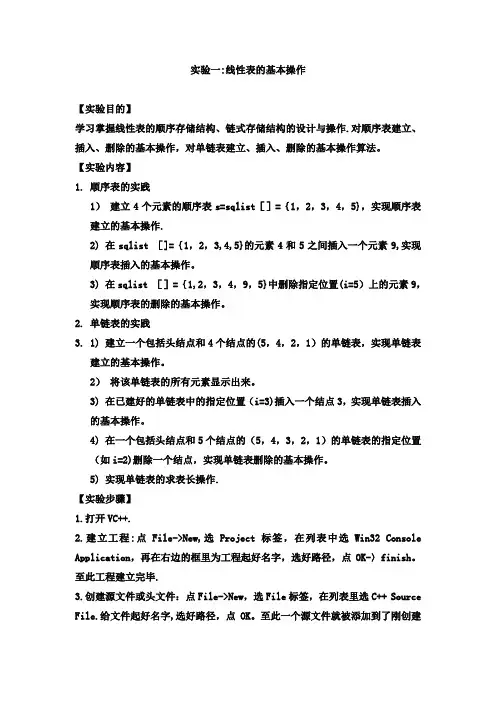
实验一:线性表的基本操作【实验目的】学习掌握线性表的顺序存储结构、链式存储结构的设计与操作.对顺序表建立、插入、删除的基本操作,对单链表建立、插入、删除的基本操作算法。
【实验内容】1.顺序表的实践1)建立4个元素的顺序表s=sqlist[]={1,2,3,4,5},实现顺序表建立的基本操作.2) 在sqlist []={1,2,3,4,5}的元素4和5之间插入一个元素9,实现顺序表插入的基本操作。
3) 在sqlist []={1,2,3,4,9,5}中删除指定位置(i=5)上的元素9,实现顺序表的删除的基本操作。
2.单链表的实践3.1) 建立一个包括头结点和4个结点的(5,4,2,1)的单链表,实现单链表建立的基本操作。
2)将该单链表的所有元素显示出来。
3) 在已建好的单链表中的指定位置(i=3)插入一个结点3,实现单链表插入的基本操作。
4) 在一个包括头结点和5个结点的(5,4,3,2,1)的单链表的指定位置(如i=2)删除一个结点,实现单链表删除的基本操作。
5) 实现单链表的求表长操作.【实验步骤】1.打开VC++.2.建立工程:点File->New,选Project标签,在列表中选Win32 Console Application,再在右边的框里为工程起好名字,选好路径,点OK-〉finish。
至此工程建立完毕.3.创建源文件或头文件:点File->New,选File标签,在列表里选C++ Source File.给文件起好名字,选好路径,点OK。
至此一个源文件就被添加到了刚创建的工程之中.4.写好代码5.编译->链接->调试1、#include "stdio。
h”#include "malloc.h”#define OK 1#define OVERFLOW -2#define ERROR 0#define LIST_INIT_SIZE 100#define LISTINCREMENT 10typedef int ElemType;typedef int Status;typedef struct {ElemType *elem;int length;int listsize;} SqList;Status InitList( SqList &L ) {int i,n;L。