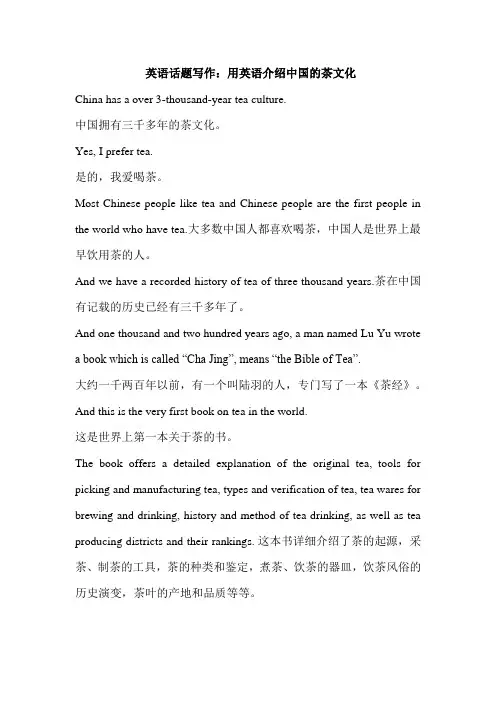
中国茶文化英语演讲稿【三篇】
- 格式:pdf
- 大小:34.98 KB
- 文档页数:2
【 导语】中国的⽂化博⼤精深,我们也要学会⽤英语的⽅式来介绍中国的⽂化,以下是⽆忧考为⼤家精⼼整理的中国茶⽂化
英语演讲稿【三篇】,欢迎⼤家阅读。
【篇⼀】中国茶⽂化英语演讲稿
The practice of drinking and serving tea has been part of China's cultural identity for centuries. China used to be theworld's sole provider of tea. Today, tea is the world's most widely consumed beverage after water, and famous Chinese teas
are still highly prized.
Tea experts estimate that top-quality Longjing will sell for 40,000 to 50,000 yuan per 500 grams this year, about 25percent higher than last year. The price of common Longjing will be around 4,000 yuan per 500 grams this year.
Though quality tea is highly pursued at home, it seems that it has not secured a strong position in the global market.
Li Shiwei is the board chairman of Tianfu Group, a flagship tea enterprise based in Fujian Province, a major productionregion of oolong tea in China. He says a major problem for today's private tea enterprises is that they do not have enough
money to operate on a large scale, let alone undertake promotions overseas.
"Most of China's tea enterprises are non-state-owned with lack of funding being their weakest point. We are glad to seethat Minsheng Bank is now offering a special loan program for tea enterprises. We hope more banks in China will give us
more support in terms of financing."
Li Jiaxun, board chairman of Zhejiang Tea Group, China's largest exporter of green tea, says a lack of widely recognizedbrand names is holding Chinese tea exports back and squeezing the industry's profit margin.
Li cites his own company as an example. The group mainly sells tea as a raw material rather than a branded product. Asa result, its profit margin is only about 5 percent, and sometimes even lower.
The tea expert adds that Chinese companies should also adapt to the needs of western customers, who might preferblack tea to green, and teabags to loose-leaf teas.
Wen Zhongliang, deputy director of the Foreign Trade Department under the Ministry of Commerce, says it is an urgenttask for Chinese tea producers and sellers to build up the image of Chinese tea abroad to boost tea exports.
"In addition to ensuring the high quality of Chinese tea, tea enterprises in the country should promote the image ofChinese tea together. It could be something of an effort to explain the cultural significance and health benefits of tea to
foreigners, but once they realize that, they will find it fascinating."
The trade official suggests that existing networks such as the Confucius Institutes be used to spread China's tea culturearound the world.
For CRI, this is Su Yi.
【篇⼆】中国茶⽂化英语演讲稿
The Chinese people, in their drinking of tea, place much significance on the act of "savoring." "Savoring tea" is not onlya way to discern good tea from mediocre tea, but also how people take delight in their reverie and in tea-drinking itself.
Snatching a bit of leisure from a busy schedule, making a kettle of strong tea, securing a serene space, and serving and
drinking tea by yourself can help banish fatigue and frustration, improve your thinking ability and inspire you with enthusiasm.
You may also imbibe it slowly in small sips to appreciate the subtle allure of tea-drinking, until your spirits soar up andup into a sublime aesthetic realm. Buildings, gardens, ornaments and tea sets are the elements that form the ambience for
savoring tea. A tranquil, refreshing, comfortable and neat locale is certainly desirable for drinking tea. Chinese gardens are
well known in the world and beautiful Chinese landscapes are too numerous to count. Teahouses tucked away in gardens
and nestled beside the natural beauty of mountains and rivers are enchanting places of repose for people to rest and
recreate themselves.
China is a country with a time-honored civilization and a land of ceremony and decorum. Whenever guests visit, it isnecessary to make and serve tea to them. Before serving tea, you may ask them for their preferences as to what kind of tea
they fancy and serve them the tea in the most appropriate teacups. In the course of serving tea, the host should take careful
note of how much water is remaining in the cups and in the kettle. Usually, if the tea is made in a teacup, boiling water should
be added after half of the cup has been consumed; and thus the cup is kept filled so that the tea retains the same bouquet
and remains pleasantly warm throughout the entire course of tea-drinking. Snacks, sweets and other dishes may be servedat tea time to complement the fragrance of the tea and to allay one's hunger. 【篇三】中国茶⽂化英语演讲稿
Ladies and Gentlemen:
It’s my honor to stand here and make a speech. My topic is “Chinese Tea Culture”.