2016年管理类联考综合、英语二真题及答案
- 格式:doc
- 大小:280.00 KB
- 文档页数:29
2016年管理类联考英语(二)试卷
Section Ⅰ Use of English
Directions:
Read the following text。 Choose the best word(s) for each numbered blank and mark
[A], [B], [C] or [D] on the ANSWER SHEET. (10 points)
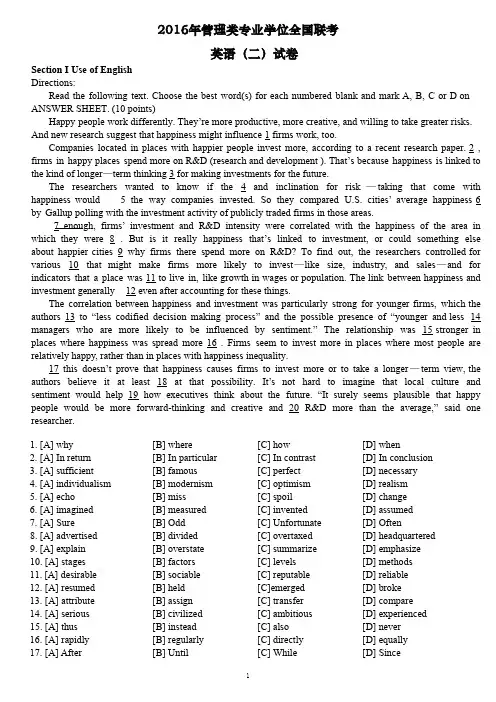
Happy people work differently. They’re more productive, more creative, and willing
to take greater risks。 And new research suggest that happiness might influence 1 firms work,
too。
Companies located in places with happier people invest more, according to a recent
research paper。 2 , firms in happy places spend more on R&D ( research and
development ). That’s because happiness is linked to the kind of longer-term thinking 3 for
making investments for the future.
The researchers wanted to know if the 4 and inclination for risk—taking that come with
happiness would 5 the way companies invested。 So they compared U。S。 cities’ average
happiness 6 by Gallup polling with the investment activity of publicly traded firms in those
areas.
7 enough, firms’ investment and R&D intensity were correlated with the happiness of
the area in which they were 8 。 But is it really happiness that's linked to investment, or
could something else about happier cities 9 why firms there spend more on R&D? To find out,
the researchers controlled for various 10 that might make firms more likely to invest – like
size, industry, and sales – and for indicators that a place was 11 to live in, like growth in
wages or population. The link between happiness and investment generally 12 even after
accounting for these things.
The correlation between happiness and investment was particularly strong for younger
firms, which the authors 13 to “less codified decision making process”and the possible
presence of “younger and less 14 managers who are more likely to be influenced by
sentiment。” The relationship was 15 stronger in places where happiness was spread more
16 。 Firms seem to invest more in places where most people are relatively happy, rather
than in places with happiness inequality。 17 this doesn’t prove that happiness causes firms to invest more or to take a longer-term
view, the authors believe it at least 18 at that possibility。 It’s not hard to imagine that local
culture and sentiment would help 19 how executives think about the future。 “It surely seems
plausible that happy people would be more forward—thinking and creative and 20 R&D more
than the average," said one researcher。
参考答案:(华章提供):
C 1. [A] why [B] where [C] how [D] when
B 2。 [A] In return [B] In particular [C] In contrast [D] In conclusion
D 3. [A] sufficient [B] famous [C] perfect [D] necessary
C 4。 [A] individualism [B] modernism [C] optimism [D] realism
D 5. [A] echo [B] miss [C] spoil [D] change
B 6. [A] imagined [B] measured [C] invented [D] assumed
A 7. [A] Sure [B] Odd [C] Unfortunate [D] Often
D 8. [A] advertised [B] divided [C] overtaxed [D] headquartered
A 9. [A] explain [B] overstate [C] summarize [D] emphasize
B 10. [A] stages [B] factors [C] levels [D] methods
A 11。 [A] desirable [B] sociable [C] reputable [D] reliable
B 12。 [A] resumed [B] held [C]emerged [D] broke
A 13. [A] attribute [B] assign [C] transfer [D]compare
D 14. [A] serious [B] civilized [C] ambitious [D]experienced
A 15. [A] thus [B] instead [C] also [D] never
D 16. [A] rapidly [B] regularly [C] directly [D] equally
C 17。 [A] After [B] Until [C] While [D] Since
C 18. [A] arrives [B] jumps [C] hints [D] strikes
A 19。 [A] shape [B] rediscover [C] simplify [D] share
B 20。 [A] pray for [B] lean towards [C] give away [D] send out Section II Reading Comprehension
Part A
Directions:
Read the following four texts. Answer the questions below each text by choosing A, B,
C or D。 Mark your answers on the ANSWER SHEET。 (40 points)
Text 1
It's true that high-school coding classes aren't essential for learning computer science in
college. Students without experience can catch up after a few introductory courses, said Tom
Cortina, the assistant dean at Carnegie Mellon’s School of Computer Science.
However, Cortina said, early exposure is beneficial. When younger kids learn computer
science, they learn that it’s not just a confusing, endless string of letters and numbers — but
a tool to build apps, or create artwork, or test hypotheses。 It’s not as hard for them to
transform their thought processes as it is for older students. Breaking down problems into
bite—sized chunks and using code to solve them becomes normal。 Giving more children this
training could increase the number of people interested in the field and help fill the jobs gap,
Cortina said。
Students also benefit from learning something about coding before they get to college,