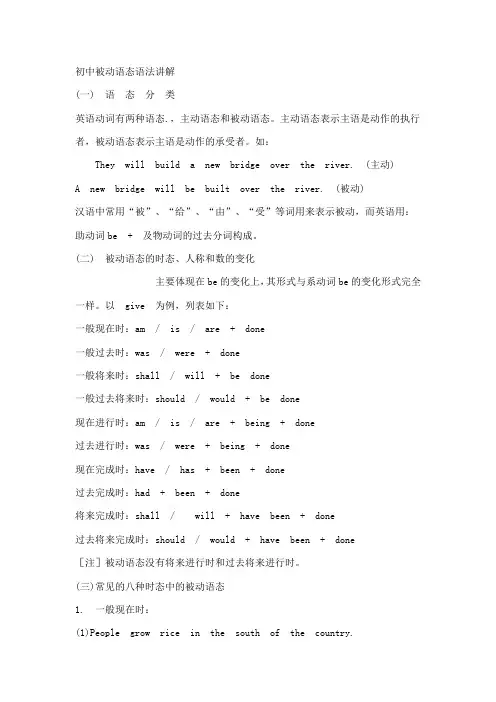
被动语态的讲解
- 格式:docx
- 大小:30.08 KB
- 文档页数:17
2.情态动词的被动语态:
3.一般过去时的被动语态:
4.一般将来时的被动语态:
5.现在进行时的被动语态:
6.过去进行时的被动语态:
7.现在完成时的被动语态:
8.过去完成时的被动语态:
9.过去将来时的被动语态: 被动语态全解
语态是动词的一种形式 , 表示句子中主语和谓语动词的关系 , 主动语态表 示主语是动作的执行者 ,被动语态表示主语是动作的承受者。只有及物动词才能 用于被动语态。
被动语态的时态:
1. 一般现在时的被动语态: am /is/ are + 动词的过去分词
情态动词 + be +动词的过去分词 was /were + 动词的过去分词 will be + 动词的过去分词 am /is /are +doing +
动词的过去分词
was/were+doing+ 动词的过去分词
have /has +been + 动词的过去分词
had+been + 动词的过去分词 would/should+be+ 动词的过去分词
二.被动语态的基本用法 :
(1) 需要强调动作的承受者时
The Great Wall is enjoyed by millions of people all over the world English is widely
spoken in the world now.
(2) 不知道或没必要指出动作的执行者时
Mr. Wang is invited to the meeting today .
The problem is dealt with now .
(3) 当说话人需要强调客观时
It is said that she was a beauty when she was young . 三.主动语态变被动语态的变法:
口诀:宾变主,主变宾,谓变 be done , 时不变,数格必须随被变。 注: 1.主动、被动的时态要一致。
2. 主动、被动的句式要一致。
3. 变成的被动语态的主语与谓语在单复数上保持一致。
四、语态转换不被动语态的步骤
1, 把原主动句中的宾语转换为被动语态的主语 2, 把动词改为被动语态形式即 "be+ 过去分词 "。
3, 原来主动语态句子中的主语 ,如果需要就放在 by 的后面以它的宾格形式出现
(因为 by 是介词 ,后面需跟宾格作介词的宾语。 )以指明做事的人或物 ,如果没有必 要,可以省略。
4, 其它成分不变
5, 被动语态中 "by+ 宾语 "的省略
被动语态句式中的 "by+ 宾语 "表示及物动词所表示动作的执行者 , 但是在遇到以
下情况时 ,表示动作执行者 "by + 宾语"常常被省略。
(1) 动作执行者不确定时
Paper is made from wood .
Many people are killed in traffic accidents every year .
(2) 不必表明动作执行者时
English is also spoken as the second language as well as one of the official languages
Football is played in most schools 。
(3 ) 动作执行者为一般大众时
Both English and Spanish are spoken in this area.
一般过去时的被动语态的基本句式
(1) 肯定式:主语+ was /were + 过去分词 +by
It was made in Beijing Ren'ai Education Institute .
(2) 否定式 :主语 +was /were + not + 过去分词 + by
She was not given a paniting by him .
This question was not discussed at the meeting yesterday .
(3) 一般疑问句 :Was /Were + 主语+过去分词 +by ?
Was it made of bamboo?
(4) 特殊疑问句 : 特殊疑问词 +was/were + 过去分词 +by
What was is made of ?
教你一招
如果句子为一般现在时 , 主动语态用 do/does , 被动语态用 is/am /are 如果句子为一般过去时 , 主动语态用 did , 被动语态用 was /were . 由情态动词构成的被动语态的基本句式 ⑴ 肯定式:主语+情态动词+be+ 过去-Water can be chan ged in to ice.
She ought to tidy up her bedroom ---- Her bedroom ought to be tidied up.
You should buy a dictionary at once ---- A dictionary should be bought at
once by you.
(2)否定式:主语+情态动词+not +be +过去分词+by
You must not take out any books .- Any books mustn't be taken out by you .
They needn't look after the little child --- The little child needn't be looked
after (by them)
⑶ 疑问句:情态动词+主语+be +过去分词+by
Can you use it ? ----- Can it be used ?
常见的情态动词有 :can,may, ought to, must , dare , need,should. 主动语态不能变为被动语态的情况 :
1, 当宾语是反身代词时 The man introduced himself as Mr.Parker .
2, 当谓语是表示状态的及物动词时 Does the pair of new shoes suit you?
We will have a meeting .
四.特殊情况的被动语态:
1. 带双宾语的被动语态:
动词+ sb(间宾)+sth(直宾) 口诀:如遇双宾语,一般变间宾,若把直宾变, to /for 间宾连。
1) .give/pass /show 与介词 to 搭配。
give sb sth —— sb +be given sth 或 sth +be given +to sb .
2) .buy/make/cook 与介词 for 搭配。
buy sb sth —— sb +be bought + sth 或 sth +be bought +for sb
He gave me a book
I _____ _____ a book by him.
A book ___ ___ ____ me by him .
My mother made me a cake .
I ___ ___ a cake by my mother
A cake ___ ___ ___ me by my mother .
2. 带省 to 的不定式作宾补的被动语态:动词 + sb + do sth . 口诀:感使动词真叫怪, to 来 to 去记心怀, 主动语态 to 离去被动语态 to 回来。 动词: make / let /have
/see /hear /feel /watch
make sb do sth -- sb + be +made +to do sth
The boss made the workers work all day
The workers ____ ___ ___ work all day by the boss.
3. see /hear /notice /keep +sb +doing sth 句型中变被动语态时 doing 不变。 A. will be published
C. is being published ( )4.
—Did you go to Jack
—No,I __ .
A. am not invited
C.haven't invited B. is publishing
B. wasn't
invited
D.didn 't invite I heard Tom singing just now Tom ________ _____ ____ by me just now .
4. _____________________________________________ 以动词短语作谓语的主动语态变被动语态时,不可丢掉后面的介词或副词。 We should take care of the old .
The old should ___________________________________ ____ ____ ____
五.注意事项:
1. 有些及物动词或动词短语不能用于被动语态:
last ,have ,ow n •…..bel ong to ,suit •••fi ne ,
2. 不及物动词是没有被动语态:
happen ,take place ,appear , hold ( 容纳)
3. 系动词是没有被动语态: Look, feel ,sound ,smell ,taste •.
The dish tastes good .
4. 有些词组没有被动语态: sell well , write well ,ride well ,drive well
This kind of skirt sells well.
5. need 表示需要时,后面常接 doing 形式表示被动意义,相当于 to be done .
All the computers need repairing .=
All the computers need ____ ____ ____ .
6. 在 too • to •及 enough to • 结构中有时表示被动意义。
The problem is too difficult to solve.
一、单项选择
( )1. —Do you often clean your classroom?
—Yes. Our classroom ___ every day.
A. clean B.cleans C.is cleaned D.is cleaning
( )2.A talk on developments in science and technology___in the school hall next
week.
A. given B.will be given C.has been given D.give ( )3.His new book___ next month.