部分倒装用法归纳
- 格式:docx
- 大小:50.48 KB
- 文档页数:21
英语部分倒装用法归纳
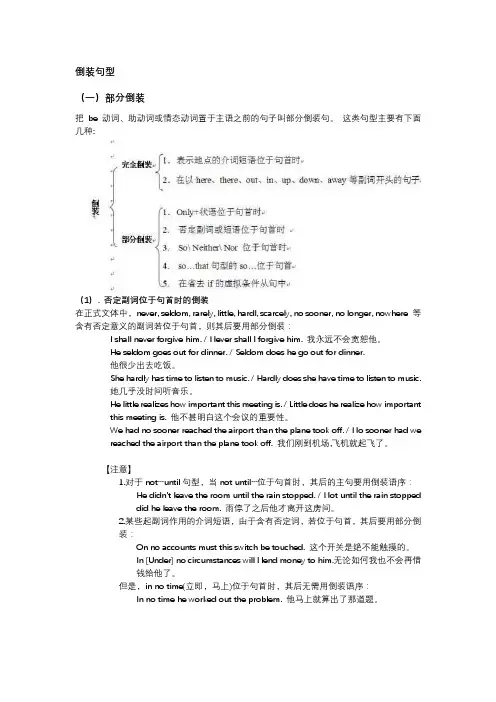
1. 否定副词位于句首时的倒装
在正式文体中, never, seldom, rarely, little, hardly, scarcely, nosooner, nolonger,
nowhere 等含有否定意义的副词若位于句首,则其后要用部分倒装:
I shall never forgive him. / Never shall I forgive him. 我永远不会宽恕他。
He seldom goes out for dinner. / Seldom does he go out for dinner. 他很少出
去吃饭。
She hardly has time to listen to music. / Hardly does she have time to listen to
music. 她几乎没时间听音乐。
He little realizes how important this meeting is. / Little does he realize how
important this meeting is. 他不甚明白这个会议的重要性。
We had no sooner reached the airport than the plane took off. / No sooner
had we reached the airport than the plane took off. 我们刚到机场,飞机就起飞了。
【注意】
(1) 对于 not…until 句型,当 not until…位于句首时,其后的主句要用倒装语序:
He didn’t leave the room until the rain stopped. / Not until the rain stopped did he leave the room. 雨停了之后他才离开这房间。
(2) 某些起副词作用的介词短语, 由于含有否定词,若位于句首,其后要用部分倒装:
On no accounts must this switch be touched. 这个开关是绝不能触摸的。
In [Under] nocircumstances will I lendmoney tohim. 无论如何我也不会再借钱给
他了。
但是, in no time(立即,马上)位于句首时,其后无需用倒装语序:
In no time he worked out the problem. 他马上就算出了那道题。
2. nly+状语”位于句首时的倒装
当一个状语受副词 only 的修饰且置于句首时,其后用部分倒装语序:
Only then did he realize that he was wrong. 到那时他才意识到他错了。
Only in this way are you able to do it well. 你只有用这种方法才能把它做好。
Only when he returnedhome didhe realize what hadhappened. 当他回到家里
时,才知道出了什么事。
3. s“o+adj. /adv.”位于句首时的倒装 副词 so 后接形容词或副词位于句首时,其后用部分倒装:
So cold was the weather that we had to stay at home. 天气太冷,我们只好呆在
家里。
So fast does light travel that we can hardly imagine its speed. 光速很快,我们
几乎没法想像它的速度。
So sudden was the attack that we had no time to escape. 袭击来得非常突然,
我们来不及逃跑。
4. s“o+助动词 +主语”倒装
当要表示前面提出的某一肯定的情况也同样适合于后者,通常就要用“So+助动词 +
主语”这种倒装结构:
Y ou are youngandsoamI. 你年轻,我也年轻。
She likes music and so do I. 她喜欢音乐,我也喜欢。
If he can do it, so can I. 要是他能做此事,我也能。
【注意】
(1) 若前面提出某一否定的情况,要表示后者也属于同样的否定情况,则应将其中的
so 改为 neither 或 nor: Y ou aren’tyoungandneither amI. 你不年轻,我也不年轻。
She hasn’t read it and nor have I. 她没有读它,我也没有读。
(2) 注意该结构与表示强调或同意的 s“o+主语 +特殊动词”结构的区别:
"It was cold yesterday." "So it was." “昨天很冷。”“的确很冷。”
"Father, you promised." "Well, soI did." 爸“爸, 你答应过的。 ”嗯“, 是答应过。 ”
5. 由 not only… but also 引出的倒装
当 not only… but also 位于句首引出句子时,not only 后的句子通常用部分倒装形式:
Not only is he a teacher, but he is alsoa poet. 他不仅是一位教师,而且是一位诗
人。
Not only didhe speak more correctly, but he spoke more easily. 不仅他讲得更
正确,也讲得更不费劲了。
6. 虚拟条件句的省略与倒装
当 if 引导的虚拟条件从句中含有 had, were, should 等时,如将 if 省略,则要将 had,
were, should 等移到主语前,构成倒装句:
Had you come yesterday, you would have seen him. 若你昨天来,你就会见到他 了。
Should you require anything give me a ring. 如果需要什么,可以给我打电话。
Were it not for your help, I would still be homeless. 要不是你帮助,我会仍然无
家可归。
【注意】省略 if 后提前的 had 不一定是助动词:
Had I money, I would buy it. 假若我有钱,我就会买它。
完全倒装的四种主要类型
1. here 和 there 位于句首时的倒装
表示地点的 here 和 there 位于句首时,其后用完全倒装形式。这类倒装句的谓语通
常是动词 be 和 come, go 等表示移动或动态的不及物动词:
Here’sTom.
There’sJim. 汤姆在这里。
吉姆在那儿。
Here comes the bus. 公共汽车来了。
There goes the bell. 铃响了。 There goes the last train. 最后一班火车开走了。
【注意】
(1) 以上倒装句中的谓语动词 come 和go 不能用进行时态,即不能说 Here is
coming the bus。
(2) 若主语为代词,则不倒装:
Here I am. 我在这儿。 / 我来了。
Here it comes. 它来了。
(3) 其中的动词有时也可能是 stand, lie, live 等表示状态的动词(表示存在):
There stood a desk against the wall. 靠墙放着一张书桌。
Once upon a time there liveda man known by the name of Beef. 从前有个人名
叫比夫。
2. away 和 down 等位于句首时的倒装
地点副词 away, down, in, off, out, over, round, up 等位于句首时,其后用完全倒装
语序。这类倒装句的谓语通常表示动态的不及物动词:
Away went the runners. 赛跑选手们跑远了。