
The First Americans
- 格式:ppt
- 大小:461.50 KB
- 文档页数:16

The History of Chinese Americans
For many years it was common in the United States to associate Chinese Americans
with restaurants and laundries. People did not realize that the Chinese had
been driven into these occupations by the prejudice and discrimination that
faced them in this country.
The first Chinese to reach the United States came during the California Gold
Rush of 1849. Like most of the other people there, they had come to search for
gold. In that largely unoccupied land, the men staked a claim for themselves
by placing makers in the ground. However, either because the Chinese were so
different from the others or because they worked so patiently that they
sometimes succeeded in turning a seemingly worthless mining claim into a
profitable one, they became the scapegoats of their envious compatitors. They

Should American Celebrate The Columbus Day?
Columbus Day, which is on the second Monday of October,
remembers Christopher Columbus' arrival in the Americas on
October 12, 1492. This holiday is controversial because the
European settlement in the Americas led to the demise of the
history and culture of the indigenous peoples.
Some Americans celebrate the anniversary of the discovery
of their country with church services and other activities. On
the other hand, some Americans oppose to celebrate this day,
and appeal to abolish it. So, I ‘m going to talk about should
Americans celebrate or abolish Columbus Day?
There are different opinions among people as to the
Columbus Day.Some people suggest that Columbus Day
should not be celebrated because he wasn't the one who found
America. There were already people(Native Americans.) living
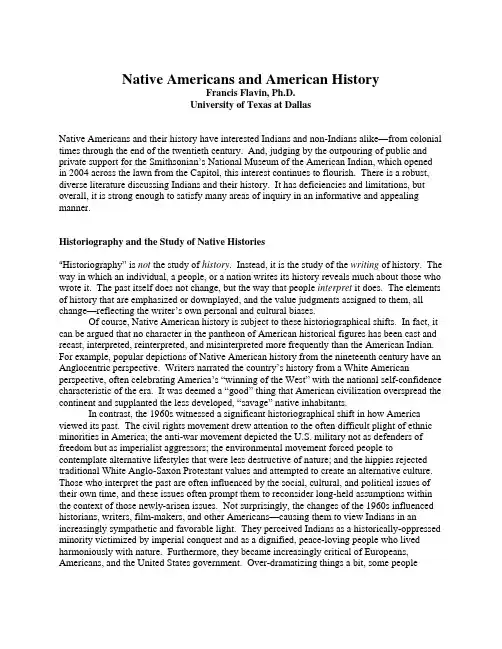
Native Americans and American History Francis Flavin, Ph.D. University of Texas at Dallas Native Americans and their history have interested Indians and non-Indians alike—from colonial times through the end of the twentieth century. And, judging by the outpouring of public and private support for the Smithsonian’s National Museum of the American Indian, which opened in 2004 across the lawn from the Capitol, this interest continues to flourish. There is a robust, diverse literature discussing Indians and their history. It has deficiencies and limitations, but overall, it is strong enough to satisfy many areas of inquiry in an informative and appealing manner. Historiography and the Study of Native Histories AHistoriography” is not the study of history. Instead, it is the study of the writing of history. The way in which an individual, a people, or a nation writes its history reveals much about those who wrote it. The past itself does not change, but the way that people interpret it does. The elements of history that are emphasized or downplayed, and the value judgments assigned to them, all change—reflecting the writer’s own personal and cultural biases. Of course, Native American history is subject to these historiographical shifts. In fact, it can be argued that no character in the pantheon of American historical figures has been cast and recast, interpreted, reinterpreted, and misinterpreted more frequently than the American Indian. For example, popular depictions of Native American history from the nineteenth century have an Anglocentric perspective. Writers narrated the country’s history from a White American perspective, often celebrating America’s “winning of the West” with the national self-confidence characteristic of the era. It was deemed a “good” thing that American civilization overspread the continent and supplanted the less developed, “savage” native inhabitants. In contrast, the 1960s witnessed a significant historiographical shift in how America viewed its past. The civil rights movement drew attention to the often difficult plight of ethnic minorities in America; the anti-war movement depicted the U.S. military not as defenders of freedom but as imperialist aggressors; the environmental movement forced people to contemplate alternative lifestyles that were less destructive of nature; and the hippies rejected traditional White Anglo-Saxon Protestant values and attempted to create an alternative culture. Those who interpret the past are often influenced by the social, cultural, and political issues of their own time, and these issues often prompt them to reconsider long-held assumptions within the context of those newly-arisen issues. Not surprisingly, the changes of the 1960s influenced historians, writers, film-makers, and other Americans—causing them to view Indians in an increasingly sympathetic and favorable light. They perceived Indians as a historically-oppressed minority victimized by imperial conquest and as a dignified, peace-loving people who lived harmoniously with nature. Furthermore, they became increasingly critical of Europeans, Americans, and the United States government. Over-dramatizing things a bit, some people replaced the old understanding of “White man good, Red man bad” with “Red man good, White man bad.” Revising history like this challenges people to contemplate the past from new—and often provocative—viewpoints. However, replacing one simplified stereotype with another doesn’t necessarily lead to better understanding. Nevertheless, after a wave of revisionism has run its course, historians often find themselves in the enviable position of being able to blend the best of the old with the best of the new, and produce more nuanced, thoughtful scholarship. This is precisely where today’s historians of Native America find themselves, and they have produced some first-rate Indian histories. Still, there remain significant limitations to understanding Indian history. The most notable is the problem of written sources. Native American peoples, up until the nineteenth century or later, were generally pre-literate. They transmitted memories of the past orally—but famines, wars, and diseases extinguished not only people, but Indian histories as well. Consequently, centuries of Indian history have been irretrievably lost. Furthermore, during the contact and post-contact eras, many of those who documented Indian life—trappers, traders, missionaries, explorers, travelers, government officials, and scientists—were of European descent, and their writings reflected White cultural biases and interests. Although the Indians may have been the subject of these writings, the writings often reflected a non-Indian perspective. One solution to the dearth of written sources is “ethnohistory.” Ethnohistory, which emerged in the 1950s and 1960s, is a methodology that blends anthropology and history. It encourages its practitioners to use historical sources to answer anthropological questions and, conversely, to use an understanding of a culture and its dynamics to answer historical questions. What results is not necessarily “history from an Indian perspective,” but rather a history that is sensitive to a tribe’s culture. In the second half of the twentieth century, scholars increasingly employed ethnohistorical methods to produce commendably sophisticated studies. The shortage of histories from an Indian viewpoint has been slowly but steadily remedied as time has progressed. In the nineteenth and early twentieth centuries native peoples either created texts of their own or allowed their testimonies to be transcribed by others. And, in the last several decades, greater numbers of historians of Indian descent have written their own histories, and are enriching the field of Indian history by adding long-absent native voices. When studying any area of history, first-hand accounts provide the reader a level of understanding and a certain “feel” that is sometimes absent from synthetic accounts. Native American history is no exception, and those studying it will benefit from reading these first-hand native accounts. References, Textbooks, and General Overviews Perhaps the most comprehensive and authoritative reference for Native American history is the Handbook of North American Indian series published by the Smithsonian Institution under the general editorship of William C. Sturtevant. This twenty-volume series describes the history, culture, and language of the different Indian tribes of North America. Each volume focuses on the tribes of a particular region, and there are separate volumes on Indian-White relations and
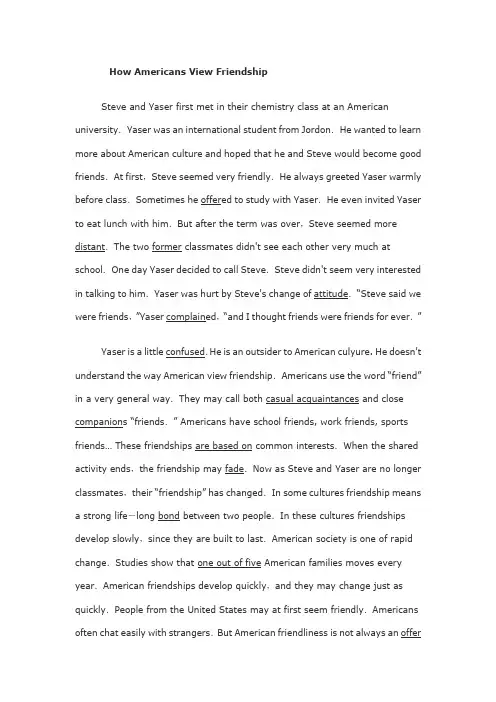
How Americans View Friendship
Steve and Yaser first met in their chemistry class at an American
university.Yaser was an international student from Jordon.He wanted to learn
more about American culture and hoped that he and Steve would become good
friends.At first,Steve seemed very friendly.He always greeted Yaser warmly
before class.Sometimes he offered to study with Yaser.He even invited Yaser
to eat lunch with him.But after the term was over,Steve seemed more
distant.The two former classmates didn't see each other very much at
school.One day Yaser decided to call Steve.Steve didn't seem very interested
in talking to him.Yaser was hurt by Steve's change of attitude.“Steve said we
were friends,”Yaser complained,“and I thought friends were friends for ever.”
Yaser is a little confused.He is an outsider to American culyure. He doesn't