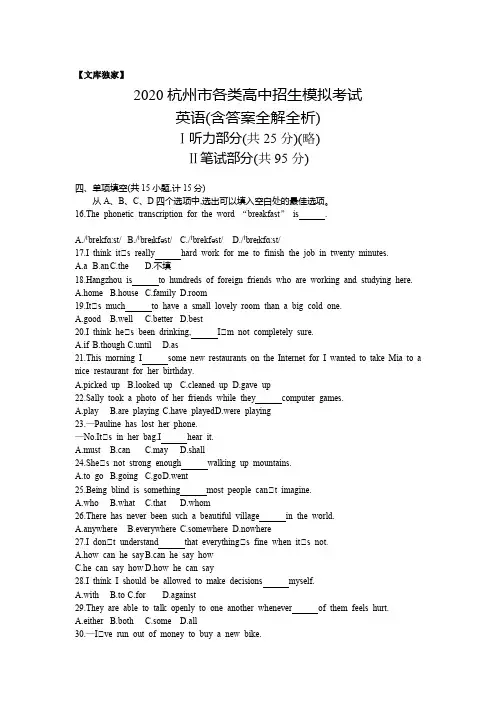
2020年中考一模检测《英语试卷》带答案解析2020年中考模拟测试英语试题注意事项:1. 答题前,请考生仔细阅读答题卡上的注意事项,并务必按照相关要求作答.2. 考试结束后,将本试卷和答题卡一并交回.第Ⅰ卷第一部分听力(一)听句子,选择适当的应答语.每个句子读两遍.1. A. Autumn. B. Physics. C. Sunday.2. A. You’re right. B. Well done. C. Good ide a.3. A. It’s very kind of you. B. Thank you. C. You’re welcome.4. A. It’s exciting. B. It’s dry. C. It’s expensive.5. A. No, go ahead. B. It’s up to you. C. That’s all right.(二)听五段对话,选择正确答案.每段对话读两遍.你将有20秒钟的时间阅读下面5个小题.6. Where will the girl spend her Saturday?A. At home.B. At a library.C. At a park.7. What’s the relationship between the two speakers?A. Husband and wife.B. Neighbors.C. Father and daughter.8. Where does the girl live now?A. Near her school.B. Near a river.C. Near a park.9. Whose key is on the sofa?A. The girl’s mom’s.B. The girl’s.C. The man’s.10. How long has the man waited there?A. For ten minutes.B. For twenty minutes.C. For thirty minutes.(三)听两段长对话,选择正确答案.每段对话读两遍.听每段对话前你将有10秒的时间阅读对应的3个小题.听第一段对话, 回答第11至13小题.11. What has the woman booked?A A table. B. A room. C. A ticket.12. Where does this conversation take place?A. In a restaurant.B. In a hotel.C. In a library.13. How does the woman feel in the conversation?A. Excited.B. Happy.C. Unhappy.听第二段对话,回答第14至16小题.14. What does Tina do?A. A reporter.B. A student.C. A teacher.15. What kind of music does Tina like?A. Loud music.B. Quiet music.C. Dance music.16. Where is Tina going to work when she grows up?A. France.B. China.C. America.(四)听短文, 回答下面四个问题, 选择正确答案.短文读两遍.你将有20秒钟的时间阅读下面4个小题.17. How long are the smallest kangaroos (袋鼠) ?A. About 50 cm.B. About 25 cm.C. About 15 cm.18. How long is a big kangaroo?A. Taller than a man.B. Shorter than a man.C. The same size as a man.19. How often does a kangaroo have a baby?A. Twice a year.B. Once a year.C. Once every two years.20. How long does a baby kangaroo stay in its mother’s pocket?A. Three months.B. Four months.C. Half a year.(五) 听短文,填表格.根据短文内容,写出下面表格中所缺的信息,每空一词.短文读三遍.你将有20秒钟的时间阅读表格内容.答题完毕后,请将答案填写在答题卡的相应位置.第二部分完形填空阅读下面短文,掌握其大意,然后从每题所给的A、B、C三个选项中,选出能填入短文相应空白处的最佳选项,并在答题卡上将该项涂黑.It does not always come easy to discover oneself. From a young age, I had a strong sense of who I was to become, but an accident made me redefine (重审)myself.To me, skating was above all. There was_____1_____ in this world that filled my heart with such joy. I spent twenty-four hours a week practicing my _____2_____.Unfortunately, in one show, I fell down and hurt myself______3______. After several X-rays and MRI(磁共振)scans, the doctor told me that I couldn't return to my sport any more. The pain in my back was hard to bear and even the______4______daily tasks became difficult.As my passion(激情)was _____5_____, I had little sense of who I was to become. After eight months of suffering, something had to _____6_____. Instead of wasting my days sitting around painfully, I began to put my_____7_____into local community service projects. After a few months, I devoted time to my interest in the arts. Little by little, I ____8____out of the shadow and rebuilt my confidence.Sometimes, some ____9____rocks block (阻碍) our way. We can choose to stay behind or try to climb over. My accident was a rock that ____10____to stop me from reaching success. Today I’m a very confident and optimistic person.1. A. everything B. something C. nothing2. A. skills B. behaviors C. thoughts3. A. quickly B. softly C. badly4. A. useful B. basic C. proper5. A. found out B. brought back C. taken away6. A. change B. remain C. leave7. A. energy B. duty C. wealth8. A. jumped B. stepped C. stood9. A. round B. large C. ugly10. A. managed B. continued C. failed第三部分阅读理解第一节阅读下列短文,从每题所给的A、B、C、D四个选项中,选出最佳选项,并在答题卡上将该项涂黑.AThe traditional Chinese lunar calendar(农历)divides the year into 24 solar terms. Grain Rain (谷雨), as the last term in spring, starts on April 19 and ends on May 4.Grain Rain comes from the old saying, “Rain brings up the growth of hundreds of grains”, which shows that this period of ra infall is very important for the growth of crops. Here’s something that you may not know about the Grain Rain.Grain Rain falls between the end of spring and the beginning of summer, and the temperature rises much higher than it does in March. With dry soil and heavy winds, sandstorms may happen more often.There is an old custom in southern China that people drink tea on the day of Grain Rain. Spring tea during Grain Rain is good for the eyes. It is also said that drinking tea on this day would prevent bad luck.People in northern China have the tradition to eat the vegetable toona sinensis during Grain Rain. An old Chinese saying goes “toona sinensis before the rain is as tender as silk (嫩如丝)”. The vegetable is good for the stomach and skin. The Grain Rain Festival is celebrated by fishing villages in northern China.Grain Rain marks the start of the fishermen’s first voyage (航行) of the year. The custom dates back to more than 2000 years ago.11. When Grain Rain ends, ________starts.A. springB. summerC. autumnD. winter12. The underlined word “crops” refers to ________.A. birds in the skyB. trees in the forestC. fishes in the seaD. plants in the field13. The people in southern China________ on the day of Grain Rain.A. drink teaB. eat toona sinensisC. start the first voyageD. eat fish14. We can infer that “toona sinensis” must be a kind of vegetable which ________.A. can bring good luckB. is delicious and healthyC. grows at the seasideD. is good for the eyesBWHICH FAMOUS PERSON IN HISTORY WOULD YOU LIKE TO HA VE MET AND WHY?For me it would clcarly be Leonardo da Vinci, I’d love to have met him. He was such a creative talent and not just an artist. He seems to have predicted a number of inventions that onlycame about hundreds of years later, like flying machines and so on. I’s like to tell him he really did see the future.Naomi, ChicagoI’d choose Cleopat ra—the last king of ancient Egypt(埃及). She is thought to have been very beautiful and is generally considered to have developed some really useful political alliances (政治同盟). Not many women were that powerful in ancient times, I’d like to have seen how sh e did it.Lucinda, NairobiI’m Latin American, so I would name Simon Bolivar as the person I would like to have known. He’s supposed t o have been a very great, brave leader'and is accepted to have helped achieve independence for several countries in Latin America in the nineteenth century. Patricia,Caracas I studied philosophy(哲学) , so I would like to have spoken face-to-face with the Chinese phi losopher donfucius. I’d15. Whose ideas about inventions have come true?A. Leonardo da Vinci’s.B. Cleopatra’s.C. Simon Bolivar’s.D. Confucius’.16. Which of the following is TRUE from the passage?A. Leonardo da Vinci invented a flying machine hundreds of years ago.B. Lucinda would like to have met Cleopatra because she was pretty.C. Simon Bolivar was a person who encouraged independence of women.D. Li Yun would like to have talked with Confucius about hisfamily values.17. In which part of a magazine can we read the passage?A. Art.B. MovieC. History.D. Technology.CBath, 97 miles west of London, is the largest city in Somerset, England. It became a World Heritage Site in 1987.The city got its name from the Roman Baths, which was a place for public bathing in Roman Britain. The water there is naturally heated under the ground. T oday visitors are no longer allowed to enter the water. However, the exhibitions there will tell you the history of the Roman Baths. You can see many ancient Roman objects, including the coins that were thrown into the water to show respect to the goddess.Looking over the city, you will see many old buildings in the color of honey. Among them, the Royal Crescent and the Circus are the most famous. The Royal Crescent is a row of 30 houses in the shape of crescent. The Circus is about 200 meters to the east of the Royal Crescent. It is a huge circle formed with large townhouses. It is divided into three pa rts of the same length by three entrances with a lawn in the center. When visiting Bath, you can’t miss these two sites.The museums in the city are also popular. You can go and appreciate western paintings. If you are interested in the English writer Jane Austen, you can go to Jane Austen Center to know more about her life with her father in Bath, If you come in October, you can even take part in the Bath Film Festival.With its own style and fantastic sights, Bath attracts millionsof tourists from all over the world.18. The passage is mainly about the ________in Bath.A. buildingsB. paintingsC. festivalsD. writers19. According to the passage, what can visitors do in the Roman Baths?A. Take a bath.B. Play in the water.C. Buy ancient Roman objects.D. Enjoy ancient coins.20. Which of the following is correct about the Royal Crescent and the Circus?A. B.C. D.21. Bath is a city________.A. that got its name from the heated waterB. where Jane Austen once livedC. where a film festival is held all year roundD. that has been a World Heritage Site for 2l yearsDImagine a perfect day: the weather is good and everything seems fine. When, suddenly, your mobile phone loses its signal, the television has no programs, and you can’t get online with your computer.What has happened? These are just the types of problems a solar storm(太阳风暴)might cause. You may not think of storms as putting our society in danger. But today, a solar storm is as serious as other bad events, such as earthquakes.A solar storm is caused by solar flares(太阳耀斑): large explosions(爆炸) near the sun that can give off lots of energy. The strong energy can stop the satellite systems(卫星系统)that control our computers, telecom networks and so on. These storms can even cause the power to go out for weeks or months.In the past of months, scientists have recorded some of the strongest sun flares in years. The most recent one happened around Valentine's Day, 2011. It caused radio and satellite signals to go down in some northern cities in China.“Solar Flare activity is going to be much worse than what w e’ve seen in the past. We’re not talking about a few cities losing power. It could be half of the country, maybe more.” SolarStormWarning. com, a US website about spaceweather, warned.Scientists say that little can be done to predict such a storm. Governments around the world are trying to work together before the next storm, although they are not sure when that may happen.22. According to the passage, a solar storm can cause many problems EXCEPT that________.A. earthquakes happenB. mobile phones have no signalsC. people cannot get onlineD. the power may go out23. According to the passage,solar flares are________. A. telecom networks B. solar storms C. large explosions near the sun D. US websites 24. From the passage, the right order of the following is________. a. solar flares give off lots of energy b. people can’t get online with their computersc. solar storms happend. satellite systems are stoppedA. a-b-c-dB. a-c-d-bC. c-a-b-dD. c-b-a-d25. The writer wrote the passage mainly to________.A. call for scientists to predict when the next solar storm will happenB. tell people how to solve the problems caused by solar stormsC. introduce what solar storms are to peopleD. ask people to work to prevent the solar storm from happening第二节根据短文内容,从短文后的选项中选出能填入空白处的最佳选项,并在答题卡上将该项涂黑.American and British people both speak English of course.But sometimes it does not seem like the same language.In fact, there are some important differences between British English and American English._____26_____ Often, Americans don’t say each word separately. They say several words together. Americans may say “I dunno” instead of “I don’t know”. Or they may say “Whaddya say?” instead of “What did you say?” However, the British are more careful in their speech. They usually say all the words and keep them separate.Sound is not only the difference between British English and American English. Words sometimes have different meanings too.Some American words are never used in England. The same thing is true of some British words in America.____27____Americans drive trucks, but in England people drive lorries._____28_____In England, if you are going to telephone your friends, you “phone them up”. In America, you “give them a call”. When you are saying goodbye in England, y ou might say “Cheerio!.” In America, you might say“See you later”.There are also some differences in grammar.For example, Americans usually use the helping verb “do” wh en they ask a question. They say “Do you have a storybook?” But the British often leave out the helpingverb._____29_____All these differences can be confusing if you are learning English. But most languages are like this. Languages change over time. When people live in separate places, the languages change in different ways.This is what has happened to English._____30_____Many people in Canada speak French but their French is very different from the French of France.A. It can also happen to other languages, such as French.B. For example, the vocabulary for cars and driving is very different.C. They say “Have you a storybook?”D. First of all, they sound very different.E. Many expressions are also different in the two countries.第Ⅱ卷第四部分书面表达(共三节)第一节词汇运用(一)单词拼写根据句意和首字母或汉语提示,将单词的正确形式完整地写在答题卡相应的位置上.31.—What do you think of Tom’s work?—He works so c________ that he often makes some mistakes.32.The Chinese scientists’ ________ (成就) make the world shocked.33.As students, we should be r________for ourselves. We can’t spend much time playing computer games.34.The little boy o________ his seat to an old lady on the crowded bus this morning.35.Teenagers should be________ (鼓励) to learn and spread Chinese culture.(二)综合填空根据短文内容,用方框中所给词语的适当形式填空,使文章通顺、完整.(每词限用一次)Cars make our lives more convenient. But they can also be a problem. Fossil fuel(矿物燃料)cars are a major cause of air pollution.To improve the environment, many countries are considering ____36____ electric vehicles (EVs, 电动车). China is taking a leading role and has created the largest EV market in the world.Last year, over 40 percent of the 753,000 EVs sold worldwide____37____sold in China, more than twice as many as the number sold in the United States, according to the International Energy Agency.Chinese ____38____are already big fans of EVs. Chinese auto companies(汽车公司) , including BYD and BAIC(北汽集团)were _____39_____ the top in the world in EV sales.“Charging(充电)an electric car is _____40_____ than filling up a fossil fuel car with gas,”said a customer, who bought an electric car from BAIC this year.____41____, there are still some problems. It can be hard tofind charging piles(充电桩) and the cars can’t go far before they need to be recharged.Some of these problems have been ____42____. In 2014, China had 31,000 charging piles, according to Xinhua News Agency. Now China has the____43____ largest EV charging network, with more than 167,000 charging piles in total, according to the Economic Daily.Developing EVs is one of many efforts China has made to reduce ____44____on its environment. The government promised to stop increasing carbon dioxide emissions(二氧化碳排放量) by 2030.“As China goes,____45____ will other countries,” the Wall Street Journal said.第二节阅读表达阅读下面的短文,并根据短文后的要求答题.(请注意问题后的字数要求)[1] Four Chinese cities Changsha, Qingdao, Wuhan and Macao have joined the UNESCO(联合国教教科文组织)Creative Cities Network. Changsha was named as “the City of media Arts; Qingdao is ” the City of Film”; Wuhan is “the City of Design(设计) and Macao is “the City of (73)Gastronomy”. (74) These four cities have made great efforts to build their creative industries.[2] Recent years have seen Changsha develop a strong cultural industry, 71(1)_______in TV, cartoon production and publishing. Hunan Satellite TV was ranked as China’s second- biggest TV brand last year, according to an industry information network. Rainbow Cat and Blue Rabbit(《虹猫蓝兔七侠传》)was also made in the city.[3] For Qingdao, film has played a major part in its development. It had its first movie theaters by the early 1900s.Film and filmmaking were first being developed. Qingdao is also home to the world’s largest film stud io(摄影棚) . More than 200 films, 71(2)______ The Great Wall, were shot in the city last year.[4] When it comes to Wuhan, perhaps some haven't known its design industry .But in fact, nearly 80 percent of China’s bridges and 7 percent of its high-speed rail ways were designed there. Some of the designs have won the international awards.[5] As for “ the City of Gastronomy”, Macao has lots of delicious food like bacalhau (鳕鱼干) and curried crab (咖喱蟹). New dishes are invented all the time and more young talent is entering the city’s food industry.46. Fill in the blanks in Paragraphs 2&3 with proper words. (no more than 2 words)(1)______________________________(2)____________________________ _________47. What made Wuhan join the UNESCO Creative Cities Network. (no more than 3 words)________________________________________________________________ ________48. What does the underlined word Gastronomy mean in Chinese?________________________________________________________________ _______49. Translate the underlined sentence in the first paragraph into Chinese.________________________________________________________________ _______50. Which sentence in this passage has the similar meaning as this one, “Here, the earliest cinemas appeared at the beginning of the tw entieth century “._____________________________________________51. What's the best title for the passage? (no more than 5 words)________________________________________________________________ _______第三节写作52.勇气是一种力量,我们到处都需要它.请根据图表信息,以“Courage”为题写一篇英语短文.2019年3月30日,四川发生森林火灾(a forest fire),二十七位森林消防指战员(firefighters)英勇牺牲.作为新时代好少年,我们应该在学习和生活中学习他们面对困难的勇气.学习方面害怕困难,曾经想到放弃,勇气帮我克服了困难.生活方面我们可能会遇到很多挑战,应该把勇气当作朋友,帮助我们更勇敢的面对困难.对勇气的体会……要求:1. 书写认真规范,词数不少于80词,开头已给出,不计入总词数;2. 短文应包括以上要点,语句通顺,可适当发挥,以使行文连贯;3. 文中不得出现自己的真实姓名和校名.CourageCourage is a kind of power. We need it everywhere.________________________________________________________________ ________________________________________________________________________________________________ ____________________________________________________________________________________________ ____________________________________________________________________________________________ ____________________________________________________________________________________________ ________________________答案与解析注意事项:1. 答题前,请考生仔细阅读答题卡上的注意事项,并务必按照相关要求作答.2. 考试结束后,将本试卷和答题卡一并交回.第Ⅰ卷第一部分听力(一)听句子,选择适当的应答语.每个句子读两遍.1. A. Autumn. B. Physics. C. Sunday.2. A. You’re right. B. Well done. C. Good idea.3. A. It’s very kind of you. B. Thank you. C. You’re welcome.4. A. It’s exciting. B. It’s dry. C. It’s expensive.5. A. No, go ahead. B. It’s up to you. C. That’s all right.(二)听五段对话,选择正确答案.每段对话读两遍.你将有20秒钟的时间阅读下面5个小题.6. Where will the girl spend her Saturday?A. At home.B. At a library.C. At a park.7. What’s the relationship between the two speakers?A. Husband and wife.B. Neighbors.C. Father and daughter.8. Where does the girl live now?A. Near her school.B. Near a river.C. Near a park.9. Whose key is on the sofa?A. The girl’s mom’s.B. The girl’s.C. The man’s.10. How long has the man waited there?A. For ten minutes.B. For twenty minutes.C. For thirty minutes.(三)听两段长对话,选择正确答案.每段对话读两遍.听每段对话前你将有10秒的时间阅读对应的3个小题.听第一段对话, 回答第11至13小题.11. What has the woman booked?A. A table.B. A room.C. A ticket.12. Where does this conversation take place?A. In a restaurant.B. In a hotel.C. In a library.13. How does the woman feel in the conversation?A. Excited.B. Happy.C. Unhappy.听第二段对话,回答第14至16小题.14. What does Tina do?A. A reporter.B. A student.C. A teacher.15. What kind of music does Tina like?A. Loud music.B. Quiet music.C. Dance music.16. Where is Tina going to work when she grows up?A. France.B. China.C. America.(四)听短文, 回答下面四个问题, 选择正确答案.短文读两遍.你将有20秒钟的时间阅读下面4个小题.17. How long are the smallest kangaroos (袋鼠) ?A. About 50 cm.B. About 25 cm.C. About 15 cm.18. How long is a big kangaroo?A. Taller than a man.B. Shorter than a man.C. The same size as a man.19. How often does a kangaroo have a baby?A. Twice a year.B. Once a year.C. Once every two years.20. How long does a baby kangaroo stay in its mother’s pocket?A. Three months.B. Four months.C. Half a year.(五) 听短文,填表格.根据短文内容,写出下面表格中所缺的信息,每空一词.短文读三遍.你将有20秒钟的时间阅读表格内容.答题完毕后,请将答案填写在答题卡的相应位置.第二部分完形填空阅读下面短文,掌握其大意,然后从每题所给的A、B、C三个选项中,选出能填入短文相应空白处的最佳选项,并在答题卡上将该项涂黑.It does not always come easy to discover oneself. From a young age, I had a strong sense of who I was to become, but an accident made me redefine (重审)myself.To me, skating was above all. There was_____1_____ in this world that filled my heart with such joy. I spent twenty-four hours a week practicing my _____2_____.Unfortunately, in one show, I fell down and hurt myself______3______. After several X-rays and MRI(磁共振)scans, the doctor told me that I couldn't return to my sport any more. The pain in my back was hard to bear and even the______4______daily tasks became difficult.As my passion(激情)was _____5_____, I had little sense of who I was to become. After eight months of suffering, something had to _____6_____. Instead of wasting my days sitting around painfully, I began to put my_____7_____into local community service projects. After a few months, I devoted time to my interest in the arts. Little by little, I ____8____out of the shadow and rebuilt my confidence. Sometimes,some ____9____rocks block (阻碍) our way. We can choose to stay behind or try to climb over. My accident was a rock that ____10____to stop me from reaching success. T oday I’ma very confident and optimistic person.1. A. everything B. something C. nothing2. A. skills B. behaviors C. thoughts3. A. quickly B. softly C. badly4. A. useful B. basic C. proper5. A. found out B. brought back C. taken away6. A. change B. remain C. leave7. A. energy B. duty C. wealth8. A. jumped B. stepped C. stood9. A. round B. large C. ugly10. A. managed B. continued C. failed【答案】1. C 2. A 3. C 4. B 5. C 6. A 7. A 8. B 9. B 10. C【解析】文章大意:短文讲述了发现自己的人生之路不总是那么容易的,作者的人生方向本来是坚定不移的滑冰,但是一次意外让作者失去了重返赛场的能力,但通过做志愿者的经历让作者重新发现了自己对艺术感兴趣,再次找到人生方向的故事.【1题详解】句意:这个世界上没有什么能让我的心充满这样的喜悦.everything每样事情;something某件事情;nothing没有事情.根据前句To me, skating was above all.对我来说,滑冰是最重要的可知,这个世界上就没有什么比滑冰能给作者带来这样的快乐,所以空处的词应是否定意义的“没有事情”,故答案为C. 【2题详解】句意:我一周花24小时练习我的技能. skills技能、技巧;behaviors行为;thoughts想法、主意.根据上文可知作者非常热爱滑冰,所以他一周花24小时练习滑冰的技能,故答案为A.【3题详解】句意:不幸的是,在一次演出中,我摔倒了,伤得很严重.quickly快地;softly轻轻地;badly非常、严重地.根据下句After several X-rays and MRI(磁共振)scans, the doctortold me that I couldn't return to my sport any more.在做了几次X光和核磁共振扫描后,医生告诉我再也不能回到我的运动了可知,伤得很严重,故答案为C.【4题详解】句意:背上的疼痛很难承受,甚至基础的日常活动都变得很困难.useful有用的;basic基础的;proper正确的.根据上文I felldown and hurt myself______3______.我摔倒了,伤得很严重和本句中The pain in my back was hard to bear背上的疼痛很难承受推测出,后半句应是“甚至基础的日常活动都变得很困难”,所以空处的词应是“基础的、基本的”,故答案为B.【5题详解】句意:当我的激情被夺走的时候,我对于自己要成为谁几乎没有了感觉.found out查明;brought back带回、使恢复;taken away拿走、夺走.根据下文Instead of wasting my days sittingaround painfully, I began to put my _____7_____into local community service projects.可知,作者开始把自己的精力投入到当地社区服务上面,所以推测出作者当初的激情被夺走了,故答案为C.【6题详解】句意:在经历了8个月的痛苦之后,有些事情不得不改变.change改变;remain保持不变、遗留;leave离开.根据下句Instead of wasting my days sitting around painfully,I began to put my _____7_____into local community service projects.可知,作者由最初的激情被夺走,对于自己要成为谁几乎没有了感觉,到后来作者开始把自己的精力投入到当地社区服务上面,由此可知在经历了8个月的痛苦后,有些事情不得不改变,故答案为A.【7题详解】句意:而不是痛苦地坐着浪费我的日子,我开始把我的精力投入到当地社区服务项目上.energy精力;duty职责;wealth财富.根据前文可知,作者有原先对滑冰的激情满满,到后来受伤,激情被夺走可知,作者是把“精力”投入到当地社区服务项目上,故答案为A.【8题详解】句意:一点一点地,我走出了阴影并且重建了信心.jumped跳;stepped行走、迈步;stood站立.step out of从……走出去,固定搭配,故答案为B.【9题详解】句意:有时一些巨大的岩石阻挡了我们的道路.round圆形的;large巨大的;ugly丑陋的.根据下句We can choose to stay behind or try to climb over. 我们可以选择待在后面或者努力爬上去可知,是巨大的岩石阻挡了我们的道路,故答案为B.【10题详解】句意:我的事故是一块岩石,未能阻止我取得成功.managed设法、管理;continued继续;failed失败、未能.根据上文叙述可知,作者觉得自己的事故就是一块岩石,但是并没有阻止自己成功,并让自己变成了一个自信乐观的人,所以空处的词应是“未能、失败”,故答案为C.第三部分阅读理解第一节阅读下列短文,从每题所给的A、B、C、D四个选项中,选出最佳选项,并在答题卡上将该项涂黑.AThe traditional Chinese lunar calendar(农历)divides the year into 24 solar terms. Grain Rain (谷雨), as the last term in spring, starts on April 19 and ends on May 4.Grain Rain comes from the old saying, “Rain brings up the growth of hundreds of grains”, which shows th at this period of rainfall is very important for the growth of crops. Here’s something that you may not know about the Grain Rain.Grain Rain falls between the end of spring and the beginning of summer, and the temperature rises much higher than it does in March. With dry soil and heavy winds, sandstorms may happen more often.There is an old custom in southern China that people drinktea on the day of Grain Rain. Spring tea during Grain Rain is good for the eyes. It is also said that drinking tea on this day would prevent bad luck.People in northern China have the tradition to eat the vegetable toona sinensis during Grain Rain. An old Chinese saying goes “toona si nensis before the rain is as tender as silk (嫩如丝)”. The vegetable is good for the stomach and skin.The Grain Rain Festival is celebrated by fishing villages in northern China. Grain Rain marks the start of the fishermen’s first voyage (航行) of the year. The custom dates back to more than 2000 years ago.11. When Grain Rain ends, ________starts.A. springB. summerC. autumnD. winter12. The underlined word “crops” refers to ________.A. birds in the skyB. trees in the forestC. fishes in the seaD. plants in the field13. The people in southern China________ on the day of Grain Rain.A. drink teaB. eat toona sinensisC. start the first voyageD. eat fish14. We can infer that “toona sinensis” must be a kind of vegetable which ________.A. can bring good luckB. is delicious and healthyC. grows at the seasideD. is good for the eyes【答案】11. B 12. D 13. A 14. B【解析】文章大意:短文介绍了谷雨这个节气.在谷雨时,雨水开始频繁,促进作物的生长.北方的人们在谷雨期间吃香椿;南方的人喝茶;在北方渔村人们会庆祝谷雨节.【11题详解】细节理解题.根据文中Grain Rain falls between the end of spring and the beginning of summer, 可知,谷雨在春末和夏初之间,因此谷雨结束的时候,夏天就开始了,故答案为B.【12题详解】词义猜测题.根据Grain Rain comes from the old saying, “Rain brings up the growth of hundreds of grains”, 可知,谷雨促进谷物的生长,谷物是庄稼,是生长在田地里的植物,故答案为D.【13题详解】细节理解题.根据文中根据There is an old custom in southern China that people drink tea on the day of Grain Rain. 可知,在中国南方,人们在谷雨这一天喝茶,故答案为A.【14题详解】推理判断题.根据文中The vegetable is good for the stomach and skin. 可知,香椿这种蔬菜对胃和皮肤好,故推断它是健康的,美味的蔬菜,故选B.BWHICH FAMOUS PERSON IN HISTORY WOULD YOU LIKE TO HA VE MET AND WHY?Fo r me it would clcarly be Leonardo da Vinci, I’d love to have met him. He was such a creative talent and not just an artist.。