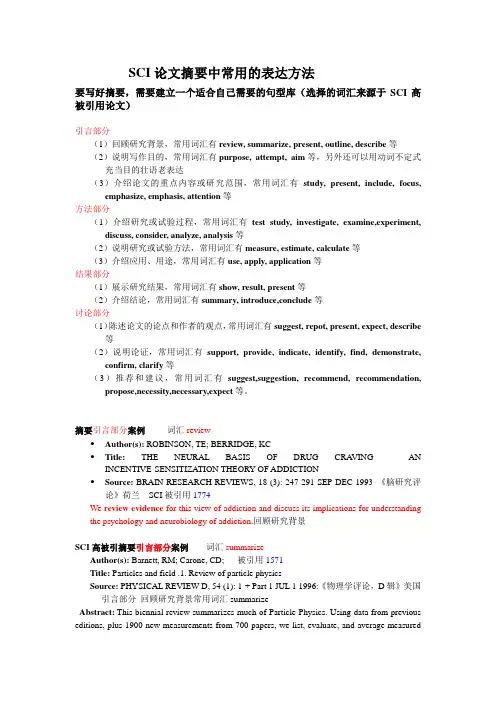
SCI论文摘要中常用的表达方法要写好摘要,需要建立一个适合自己需要的句型库(选择的词汇来源于SCI高被引用论文)引言部分(1)回顾研究背景,常用词汇有review, summarize, present, outline, describe等(2)说明写作目的,常用词汇有purpose, attempt, aim等,另外还可以用动词不定式充当目的壮语老表达(3)介绍论文的重点内容或研究范围,常用词汇有study, present, include, focus, emphasize, emphasis, attention等方法部分(1)介绍研究或试验过程,常用词汇有test study, investigate, examine,experiment, discuss, consider, analyze, analysis等(2)说明研究或试验方法,常用词汇有measure, estimate, calculate等(3)介绍应用、用途,常用词汇有use, apply, application等结果部分(1)展示研究结果,常用词汇有show, result, present等(2)介绍结论,常用词汇有summary, introduce,conclude等讨论部分(1)陈述论文的论点和作者的观点,常用词汇有suggest, repot, present, expect, describe 等(2)说明论证,常用词汇有support, provide, indicate, identify, find, demonstrate, confirm, clarify等(3)推荐和建议,常用词汇有suggest,suggestion, recommend, recommendation, propose,necessity,necessary,expect等。
摘要引言部分案例词汇review•Author(s): ROBINSON, TE; BERRIDGE, KC•Title:THE NEURAL BASIS OF DRUG CRA VING - AN INCENTIVE-SENSITIZATION THEORY OF ADDICTION•Source: BRAIN RESEARCH REVIEWS, 18 (3): 247-291 SEP-DEC 1993 《脑研究评论》荷兰SCI被引用1774We review evidence for this view of addiction and discuss its implications for understanding the psychology and neurobiology of addiction.回顾研究背景SCI高被引摘要引言部分案例词汇summarizeAuthor(s): Barnett, RM; Carone, CD; 被引用1571Title: Particles and field .1. Review of particle physicsSource: PHYSICAL REVIEW D, 54 (1): 1-+ Part 1 JUL 1 1996:《物理学评论,D辑》美国引言部分回顾研究背景常用词汇summarizeAbstract: This biennial review summarizes much of Particle Physics. Using data from previous editions, plus 1900 new measurements from 700 papers, we list, evaluate, and average measuredproperties of gauge bosons, leptons, quarks, mesons, and baryons. We also summarize searches for hypothetical particles such as Higgs bosons, heavy neutrinos, and supersymmetric particles. All the particle properties and search limits are listed in Summary Tables. We also give numerous tables, figures, formulae, and reviews of topics such as the Standard Model, particle detectors, probability, and statistics. A booklet is available containing the Summary Tables and abbreviated versions of some of the other sections of this full Review.SCI摘要引言部分案例attentionSCI摘要方法部分案例considerSCI高被引摘要引言部分案例词汇outline•Author(s): TIERNEY, L SCI引用728次•Title:MARKOV-CHAINS FOR EXPLORING POSTERIOR DISTRIBUTIONS 引言部分回顾研究背景,常用词汇outline•Source: ANNALS OF STATISTICS, 22 (4): 1701-1728 DEC 1994•《统计学纪事》美国•Abstract: Several Markov chain methods are available for sampling from a posterior distribution. Two important examples are the Gibbs sampler and the Metropolis algorithm.In addition, several strategies are available for constructing hybrid algorithms. This paper outlines some of the basic methods and strategies and discusses some related theoretical and practical issues. On the theoretical side, results from the theory of general state space Markov chains can be used to obtain convergence rates, laws of large numbers and central limit theorems for estimates obtained from Markov chain methods. These theoretical results can be used to guide the construction of more efficient algorithms. For the practical use of Markov chain methods, standard simulation methodology provides several Variance reduction techniques and also gives guidance on the choice of sample size and allocation.SCI高被引摘要引言部分案例回顾研究背景presentAuthor(s): L YNCH, M; MILLIGAN, BG SC I被引用661Title: ANAL YSIS OF POPULATION GENETIC-STRUCTURE WITH RAPD MARKERS Source: MOLECULAR ECOLOGY, 3 (2): 91-99 APR 1994《分子生态学》英国Abstract: Recent advances in the application of the polymerase chain reaction make it possible to score individuals at a large number of loci. The RAPD (random amplified polymorphic DNA) method is one such technique that has attracted widespread interest.The analysis of population structure with RAPD data is hampered by the lack of complete genotypic information resulting from dominance, since this enhances the sampling variance associated with single loci as well as induces bias in parameter estimation. We present estimators for several population-genetic parameters (gene and genotype frequencies, within- and between-population heterozygosities, degree of inbreeding and population subdivision, and degree of individual relatedness) along with expressions for their sampling variances. Although completely unbiased estimators do not appear to be possible with RAPDs, several steps are suggested that will insure that the bias in parameter estimates is negligible. To achieve the same degree of statistical power, on the order of 2 to 10 times more individuals need to be sampled per locus when dominant markers are relied upon, as compared to codominant (RFLP, isozyme) markers. Moreover, to avoid bias in parameter estimation, the marker alleles for most of these loci should be in relatively low frequency. Due to the need for pruning loci with low-frequency null alleles, more loci also need to be sampled with RAPDs than with more conventional markers, and sole problems of bias cannot be completely eliminated.SCI高被引摘要引言部分案例词汇describe•Author(s): CLONINGER, CR; SVRAKIC, DM; PRZYBECK, TR•Title: A PSYCHOBIOLOGICAL MODEL OF TEMPERAMENT AND CHARACTER•Source: ARCHIVES OF GENERAL PSYCHIATRY, 50 (12): 975-990 DEC 1993《普通精神病学纪要》美国•引言部分回顾研究背景,常用词汇describe 被引用926•Abstract: In this study, we describe a psychobiological model of the structure and development of personality that accounts for dimensions of both temperament and character. Previous research has confirmed four dimensions of temperament: novelty seeking, harm avoidance, reward dependence, and persistence, which are independently heritable, manifest early in life, and involve preconceptual biases in perceptual memory and habit formation. For the first time, we describe three dimensions of character that mature in adulthood and influence personal and social effectiveness by insight learning about self-concepts.Self-concepts vary according to the extent to which a person identifies the self as (1) an autonomous individual, (2) an integral part of humanity, and (3) an integral part of the universe as a whole. Each aspect of self-concept corresponds to one of three character dimensions called self-directedness, cooperativeness, and self-transcendence, respectively. We also describe the conceptual background and development of a self-report measure of these dimensions, the Temperament and Character Inventory. Data on 300 individuals from the general population support the reliability and structure of these seven personality dimensions. We discuss the implications for studies of information processing, inheritance, development, diagnosis, and treatment.摘要引言部分案例•(2)说明写作目的,常用词汇有purpose, attempt, aimSCI高被引摘要引言部分案例attempt说明写作目的•Author(s): Donoho, DL; Johnstone, IM•Title: Adapting to unknown smoothness via wavelet shrinkage•Source: JOURNAL OF THE AMERICAN STATISTICAL ASSOCIATION, 90 (432): 1200-1224 DEC 1995 《美国统计学会志》被引用429次•Abstract: We attempt to recover a function of unknown smoothness from noisy sampled data. We introduce a procedure, SureShrink, that suppresses noise by thresholding the empirical wavelet coefficients. The thresholding is adaptive: A threshold level is assigned to each dyadic resolution level by the principle of minimizing the Stein unbiased estimate of risk (Sure) for threshold estimates. The computational effort of the overall procedure is order N.log(N) as a function of the sample size N. SureShrink is smoothness adaptive: If the unknown function contains jumps, then the reconstruction (essentially) does also; if the unknown function has a smooth piece, then the reconstruction is (essentially) as smooth as the mother wavelet will allow. The procedure is in a sense optimally smoothness adaptive: It is near minimax simultaneously over a whole interval of the Besov scale; the size of this interval depends on the choice of mother wavelet. We know from a previous paper by the authors that traditional smoothing methods-kernels, splines, and orthogonal series estimates-even with optimal choices of the smoothing parameter, would be unable to perform in a near-minimax way over many spaces in the Besov scale.Examples of SureShrink are given. The advantages of the method are particularly evident when the underlying function has jump discontinuities on a smooth backgroundSCI高被引摘要引言部分案例To investigate说明写作目的•Author(s): OLTV AI, ZN; MILLIMAN, CL; KORSMEYER, SJ•Title: BCL-2 HETERODIMERIZES IN-VIVO WITH A CONSERVED HOMOLOG, BAX, THAT ACCELERATES PROGRAMMED CELL-DEATH•Source: CELL, 74 (4): 609-619 AUG 27 1993 被引用3233•Abstract: Bcl-2 protein is able to repress a number of apoptotic death programs. To investigate the mechanism of Bcl-2's effect, we examined whether Bcl-2 interacted with other proteins. We identified an associated 21 kd protein partner, Bax, that has extensive amino acid homology with Bcl-2, focused within highly conserved domains I and II. Bax is encoded by six exons and demonstrates a complex pattern of alternative RNA splicing that predicts a 21 kd membrane (alpha) and two forms of cytosolic protein (beta and gamma). Bax homodimerizes and forms heterodimers with Bcl-2 in vivo. Overexpressed Bax accelerates apoptotic death induced by cytokine deprivation in an IL-3-dependent cell line. Overexpressed Bax also counters the death repressor activity of Bcl-2. These data suggest a model in which the ratio of Bcl-2 to Bax determines survival or death following an apoptotic stimulus.SCI高被引摘要引言部分案例purposes说明写作目的•Author(s): ROGERS, FJ; IGLESIAS, CA•Title: RADIATIVE ATOMIC ROSSELAND MEAN OPACITY TABLES•Source: ASTROPHYSICAL JOURNAL SUPPLEMENT SERIES, 79 (2): 507-568 APR 1992 《天体物理学杂志增刊》美国SCI被引用512•Abstract: For more than two decades the astrophysics community has depended on opacity tables produced at Los Alamos. In the present work we offer new radiative Rosseland mean opacity tables calculated with the OPAL code developed independently at LLNL. We give extensive results for the recent Anders-Grevesse mixture which allow accurate interpolation in temperature, density, hydrogen mass fraction, as well as metal mass fraction. The tables are organized differently from previous work. Instead of rows and columns of constant temperature and density, we use temperature and follow tracks of constant R, where R = density/(temperature)3. The range of R and temperature are such as to cover typical stellar conditions from the interior through the envelope and the hotter atmospheres. Cool atmospheres are not considered since photoabsorption by molecules is neglected. Only radiative processes are taken into account so that electron conduction is not included. For comparison purposes we present some opacity tables for the Ross-Aller and Cox-Tabor metal abundances. Although in many regions the OPAL opacities are similar to previous work, large differences are reported.For example, factors of 2-3 opacity enhancements are found in stellar envelop conditions.SCI高被引摘要引言部分案例aim说明写作目的•Author(s):EDV ARDSSON, B; ANDERSEN, J; GUSTAFSSON, B; LAMBERT, DL;NISSEN, PE; TOMKIN, J•Title:THE CHEMICAL EVOLUTION OF THE GALACTIC DISK .1. ANALYSISAND RESULTS•Source: ASTRONOMY AND ASTROPHYSICS, 275 (1): 101-152 AUG 1993 《天文学与天体物理学》被引用934•Abstract:With the aim to provide observational constraints on the evolution of the galactic disk, we have derived abundances of 0, Na, Mg, Al, Si, Ca, Ti, Fe, Ni, Y, Zr, Ba and Nd, as well as individual photometric ages, for 189 nearby field F and G disk dwarfs.The galactic orbital properties of all stars have been derived from accurate kinematic data, enabling estimates to be made of the distances from the galactic center of the stars‘ birthplaces. 结构式摘要•Our extensive high resolution, high S/N, spectroscopic observations of carefully selected northern and southern stars provide accurate equivalent widths of up to 86 unblended absorption lines per star between 5000 and 9000 angstrom. The abundance analysis was made with greatly improved theoretical LTE model atmospheres. Through the inclusion of a great number of iron-peak element absorption lines the model fluxes reproduce the observed UV and visual fluxes with good accuracy. A new theoretical calibration of T(eff) as a function of Stromgren b - y for solar-type dwarfs has been established. The new models and T(eff) scale are shown to yield good agreement between photometric and spectroscopic measurements of effective temperatures and surface gravities, but the photometrically derived very high overall metallicities for the most metal rich stars are not supported by the spectroscopic analysis of weak spectral lines.•Author(s): PAYNE, MC; TETER, MP; ALLAN, DC; ARIAS, TA; JOANNOPOULOS, JD•Title:ITERA TIVE MINIMIZATION TECHNIQUES FOR ABINITIO TOTAL-ENERGY CALCULATIONS - MOLECULAR-DYNAMICS AND CONJUGA TE GRADIENTS•Source: REVIEWS OF MODERN PHYSICS, 64 (4): 1045-1097 OCT 1992 《现代物理学评论》美国American Physical Society SCI被引用2654 •Abstract: This article describes recent technical developments that have made the total-energy pseudopotential the most powerful ab initio quantum-mechanical modeling method presently available. In addition to presenting technical details of the pseudopotential method, the article aims to heighten awareness of the capabilities of the method in order to stimulate its application to as wide a range of problems in as many scientific disciplines as possible.SCI高被引摘要引言部分案例includes介绍论文的重点内容或研究范围•Author(s):MARCHESINI, G; WEBBER, BR; ABBIENDI, G; KNOWLES, IG;SEYMOUR, MH; STANCO, L•Title: HERWIG 5.1 - A MONTE-CARLO EVENT GENERA TOR FOR SIMULATING HADRON EMISSION REACTIONS WITH INTERFERING GLUONS SCI被引用955次•Source: COMPUTER PHYSICS COMMUNICATIONS, 67 (3): 465-508 JAN 1992:《计算机物理学通讯》荷兰Elsevier•Abstract: HERWIG is a general-purpose particle-physics event generator, which includes the simulation of hard lepton-lepton, lepton-hadron and hadron-hadron scattering and soft hadron-hadron collisions in one package. It uses the parton-shower approach for initial-state and final-state QCD radiation, including colour coherence effects and azimuthal correlations both within and between jets. This article includes a brief review of the physics underlying HERWIG, followed by a description of the program itself. This includes details of the input and control parameters used by the program, and the output data provided by it. Sample output from a typical simulation is given and annotated.SCI高被引摘要引言部分案例presents介绍论文的重点内容或研究范围•Author(s): IDSO, KE; IDSO, SB•Title: PLANT-RESPONSES TO ATMOSPHERIC CO2 ENRICHMENT IN THE FACE OF ENVIRONMENTAL CONSTRAINTS - A REVIEW OF THE PAST 10 YEARS RESEARCH•Source: AGRICULTURAL AND FOREST METEOROLOGY, 69 (3-4): 153-203 JUL 1994 《农业和林业气象学》荷兰Elsevier 被引用225•Abstract:This paper presents a detailed analysis of several hundred plant carbon exchange rate (CER) and dry weight (DW) responses to atmospheric CO2 enrichment determined over the past 10 years. It demonstrates that the percentage increase in plant growth produced by raising the air's CO2 content is generally not reduced by less than optimal levels of light, water or soil nutrients, nor by high temperatures, salinity or gaseous air pollution. More often than not, in fact, the data show the relative growth-enhancing effects of atmospheric CO2 enrichment to be greatest when resource limitations and environmental stresses are most severe.SCI高被引摘要引言部分案例介绍论文的重点内容或研究范围emphasizing •Author(s): BESAG, J; GREEN, P; HIGDON, D; MENGERSEN, K•Title: BAYESIAN COMPUTATION AND STOCHASTIC-SYSTEMS•Source: STATISTICAL SCIENCE, 10 (1): 3-41 FEB 1995《统计科学》美国•SCI被引用296次•Abstract: Markov chain Monte Carlo (MCMC) methods have been used extensively in statistical physics over the last 40 years, in spatial statistics for the past 20 and in Bayesian image analysis over the last decade. In the last five years, MCMC has been introduced into significance testing, general Bayesian inference and maximum likelihood estimation. This paper presents basic methodology of MCMC, emphasizing the Bayesian paradigm, conditional probability and the intimate relationship with Markov random fields in spatial statistics.Hastings algorithms are discussed, including Gibbs, Metropolis and some other variations. Pairwise difference priors are described and are used subsequently in three Bayesian applications, in each of which there is a pronounced spatial or temporal aspect to the modeling. The examples involve logistic regression in the presence of unobserved covariates and ordinal factors; the analysis of agricultural field experiments, with adjustment for fertility gradients; and processing oflow-resolution medical images obtained by a gamma camera. Additional methodological issues arise in each of these applications and in the Appendices. The paper lays particular emphasis on the calculation of posterior probabilities and concurs with others in its view that MCMC facilitates a fundamental breakthrough in applied Bayesian modeling.SCI高被引摘要引言部分案例介绍论文的重点内容或研究范围focuses •Author(s): HUNT, KJ; SBARBARO, D; ZBIKOWSKI, R; GAWTHROP, PJ•Title: NEURAL NETWORKS FOR CONTROL-SYSTEMS - A SURVEY•Source: AUTOMA TICA, 28 (6): 1083-1112 NOV 1992《自动学》荷兰Elsevier•SCI被引用427次•Abstract:This paper focuses on the promise of artificial neural networks in the realm of modelling, identification and control of nonlinear systems. The basic ideas and techniques of artificial neural networks are presented in language and notation familiar to control engineers. Applications of a variety of neural network architectures in control are surveyed. We explore the links between the fields of control science and neural networks in a unified presentation and identify key areas for future research.SCI高被引摘要引言部分案例介绍论文的重点内容或研究范围focus•Author(s): Stuiver, M; Reimer, PJ; Bard, E; Beck, JW;•Title: INTCAL98 radiocarbon age calibration, 24,000-0 cal BP•Source: RADIOCARBON, 40 (3): 1041-1083 1998《放射性碳》美国SCI被引用2131次•Abstract: The focus of this paper is the conversion of radiocarbon ages to calibrated (cal) ages for the interval 24,000-0 cal BP (Before Present, 0 cal BP = AD 1950), based upon a sample set of dendrochronologically dated tree rings, uranium-thorium dated corals, and varve-counted marine sediment. The C-14 age-cal age information, produced by many laboratories, is converted to Delta(14)C profiles and calibration curves, for the atmosphere as well as the oceans. We discuss offsets in measured C-14 ages and the errors therein, regional C-14 age differences, tree-coral C-14 age comparisons and the time dependence of marine reservoir ages, and evaluate decadal vs. single-year C-14 results. Changes in oceanic deepwater circulation, especially for the 16,000-11,000 cal sp interval, are reflected in the Delta(14)C values of INTCAL98.SCI高被引摘要引言部分案例介绍论文的重点内容或研究范围emphasis •Author(s): LEBRETON, JD; BURNHAM, KP; CLOBERT, J; ANDERSON, DR•Title: MODELING SURVIV AL AND TESTING BIOLOGICAL HYPOTHESES USING MARKED ANIMALS - A UNIFIED APPROACH WITH CASE-STUDIES •Source: ECOLOGICAL MONOGRAPHS, 62 (1): 67-118 MAR 1992•《生态学论丛》美国•Abstract: The understanding of the dynamics of animal populations and of related ecological and evolutionary issues frequently depends on a direct analysis of life history parameters. For instance, examination of trade-offs between reproduction and survival usually rely on individually marked animals, for which the exact time of death is most often unknown, because marked individuals cannot be followed closely through time.Thus, the quantitative analysis of survival studies and experiments must be based oncapture-recapture (or resighting) models which consider, besides the parameters of primary interest, recapture or resighting rates that are nuisance parameters. 结构式摘要•T his paper synthesizes, using a common framework, these recent developments together with new ones, with an emphasis on flexibility in modeling, model selection, and the analysis of multiple data sets. The effects on survival and capture rates of time, age, and categorical variables characterizing the individuals (e.g., sex) can be considered, as well as interactions between such effects. This "analysis of variance" philosophy emphasizes the structure of the survival and capture process rather than the technical characteristics of any particular model. The flexible array of models encompassed in this synthesis uses a common notation. As a result of the great level of flexibility and relevance achieved, the focus is changed from fitting a particular model to model building and model selection.SCI摘要方法部分案例•方法部分•(1)介绍研究或试验过程,常用词汇有test,study, investigate, examine,experiment, discuss, consider, analyze, analysis等•(2)说明研究或试验方法,常用词汇有measure, estimate, calculate等•(3)介绍应用、用途,常用词汇有use, apply, application等SCI高被引摘要方法部分案例discusses介绍研究或试验过程•Author(s): LIANG, KY; ZEGER, SL; QAQISH, B•Title: MULTIV ARIATE REGRESSION-ANAL YSES FOR CATEGORICAL-DATA •Source:JOURNAL OF THE ROY AL STA TISTICAL SOCIETY SERIES B-METHODOLOGICAL, 54 (1): 3-40 1992《皇家统计学会志,B辑:统计方法论》•SCI被引用298•Abstract: It is common to observe a vector of discrete and/or continuous responses in scientific problems where the objective is to characterize the dependence of each response on explanatory variables and to account for the association between the outcomes. The response vector can comprise repeated observations on one variable, as in longitudinal studies or genetic studies of families, or can include observations for different variables.This paper discusses a class of models for the marginal expectations of each response and for pairwise associations. The marginal models are contrasted with log-linear models.Two generalized estimating equation approaches are compared for parameter estimation.The first focuses on the regression parameters; the second simultaneously estimates the regression and association parameters. The robustness and efficiency of each is discussed.The methods are illustrated with analyses of two data sets from public health research SCI高被引摘要方法部分案例介绍研究或试验过程examines•Author(s): Huo, QS; Margolese, DI; Stucky, GD•Title: Surfactant control of phases in the synthesis of mesoporous silica-based materials •Source: CHEMISTRY OF MATERIALS, 8 (5): 1147-1160 MAY 1996•SCI被引用643次《材料的化学性质》美国•Abstract: The low-temperature formation of liquid-crystal-like arrays made up of molecular complexes formed between molecular inorganic species and amphiphilic organic molecules is a convenient approach for the synthesis of mesostructure materials.This paper examines how the molecular shapes of covalent organosilanes, quaternary ammonium surfactants, and mixed surfactants in various reaction conditions can be used to synthesize silica-based mesophase configurations, MCM-41 (2d hexagonal, p6m), MCM-48 (cubic Ia3d), MCM-50 (lamellar), SBA-1 (cubic Pm3n), SBA-2 (3d hexagonal P6(3)/mmc), and SBA-3(hexagonal p6m from acidic synthesis media). The structural function of surfactants in mesophase formation can to a first approximation be related to that of classical surfactants in water or other solvents with parallel roles for organic additives. The effective surfactant ion pair packing parameter, g = V/alpha(0)l, remains a useful molecular structure-directing index to characterize the geometry of the mesophase products, and phase transitions may be viewed as a variation of g in the liquid-crystal-Like solid phase. Solvent and cosolvent structure direction can be effectively used by varying polarity, hydrophobic/hydrophilic properties and functionalizing the surfactant molecule, for example with hydroxy group or variable charge. Surfactants and synthesis conditions can be chosen and controlled to obtain predicted silica-based mesophase products. A room-temperature synthesis of the bicontinuous cubic phase, MCM-48, is presented. A low-temperature (100 degrees C) and low-pH (7-10) treatment approach that can be used to give MCM-41 with high-quality, large pores (up to 60 Angstrom), and pore volumes as large as 1.6 cm(3)/g is described.Estimates 介绍研究或试验过程SCI高被引摘要方法部分案例•Author(s): KESSLER, RC; MCGONAGLE, KA; ZHAO, SY; NELSON, CB; HUGHES, M; ESHLEMAN, S; WITTCHEN, HU; KENDLER, KS•Title:LIFETIME AND 12-MONTH PREV ALENCE OF DSM-III-R PSYCHIATRIC-DISORDERS IN THE UNITED-STA TES - RESULTS FROM THE NATIONAL-COMORBIDITY-SURVEY•Source: ARCHIVES OF GENERAL PSYCHIATRY, 51 (1): 8-19 JAN 1994•《普通精神病学纪要》美国SCI被引用4350次•Abstract: Background: This study presents estimates of lifetime and 12-month prevalence of 14 DSM-III-R psychiatric disorders from the National Comorbidity Survey, the first survey to administer a structured psychiatric interview to a national probability sample in the United States.Methods: The DSM-III-R psychiatric disorders among persons aged 15 to 54 years in the noninstitutionalized civilian population of the United States were assessed with data collected by lay interviewers using a revised version of the Composite International Diagnostic Interview. Results: Nearly 50% of respondents reported at least one lifetime disorder, and close to 30% reported at least one 12-month disorder. The most common disorders were major depressive episode, alcohol dependence, social phobia, and simple phobia. More than half of all lifetime disorders occurred in the 14% of the population who had a history of three or more comorbid disorders. These highly comorbid people also included the vast majority of people with severe disorders.Less than 40% of those with a lifetime disorder had ever received professional treatment,and less than 20% of those with a recent disorder had been in treatment during the past 12 months. Consistent with previous risk factor research, it was found that women had elevated rates of affective disorders and anxiety disorders, that men had elevated rates of substance use disorders and antisocial personality disorder, and that most disorders declined with age and with higher socioeconomic status. Conclusions: The prevalence of psychiatric disorders is greater than previously thought to be the case. Furthermore, this morbidity is more highly concentrated than previously recognized in roughly one sixth of the population who have a history of three or more comorbid disorders. This suggests that the causes and consequences of high comorbidity should be the focus of research attention. The majority of people with psychiatric disorders fail to obtain professional treatment. Even among people with a lifetime history of three or more comorbid disorders, the proportion who ever obtain specialty sector mental health treatment is less than 50%.These results argue for the importance of more outreach and more research on barriers to professional help-seekingSCI高被引摘要方法部分案例说明研究或试验方法measure•Author(s): Schlegel, DJ; Finkbeiner, DP; Davis, M•Title:Maps of dust infrared emission for use in estimation of reddening and cosmic microwave background radiation foregrounds•Source: ASTROPHYSICAL JOURNAL, 500 (2): 525-553 Part 1 JUN 20 1998 SCI 被引用2972 次《天体物理学杂志》美国•The primary use of these maps is likely to be as a new estimator of Galactic extinction. To calibrate our maps, we assume a standard reddening law and use the colors of elliptical galaxies to measure the reddening per unit flux density of 100 mu m emission. We find consistent calibration using the B-R color distribution of a sample of the 106 brightest cluster ellipticals, as well as a sample of 384 ellipticals with B-V and Mg line strength measurements. For the latter sample, we use the correlation of intrinsic B-V versus Mg, index to tighten the power of the test greatly. We demonstrate that the new maps are twice as accurate as the older Burstein-Heiles reddening estimates in regions of low and moderate reddening. The maps are expected to be significantly more accurate in regions of high reddening. These dust maps will also be useful for estimating millimeter emission that contaminates cosmic microwave background radiation experiments and for estimating soft X-ray absorption. We describe how to access our maps readily for general use.SCI高被引摘要结果部分案例application介绍应用、用途•Author(s): MALLAT, S; ZHONG, S•Title: CHARACTERIZATION OF SIGNALS FROM MULTISCALE EDGES•Source: IEEE TRANSACTIONS ON PATTERN ANALYSIS AND MACHINE INTELLIGENCE, 14 (7): 710-732 JUL 1992•SCI被引用508次《IEEE模式分析与机器智能汇刊》美国•Abstract: A multiscale Canny edge detection is equivalent to finding the local maxima ofa wavelet transform. We study the properties of multiscale edges through the wavelet。