
人教高中英语必修二Unit_2_The_Olympic_Games-Reading
- 格式:ppt
- 大小:1.77 MB
- 文档页数:32
Greek Olympic Games
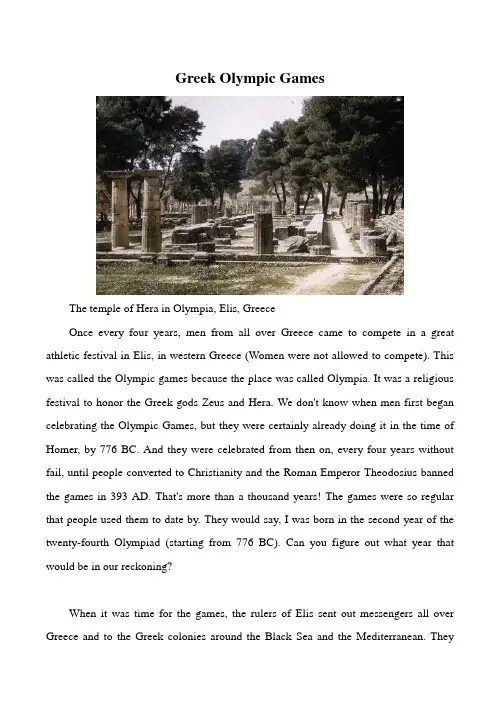
The temple of Hera in Olympia, Elis, Greece
Once every four years, men from all over Greece came to compete in a great
athletic festival in Elis, in western Greece (Women were not allowed to compete). This
was called the Olympic games because the place was called Olympia. It was a religious
festival to honor the Greek gods Zeus and Hera. We don't know when men first began
celebrating the Olympic Games, but they were certainly already doing it in the time of
Homer, by 776 BC. And they were celebrated from then on, every four years without
fail, until people converted to Christianity and the Roman Emperor Theodosius banned
the games in 393 AD. That's more than a thousand years! The games were so regular
that people used them to date by. They would say, I was born in the second year of the

Book2 Unit 2 The Olympic Games
一、重点词汇总结
1.ancient adj.古代的 in ancient times 在古代;古老的;年代久远的
We were deeply attracted by the ancient buildings.
pete vi. 竞争,对抗,compete with 与……竞争,compete for 竞争以获得……
compete with/against sb. for sth. 为得到某物与某人竞争, compete in (a game, a match) 参加;在……方面竞争,be in competition with sb.和某人竞争
competition n.比赛;竞争,competitor n.比赛者;竞争者,competitive adj.竞争的;有竞争力的
He believed that nobody could compete with him.
More than 1000 competitors took part in the competition to compete for the first prize.
Wang Junxia has competed in two Olympics.
3. take part in 参加
Did you take part in the fighting?
4.medal 奖牌/章 a gold/silver/bronze medal 金/银/铜牌
It’s certain that he will win a silver medal for racing.
5.stand for 是……的意思,代表(不用于进行时);容忍,忍受(用于否定句中);支持,主张
P.O. stands for Post Office.

人教版高中英语必修2《Unit 2 The Olympic Games》
教学目标
Goal For Knowledge
1. Get the students to learn the useful new words and expressions in bold in this
part: ancient, compete, medal, volunteer, Greece, homeland, regular, basis, athlete,
admit, slave, nowadays, gymnastics, stadium, gymnasium, host, responsibility, replace,
swift, motto, take part in, stand f or, as well
2. Let students learn about the basic knowledge on the Olympic Games.
Goal For Ability
1. Develop the students’ reading ability and let them learn different reading
skills.
2. Enable the students to learn to talk about the Olympic Games.
Goal On Emotion
1. Arouse the students’ great interest in the Olympic Games.
2. Develop the students’ sense of cooperative learning.
教学重难点
Key Points about the Class
1. Let the students learn more about the basic knowledge on the Olympic Games.

奥运会的起源与发展
古希腊是一个神话王国,优美动人的神话故事和曲折离奇的民间传说,为古奥运会的起源蒙上一层神秘的色彩。传说:古代奥林匹克运动会是为祭祀宙斯而定期举行的体育竞技活动。另一种传说与宙斯的儿子赫拉克勒斯有关。赫拉克勒斯因力大无比获"大力神"的美称。他在伊利斯城邦完成了常人无法完成的任务,不到半天功夫便扫干净了国王堆满牛粪的牛棚,但国王不想履行赠送300头牛的许诺,赫拉克勒一气之下赶走了国王。为了庆祝胜利,他在奥林匹克举行了运动会。
关于古奥运会起源流传最广的是佩洛普斯娶亲的故事。古希腊伊利斯国王为了给自己的女儿挑选一个文武双全的驸马,提出应选者必须和自己比赛战车。比赛中,先后有13个青年丧生于国王的长矛之下,而第14个青年正是宙斯的孙子和公主的心上人佩洛普斯。在爱情的鼓舞下,他勇敢地接受了国王的挑战,终于以智取胜。为了庆贺这一胜利,佩洛普斯与公主在奥林匹亚的宙斯庙前举行盛大的婚礼,会上安排了战车、角斗等项比赛,这就是最初的古奥运会,佩洛普斯成了古奥运会传说中的创始人。
奥运会的起源,实际上与古希腊的社会情况有着密切的关系。公元前9-8世纪,希腊氏族社会逐步瓦解,城邦制的奴隶社会逐渐形成,建立了200多个城邦。城邦各自为政,无统一君主,城邦之间战争不断。为了应付战争,各城邦都积极训练士兵。斯巴达城邦儿童从7岁起就由国家抚养,并从事体育、军事训练,过着军事生活。战争需要士兵,士兵需要强壮身体,而体育是培养能征善战士兵的有力手段。战争促进了希腊体育运动的开展,古奥运会的比赛项目也带有明显的军事烙印。连续不断的战事使人民感到厌恶,普遍渴望能有一个赖以休养生息的和平环境。后来斯巴达王和伊利斯王签订了"神圣休战月"条约。于是,为准备兵源的军事训练和体育竞技,逐渐变为和平与友谊的运动会。
古代奥运会的盛衰
古奥运会从公元前776年起,到公元394年止,经历了1168年,共举行了293届。按其起源、盛衰,大致分为三个时期。