初中英语语法---形容词
- 格式:docx
- 大小:44.89 KB
- 文档页数:7
页 1 形容词:
考点一:形容词的基本用法
1. 形容词的作用及位置
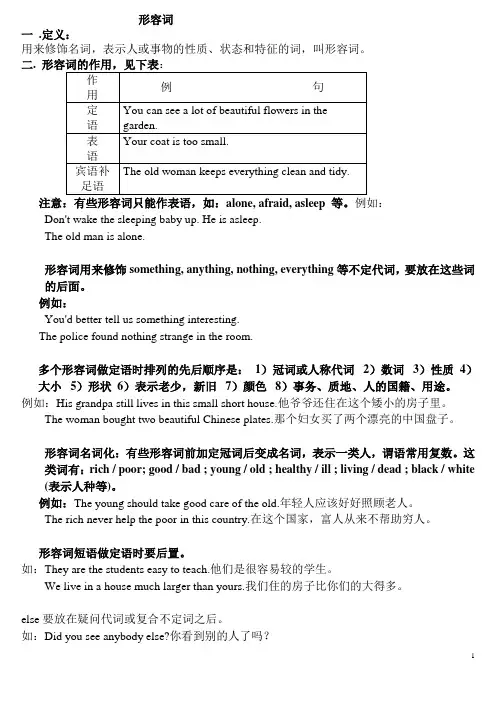
说明人或事物的性质、特征或状态,常用来修饰名词或者不定代词的词叫形容词。
(1) 作定语,修饰名词放在名词之前,修饰复合不定代词放在不定代词之后。如:
① He has long straight brown hair and big eyes. 他有长而直的棕色头发和大眼睛。
②) Did you do anything interesting last weekend? 上周末你做了什么有趣的事情了吗?
(2) 作表语,放在系动词之后。如:
She knows hamburgers are not good for her, but they taste good. 她知道汉堡包对自己没有好处,
但是它们很美味。
(3) 作宾语补足语,放在宾语之后,常与make、leave、keep、find等动词连用。如:
There we put up our tents and made a fire to keep us warm. 在那里,我们搭起帐篷,堆起了,
堆来保持温暖。
2. 形容词的名词化
某些形容词放在定冠词之后,相当于名词,表示一类人,常见词有good/bad、rich/poor、young
old等。如:
The young should be polite to the old. 年轻人应该对老人有礼貌。
3. 形容词的排列顺序
当名词由两个以上的形容词和一些具有形容词功能的限定词修饰时,这些词的顺序通常遵循一定的规则,一般不得随意调换,也不能依照汉语的习惯去排列。通常可按下面的顺序排列:
(1) 限定词,包括:冠词、指示代词、形容词性物主代词、名词所有格、数词等。
(2) 表示观点的描述性形容词,如:beautiful、fine、interesting等。
(3) 表示大小、长短、高低等的形容词,如:tall、high、small、little、round等。
(4) 表示年龄、新旧的形容词,如:young、 old、new等。
(5) 表示颜色的形容词,如:black、white、blue等。
(6) 表示国籍、地区、出处的形容词,如:Japanese、American、English等。
(7) 表示构成中心名词的材料的形容词,如:plastic、silky、wooden等。如:
three small round old Chinese wooden tables三张旧的中式木制小圆桌
4. 有一些表示情感等的表语形容词后可接动词不定式
构成be+ adj. +to do sth. 的结构
如:
① I'm so happy to see them again. 我很高兴又见到他们。
② For many students, it is easy to get to school. 对许多学生来说,到达学校很容易。
页 2 5. 常见的名词变形容词的方法
名词 构成方法 意义 举例
表示天气的名词
-y
充满……的
多……的 rain-rainy
wind-windy
表示方位的名词
-ern ····方位的
朝······方位的 west-western
east-eastern
表示称谓的名词 -ly ……般 friend-friendly
mother-motherly
表示时间的名词 -ly 每……的 week-weekly
month-monthly
表示物质的名词 -en ……材质的 wood-wooden
gold-golden
表示抽象意义的名词 -ful
-y
-less ……的
无……的 care-careful
use-useful
luck-lucky
hope-hopeless
表示大洲与国家的名词 -n ……国的
……人的 Asia-Asian
America-American
考点二:形容词的比较等级
1. 形容词原级的用法
(1) 说明人或事物自身的特征、性质和状态时,用形容词原级。如:
I like dogs because they're friendly and smart. 我喜欢狗,因为它们既友好又聪明。
(2) 前面有副词修饰时,如very、so、too、enough、quite、really等,用形容词原级。如:
① Your dog is really cute, 你的狗真可爱。
② My best friend Carol is really kind and very funny. 我最好的朋友卡罗尔真的很善良,很有趣。
(3) 表示A和B在某方面程度相同或者不同时,用形容词原级。如:
•肯定句结构:"A. . . +as+形容词原级+as+B”。如:
I think science is as important as math. 我认为科学和数学一样重要。
•否定句结构:"A. . .not+as/so+形容词原级+as+B”。如:
① It is not as/so warm today as yesterday. 今天不像昨天那么暖和。
② Huang Lei isn't as good at tennis as Larry, 黄雷不如拉里擅长网球。
否定句的结构中部分双音节和多音节形容词除使用“not+as/so+形容词原级+as”结构外,
还可以使用“less+形容词原级+than”结构。如:
Jeff is less serious than most kids. 相比大多数孩子,杰夫不太严肃。
•表示“A是B的几倍”时,用"A. . . +倍数+as+形容词原级+as+B”结构。如:
Our school is three times as big as theirs. 我们学校是他们学校的三倍大。
2. 形容词比较等级的用法
(1) 形容词比较级、最高级的构成
•规则变化 页 3 类别 构成方法 原级 比较级 最高级
单音节词
和部分双
音节词
一般在词尾直接加-er, -est high
tall higher
taller highest
tallest
以字母e结尾的词,在词尾加-r,
-st late
large later
larger latest
largest
以辅音字母加-y结尾的双音节词,先把-y改为-i, 再加-er, -est easy
happy easier
happier
easiest
happiest
重读闭音节词词尾只有一个辅音字母时,先双写该辅音字母,再加-er, -est big
fat bigger
fatter biggest
fattest
多音节词
和部分双
音节词
在词前加more,most interesting
beautiful more interesting
more beautiful most interesting
most beautiful
•不规则变化
原级 比较级 最高级
good/well better best
bad/badly worse worst
many/much more most
little less least
far farther further farthest furthest
old older elder oldest eldest
(2) 形容词比较级的用法
•表示两者(人或事物)之间的比较时用形容词的比较级,其结构为“A. . . +比较级+than+B”。如。
I'm more outgoing than my sister. 我比我的姐姐更外向。
•形容词比较级前可使用程度副词a little、a bit, a great deal, a lot, much、even、still、 far
修饰语,以强调程度。如:
① I'm outgoing, but my best friend is a lot more outgoing than me. 我很外向,但是我最好的朋友比我还要外向。
③ It is much colder today than yesterday. 今天比昨天冷得多。
•表示两者之间的选择“哪一个更······”时,用句型“which/who+. . . +形容词比较级,A or
B? ”表示。如:
Which one is bigger, the sun or the earth? 太阳和地球哪一个更大?
•表示倍数时,用“倍数+比较级+than”表示。如:
The elephant weighs many times more than this panda. 这头大象比这只熊猫要重许多倍。 页 4 •表示“两者之间比较······的一个(of the two) ”时,常用“the+比较级”结构。如:
Mary is the taller of the two girls. 玛丽是两个女孩中较高的那一个。
•表示“越来越·····. ”用比较级的重叠结构,即“比较级+and+比较级”。当形容词为多音节
词或部分双音节词时,用“more and more+形容词原级”。如:
① It's getting warmer and warmer in spring. 在春天,天气变得越来越暖和。
② Talent shows are getting more and more popular. 才艺秀越来越受欢迎了。
•表示“越······就越······”时,用“the+比较级+ (主语+谓语),the+比较级+ (主语+谓
语)”结构。如:
① The more, the better. 越多越好。
② The more you eat, the fatter you will be. 你吃得越多,就会长得越胖。
③ The more careful you are, the fewer mistakes you will make. 你越仔细,犯的错误就会越少。
(3) 形容词最高级的用法
•表示三者或三者以上(人或物)之间的比较时,其中有一个在某方面超过其他几个,用最
高级形式。形容词最高级前必须加定冠词the, 后面可用in/of短语来说明比较范围。、如:
Screen City is the best theater in the town. “电影城”是这个小镇上最好的剧场
•表示在三者或三者以上的人或物中进行选择时,用“which/who+be+the+形容词最高级十A,
B or C? ”结构。如:
Which is the most beautiful city, Beijing, Shanghai or Fuzhou?
哪座城市最漂亮,北京、上海还是福州?
•表示“最······的·. ····之一”时,用“one of the+形容词最高级+可数名词复数”结构、如:
Jay Chou is one of the most popular singers. 周杰伦是最受欢迎的歌手之一。