英语常用简写 -回复
- 格式:doc
- 大小:12.14 KB
- 文档页数:5
英语常用简写 -回复
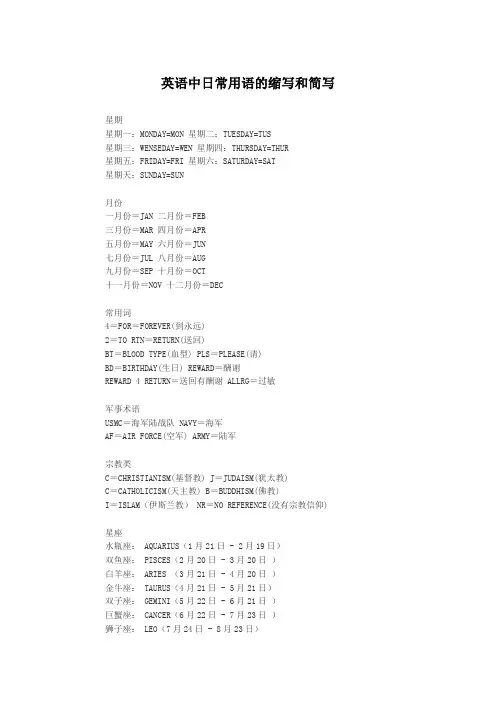
What Are Some Common Abbreviations in English?
Abbreviations play a significant role in the English language. They
help save time, space, and effort by condensing long phrases or
words into shorter representations. These abbreviated forms are
commonly used in various aspects of our daily lives, such as in
formal writing, social media, texting, and even in spoken language.
In this article, we will explore the most frequently used English
abbreviations and discuss their usage and meaning.
1. ASAP [As Soon As Possible]
ASAP stands for "As Soon As Possible" and is commonly used to
indicate urgency or a prompt response. It implies the need for
immediate action or attention.
For example:
- Please submit the report ASAP.
2. DIY [Do It Yourself]
DIY refers to the practice of accomplishing a task or creating
something on your own without professional assistance. It is widely used in various fields, including home improvement, crafts, and
cooking.
For example:
- Check out these DIY tips for redecorating your living room.
3. RSVP [Répondez S'il Vous Plaît]
RSVP is derived from the French phrase, which translates to "Please
respond." It is used to request a response or confirmation
regarding attendance or participation in an event.
For example:
- Kindly RSVP to the wedding invitation by next week.
4. ETA [Estimated Time of Arrival]
ETA is used to refer to the approximate time of arrival or the
expected time when a person or item will reach a certain
destination.
For example:
- What's your ETA? I'm waiting for you at the coffee shop.
5. OOTD [Outfit of the Day]
OOTD is commonly used in the context of fashion and social media.
It refers to showcasing one's chosen outfit or attire for the day.
For example:
- Share your OOTD and tag us in your Instagram posts.
6. FAQ [Frequently Asked Questions]
FAQ is an abbreviation used to refer to a list of frequently asked
questions and their corresponding answers. It is commonly found
on websites, product manuals, and customer support pages.
For example:
- Please refer to the FAQ section for more information about our
services.
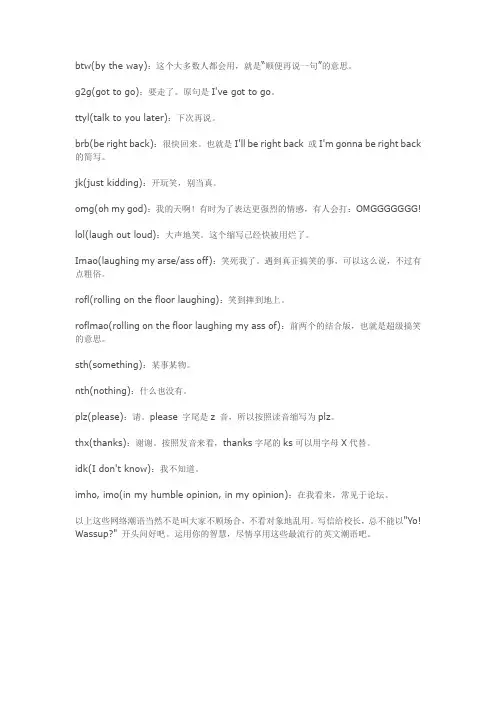
7. LOL [Laugh Out Loud]
LOL is a widely recognized abbreviation used in digital
communication to indicate laughter or amusement. It has evolved
to signify humor or sarcasm.
For example: - That joke was hilarious, LOL!
8. FYI [For Your Information]
FYI is often used to convey additional information or to share
something without expecting a response or action from the
recipient.
For example:
- FYI, the meeting has been rescheduled to tomorrow at 3 PM.
9. CEO [Chief Executive Officer]
CEO is an abbreviation commonly used in business contexts to
denote the highest-ranking executive in an organization. The CEO
is responsible for making major decisions and leading the
company.
For example:
- The CEO will be presenting the annual report during the
shareholders' meeting.
10. ASAP [As Simple As Possible]
ASAP, in a different context from the one mentioned earlier, can also stand for "As Simple As Possible." It is used to emphasize the
need for simplicity or an uncomplicated solution.
For example:
- Please explain the instructions ASAP to ensure everyone
understands.
In conclusion, abbreviations are an essential part of the English
language, allowing us to communicate more efficiently in various
contexts. Whether it is in formal writing, text messages, or social
media posts, knowing and correctly using these common English
abbreviations can enhance our communication skills and save time
and effort.