人教版七年级下册英语期中复习
- 格式:docx
- 大小:38.50 KB
- 文档页数:7
人教版七年级下册英语期中复习
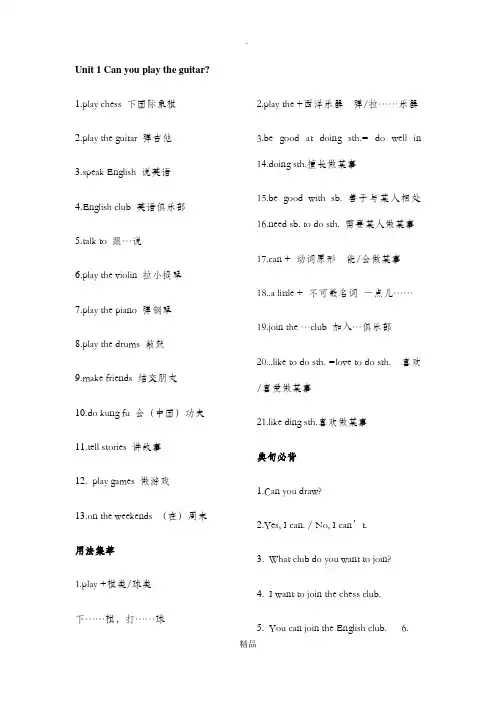
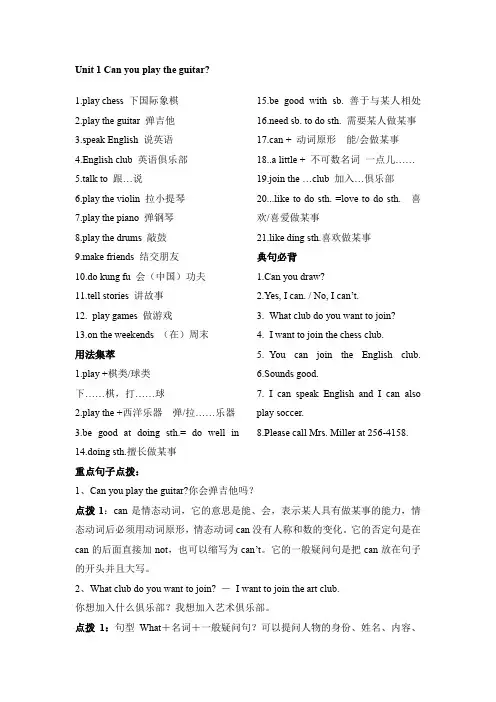
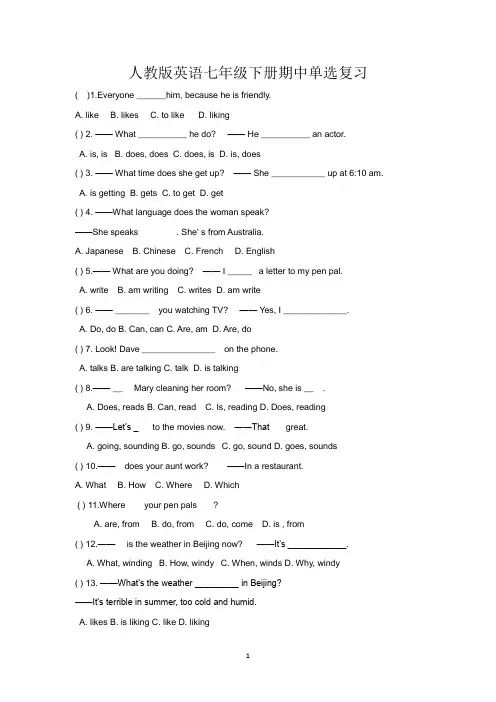
Unit 1 Can you play the guitar?
XXX "can":
Can" can be used to express ability。such as "He can speak
English very well" or "She can sing some English songs." It can
also be used to express n。such as "You can play the lin after
school every day" or "Students can't take cell phones or Mp3
players to school." "Can" can also be used to make a polite request。with "Could you help me with my English?" being an example。"Can't" is the negative form of "can," and can be used to express
impossibility。such as "That can't be him。He is in New York
now."
Negative and interrogative forms:
To form the negative form of a modal verb like "can," simply
add "not" after the verb。To form the interrogative form。invert
the subject and the modal verb。For example。"He can play the drums" es "He can't play the drums" in the negative。and "Can he
play the drums?" in the interrogative.
Unit 2 What time do you go to school?
Structure:
The structure for asking about time is to use a special n word
(such as "what" in this case)。followed by the verb "be," and then
the subject。For example。"What time do you go to school?" is a
correct XXX.
Unit 3 How do you get to school?
Unit 3 discusses n to school。and the n "How do you get to
school?" is a common way to ask about this。Some possible
answers could be "I take the bus" or "I walk."
Unit 4 Don't eat in class.
Unit 4 is about classroom rules。and one of the most
common rules is "Don't eat in class." This is because eating can be
distracting to other students and can make a mess in the classroom.
Unit 5 Why do you like pandas?
Unit 5 is about animals。and the n "Why do you like
pandas?" is a way to ask XXX。Some possible answers could be
"I like pandas because they are cute" or "I like pandas because they
are endangered and need our help."
Unit 6 I'm watching TV.
Unit 6 is about what people are currently doing。and "I'm
watching TV" is an example of a present XXX。such as "She is
reading a book" or "They are playing soccer."
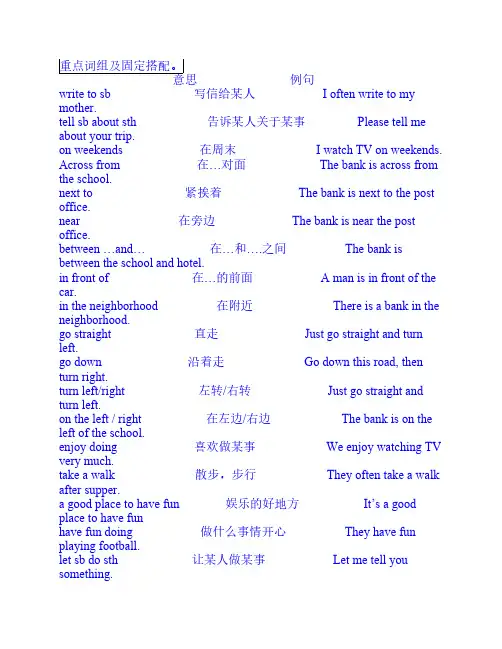
特殊疑问词+助动词do/does+主语+实义动词的用法是用来构成疑问句的。常用的特殊疑问词包括什么时候、什么地方、谁、谁的、如何等等。
练部分:
1.对画线部分提问:
1.What time do they get dressed?
2.When does she take a walk?
3.Where does he usually swim?
4.How does Jack go to school?
2.表示时间的方法:
1.使用数字表示时间,例如7:20可以表示为XXX,8:55可以表示为eight fifty-five。
2.使用介词past或to。当分钟数小于等于30分钟时,使用介词past,例如9:10可以表示为ten minutes past nine,10:30可以表示为half past ten;当分钟数大于30分钟时,使用介词to,例如11:40可以表示为XXX。
3.特殊时间段的表示法:30分钟可以使用half past代替,15分钟可以使用a quarter代替。
4.在某一时刻使用介词at。
5.提问时间使用“What time is it?”或“What's the time?”的形式。
文章本身没有明显的格式错误,但是第一段有一些语法和标点错误,已经进行了修正。另外,第四段的内容比较简单,可以删除。
Unit 4: Don't eat in class.
A sentence used to express a request is called an imperative
sentence。The present tense is used in XXX。The structure is
verb base form + other components + please。In negative
imperative sentences。the verb base form is preceded by "don't"。For example: Be quiet in the classroom。please。Don't fight.
The modal verbs "have to" and "must" have similar meanings。"Have to" indicates that something must be done based on ns。while "must" indicates that the speaker must do something。For
example: ①There is no bus。you have to walk home。②I must
study English well。"Have to" has different forms。while "must"
has only one form。For example: He has to stay at home。it's
raining。
In negative structures。"don't have to" is used instead of
"mustn't"。For example: You don't have to wait for him。You
mustn't play with fire。It's dangerous.
Unit 5: Why do you like pandas?
XXX interrogative adverb "why" is used to ask XXX。The
structure is Why + do(n't)/does(n't) + subject + other。The answer
to a "why" n can only be "because"。For example: Why do you
like monkeys。Because they are very clever.
XXX interrogative adverb "where" is used to ask ns about n。The structure is Where + be + subject + other。Or Where +
do/does + subject + verb base form + other。For example: Where
are you from。I am from Shandong。Where does Peter live。He
lives in UK.
In this lesson。"Isn't she beautiful?" is a negative
interrogative sentence。The structure is auxiliary verb + not +
subject + (main verb) + other? Unit 6 I'm watching TV.
现在进行时表示正在进行的动作或状态。构成为助动词“am/is/are”和动词的“ing”形式。时间状语可以是“now”、“XXX”、“look”、“listen”或者“It's+某一时刻”。
肯定句的结构为主语+am/is/are+v。ing,否定句则在助动词后加“not”。一般疑问句的结构为Am/Is/Are+主语+v。ing,回答时根据肯定或否定回答即可。特殊疑问句则需要加上特殊疑问词。
动词的“ing”形式的构成方法有三种。一种是在规则动词后加“ing”,如watch—watching;read—reading;listen—listening;另一种是以不发音字母“e”结尾的动词去掉“e”,再加“ing”,如make—making;use—using;exercise—exercising;live—living;最后一种是以重读闭音节结尾的动词,末尾只有一个辅音字母时,双写这个辅音字母,再加“ing”,如put—putting;—ping;sit—sitting;begin—beginning。