
farmer and goose
- 格式:doc
- 大小:11.50 KB
- 文档页数:1
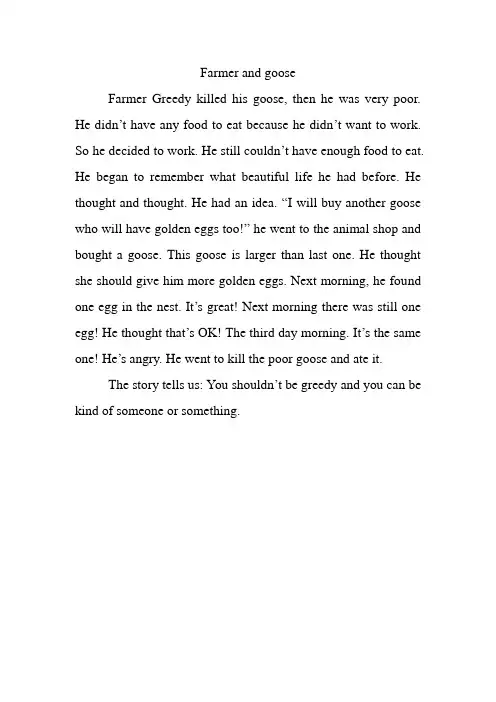

农夫与鹅的故事英文版There is a young peasant watch in front of the bush, and his daily wish is to pick up a goose egg from the goose cage for breakfast.One day he found a golden egg in the goose cage fruit. of course he didn't believe it was true and so on.he thinks.Maybe someone is catching without him.For the sake of caution, he showed the golden egg, but the golden smith assured him that after the golden egg it was made of pure gold, and the farmer sold it The golden egg was laid, and then a grand celebration was held. The next morning, he got up and felt the goose cage, where there was a golden egg.This situation has been continued for several days. But the farmer was a greedy man, and he was very dissatisfied with his goose, which could not explain to him how he had laid it, otherwise perhaps he would have made it himself.He was also angry The lazy goose should lay at least two golden eggs a day, which is too slow now.His anger grew, and at last he pulled the goose out of the cage and split it in half. After then he never got golden eggs. In Puppy Money Money, Mr.King tells you, do not kill your goose.Goose represents your money and if you save, you getinterest.Interest is like a golden egg.。

英语章节书《the goose's gold》简介1. 引言本文将介绍英语章节书《the goose's gold》的概述、作品简介以及撰写此文章的目的。
1.1 概述在世界各地,英语是一门被广泛使用和学习的语言。
随着全球化的发展,掌握英语已经成为了必备的技能。
因此,在学习英语的过程中,阅读原版英文书籍是提高自己口语和写作能力的重要途径之一。
《the goose's gold》就是一本适合初级英语学习者阅读的书籍。
1.2 《the goose's gold》介绍《the goose's gold》是由约翰·斯皮卡特(John Speakout)所编写的一本英语小说。
该故事讲述了一个农夫和他饲养的鹅之间发生的奇妙冒险。
故事通过精彩纷呈的情节和有趣迷人的角色,带领读者进入一个神秘而充满想象力的世界。
1.3 目的本篇文章旨在帮助读者更好地了解《the goose's gold》这本书,并为初级英语学习者提供有关如何利用这本书提高自己英语水平的建议。
通过对主要角色、情节以及书中包含的主题和教训进行分析与解读,读者将能够更深入地理解这本书的意义,并从中获得启示。
最后,文章还将提供个人的阅读体会、反思和感悟,并对《the goose's gold》作出评价和推荐意见。
通过阅读本文,读者将能够对该书有一个全面而深入的了解,并为自己未来的阅读计划和学习方向提供参考。
2. 故事梗概:2.1 主要角色介绍:故事《the goose's gold》主要围绕着两个主要角色展开。
第一个主要角色是一只名叫小鹅的年轻雄性鹅,它拥有一身美丽而特殊的羽毛,被其他动物视为珍贵的财富。
第二个主要角色是农夫约翰,他是小鹅的所有者。
2.2 情节简述:故事开始描绘了小鹅和农夫约翰之间的亲密关系。
小鹅吸引了很多人的注意,他们都希望能够拥有小鹅身上的金色羽毛。
然而,农夫约翰非常珍惜小鹅,并且并不想将它卖给其他人。

The farmer and the snakeIt was a cold winter day. A farmer found(找到) a snake on the ground (地上). It was nearly(差不多)dead(死了)by cold. The farmer was a kind(仁慈)man. He picked up(捡起) the snake carefully(小心地)and put it under the coat. Soon the snake began to move(移动)and it raised (抬起)its mouth and bite(咬)the farmer. “Oh , my god !” said the farmer, “I save(救)your life(命), but you thank me in that way. You must die(死).” Then he killed(杀)the snake with a stick. At last he died , too.found 英 [faʊnd] 找到(find的过去分词)ground 英 [graʊnd] n. 地面;土地;范围;战场nearly 英 ['nɪəlɪ] adv. 差不多,几乎;密切地dead 英 [ded] adj. 无生命的;呆板的;废弃了的kind 英 [kaɪnd] adj. 和蔼的;宽容的;令人感激的,仁慈的pick up 捡起;获得;收拾;(汽车;飞机)乘载carefully 英 ['keəfəlɪ] adv. 小心地begin to do sth 开始做某事move 英 [muːv] 移动raise 英 [reɪz] 提高;筹集;养育;升起bite 英 [baɪt] 咬save 英 [seɪv] 救die 英 [daɪ] 死kill 英 [kɪl] 杀死died 英 [daɪd] v. 死亡,消逝(die的过去式和过去分词)。

L4Part 1 Intensive ReadingXinhua Dictionary, 50 Years On“I killed the wrong goose,” a man plained in his letter to the editors of the Xinhua Dictionary.It was the 1970s. The man, a goose farmer, wanted to kill a male goose. He didn't know the difference between male and female geese.so he turned to the dictionary for help.“Goose: a kind of poultry (家禽).”it read.“The males have a yellow bump(突起物) on their head.”The man chose a goose that matched the description. But when he opened its stomach, many eggs poured out onto the counter, and the man was angry.The dictionary entry (词条) wasn't totally wrong. However, it didn't make it clear that all geese have a yellow bump on their head.Males just have bigger ones. The dictionary 's editors corrected the error in the next edition (版次).Since its birth in 1953, the Xinhua Dictionary has been used as an encyclopedia by people across China. More than 600 million copies have been sold. Few books have remained so popular for so many years.When the dictionary was first published, the name Xinhua bore the hope of a country reborn. In 1949, about 80 percent of China's population was illiterate (不识字的). Although one of its early editions failed the goose farmer, Xinhua succeeded in opening up knowledge and opportunities 一to millions of Chinese people. “I got my first dictionary in 1971 and I still treasure it," said a woman in her 50s. “I had no education when I was little. The dictionary helped me get into high school."Over the past 50 years, the dictionary has been revised (修正)many times.“鲟(sturgeon)”was once explained as“edible(可食用的)." Later editions made it clear that it was “an animal in danger.Similarly,“豹(leopards)”are no longer“wild animals whose fur can be made into clothes.”Recent editions have included many new explanations. The character “晒”(to dry something under the sun),for example, now has a second meaning: to share. Popular expressions like“初心”(original intention) and “点赞”(to give somebody a thumbs up) have also been added to the dictionary.In a way, Xinhua hasn’t just explained words; it has shaped the way Chinese people think.“Primary school positions across China are similar,”read a 2010 article in Southern Weekly (《南方周末》).“When children write about a spring outing, the sky is always ‘cloudless for tenthousand miles.’They will always “sing and dance’on the way.”“Both sentences, the article added, “are based on examples in the Xinhua Dictionary.Part2 Choose1. Yesterday I saw ______ action film ______ Cheng Long.A. a; starringB. an; starredC. an; starringD. a; starred2. —Must we get there before six?—No, you ______.A. mustn'tB. may notC. can'tD. don't have to3. His mother's ______ was a great blow to him.A. diedB. deadC. deathD. die4. There is ______ food in the fridge. Let's go to the supermarket.A. a bitB. a bit ofC. littleD. a little of5. —Would you mind ______ care of our child?—______.I'd love to.A. to take; Of courseB. taking; CertainlyC. to take; Certainly notD. taking; Of course not6. I don't know if she ______ tomorrow. If it ______, perhaps she'll e.A. will e; stops rainingB. es; will stop rainingC. will e; won't rainD. es; doesn't rain7. I found John was very careful. He ______ everything ______ than I did.A. plans; betterB. planed; bestC. planned; betterD. planned; well8. Hainan is a good place ______ for touring ______ for surfing. It has the best beaches and waves all the year round.A. neither; norB. not only; but alsoC. either; orD. both; and9. He couldn't decide ______.A. which sweater he boughtB. which sweater did he buyC. which sweater will I buyD. which sweater to buy10. She asked ______.A. who was he talking withB. who he is talking withC. who he was talking withD. who is he talking with11. He had a bad cough. The doctor advised him to give up ______.A. smokeB. smokingC. to smokeD. smoked12. He is ______ at English than Kate.A. betterB. bestC. goodD. well13. If he does the work ______, he will make ______ mistakes.A. more carefully; fewerB. more careful; lessC. more carefully; fewD. carefully; less14. Hawaii is ______ island that it attracts ______ many tourists.A. so beautiful; soB. such beautiful; suchC. quite a beautiful; suchD. such a beautiful; so15. ______ were sitting at the supper table when I knocked at the door.A. WhiteB. The WhiteC. The WhitesD. Whites16. It's ______ now. Let's go home.A. fifty past fourB. four past fiftyC. fifty to fiveD. ten to five17. —______ do you watch TV, Lin Feng?—Twice a week.A. How oftenB. How longC. How soonD. How much18. The bus ticket from Nanjing to Shanghai ______ about 80 yuan.A. costsB. takesC. spendsD. pays19. My father can't e to the parents' meeting. He ______ to Beijing on business this morning.A. has goneB. has beenC. wentD. would go20. I ______ to answer the question in English. But as you know, I'm not so good at English.A. toldB. was toldC. have toldD. was telling21. Would you please ______ him up? He is too tired and let him have a good rest.A. not to wakeB. not wakeC. don't wakeD. to not wake22. —What a day! It is quite hot today.—______.A. So it isB. So is itC. So it doesD. So does it23. Beethoven heard someone playing ______ piano while he was walking in the street.A. aB. anC. theD. /24. My uncle can speak German. He can make friends with ______.A. GermanB. GermenC. GermansD. Germens25. There is no ______ in this boat, so we have to wait for another one.A. seatsB. roomC. roomsD. a seat26. The wind is blowing more and more strongly. Why not ______ the windows ______?A. to keep; closeB. to keep; openC. keep; openedD. keep; closed27. There are a lot of new buildings on ______ side of the street.A. everyB. eitherC. bothD. all28. It was a very long day for Jackson. He didn't get home from school ______ six o'clock.A. sinceB. afterC. untilD. by29. Li Lei looks happy, ______ he's ______ his English exam.A. because; pastB. when; pastC. since; passedD. because; passed30. No matter ______, we should not change our plan.A. what does it happensB. happens whatC. what is happenedD. what happens31. Mr. Green and Mr. King ______ at this school ______ they came to China two years ago.A. taught; whenB. have taught; sinceC. have taught; becauseD. taught; until32. Nobody except Li Ping and Liu Ying ______ at school this time yesterday.A. wereB. has beenC. wasD. had been33. Those foreign friends have already ______ Nanjing for about two weeks.A. reachedB. arrived inC. got toD. been in34. I think traveling by train is much cheaper and ______ a rushed trip by air.A. far more enjoyable thanB. very much enjoyable thanC. so much enjoyable thanD. much more enjoyable as35. —Will you please ______ him the pictures as soon as he ______ back tomorrow?—With pleasure.A. to give; will eB. give; esC. gave; will eD. giving; e36. The teacher has done his best ______ their studies.A. help his students to improveB. to help his students improveC. helps his students improvingD. helped his students to improve37. She feels like ______ TV.A. watchesB. watchC. watchingD. to watch38. Our teacher, Miss Chen, ______ English on the radio the day before yesterday.A. teachesB. taughtC. teachD. had taught39. Hello, Mr. Green! I want to see you right now. Can you e as ______ as possible?A. manyB. lateC. muchD. soon40. I must return the camera to Li Lei. I ______ it for two weeks.A. have boughtB. have borrowedC. have keptD. have lent41. The black bag ______ be Anna's. She has a blue one.A. shouldB. can'tC. wouldn'tD. could42. ______ the morning of July the 5th, we finally ______ the town by train.A. At; reachB. On; arrived atC. In; got toD. On; arrived in43. My watch doesn't work. I have to ______ it ______ right now.A. make; repairB. have; repairedC. make; to repairD. have; repair44. We prefer ______ at the party rather than ______.A. to sing; danceB. to sing; dancingC. sing; to danceD. sing; dance45. —May I speak to Mr. Black, please?—Sorry, he's ______ Beijing for about three days.A. been toB. gone toC. been inD. gone in46. Parents are more worried about their children's lessons. In fact, it's not necessary for them to watch their children ______ every night.A. studyB. to studyC. studiesD. studying47. —Have you sent your grandparents an email telling them you arrived already?—No. ______ of them can use a puter.A. NoneB. BothC. NeitherD. All48. ______ interesting work it is!A. HowB. What anC. How anD. What49. ______ the bike isn't expensive, the young man can't afford it.A. BecauseB. ThoughC. IfD. While50. ______ of the students in Class 7 are League members.A. Three fifthsB. Three fifthC. Third fivesD. Thirds fivePart3 ReadingANow students’ English handwriting (书法)gets worse and worse. That makes their teachers feel w__1__. Is your English handwriting beautiful? If not, here are four steps that really work!◆Use paper with linesUsing paper with lines can keep you writing straight instead of up or down when you write English words or sentences. Those lines on the paper can help you to write words in the r__2__ size. Be sure to fill the lined space pletely. And make sure those capital letters (大写字母) are written properly.◆Slow downIf your writing is hard to read, try slowing down a little. For some kids, going slower makes the handwriting clear. If you write too fast, it’s hard for you to stop where you should, and even w__3__,you may make more mistakes.◆Hold your pencil rightWhen you hold your pencil in a correct way,writing is much easier. Some kids press down really hard when they write. That makes the handwriting not nice. Try to be relaxed and don’t hold the pencil so hard. Let your writing appear nice and clean. If you do so, people will guess you area student with a good h__4___.◆Draw more picturesDrawing can improve your handwriting. You need to use the skills to c__ 5__ your pencil better when you are drawing pictures.Even though you have no chance to draw at school, you can practice by y__6___at home.Handwriting is very important. Imagine you are a worldfamous movie star or a wellknown sports player, what do you do when your f__7__ run up to you? Give them your autographs(亲笔签名), of course.BThe night was dark, though sometimes the moving clouds allowed a star or two to be seen in the sky. Mr Brown and his friends held on to any bit of wood they could find in the water. They called to the Marie, a ship, for h1. _____ , but she was far beyond the reach of the human voice. At one o'clock in the morning, the water seemed to get c2. _____ and a strong wind had begun to blow. Suddenly lights were seen in the distance — another ship! The shouts of the swimmers were heard on board, and willing hands pulled them out of the water. The n3. _____ of the ship that had so fortunately arrived on the scene in time to save their lives was the Ellen. What had brought her to the exact spot through the d4. _____ and the pathless sea? Her captain knew n5. _____ about the wreck (沉船), but indeed attempted to arrive at the spot. Let him speak for himself.“I was forced by the wind,”he said long afterwards,“to change my course (航道). Just as I did so, a small bird flew across the ship once or twice and then flew at my face. I took good care of this until exactly the same thing happened a second time, which I thought rather u6. _____. While I was thus expect the matter, the same bird for the third time, made its appearance and flew about in the same way as before. I was then p7. _____ to change my course back to the original one. I had not gone far when I heard strange noises; and when I tried to make sure where they came from, I found I was in the middle of people who had been shipwrecked. I immediately did my best to save them.”CEach year on December 10, the Alfred Nobel Foundation presents six prizes. These prizes are n1. _____ after Alfred Nobel, the man who invented dynamite (炸药). It was Mr Nobel's idea to create the prize. During his life, Mr Nobel m2. _____ a lot of money from his invention. He put the money in a bank, and the money earned more money through interest from the bank. The money grew to be a very large amount.Mr Nobel d3. _____ that he wanted to use his money to help scientists, artists and people who worked to help others around the world. He created the Noble Prize to do this.The prizes set up by Mr Nobel i4. _____ physics, medicine, chemistry, literature and peace. These five Nobel Prizes were first given out in 1901. Later, the Central Bank of Sweden made the Alfred Nobel Memorial Prize in Economic Sciences in 1968 to celebrate the bank's 300th year ofbusiness. All of the prizes are handed out in Stockholm except for the Peace Prize, which is presented in Oslo.Each person who r5. _____ a Nobel Prize is given a cash prize, a medal and a special paper which explains the prize the person won. The amount of money that each person receives is calculated from the interest earned from all of Mr Nobel's money which is still in the bank. This interest is divided e6. _____among the five prize winners in physics, medicine, chemistry, literature and peace. The Central Bank of Sweden then pays an equal amount to the winner of the prize in economics.The most Nobel Prizes awarded to one person or group have gone to the International mittee of the Red Cross. This o7. _____has received three Peace Prizes.。