
2016届英语会考范围及题型
- 格式:doc
- 大小:26.50 KB
- 文档页数:1


2016年北京市夏季普通高中会考三、完形填空(共15小题,15分。
每小题1分)阅读下面短文,从各题A、B、C、D四个选项中,选出可以填入空白处的最佳答案。
I was coming back home late at night in a “Sharing” minivan. In Hyderabad, India, it is a cheap and quick means of transport. The van drivers ply (揽客) as many as 13 people at times in a vehicle which is designed for the transport of 8 people. Our van was 36 as well. People were getting off and on at many places.On the journey, one girl signaled the driver to 37 . While getting down, she tripped and38 . None of us noticed it, as it was 39 . The driver was waiting for her to pay. It was40 that we saw the girl was on her knees by the side of the road. Another passenger and I got41 and held her up.Even in pain, the girl held up a note and asked us to 42 the driver. The other passenger took the note and paid the driver. My stop was a few hundred meters away. I decided to stay with her till she was 43 . I paid the driver for myself and he took off with other passengers.I neither knew 44 nor did I know what to do, 45 I was there, saying some comforting words to a stranger in46 . I asked her to stand still for a few minutes. We then looked for a place for her to sit. From out of nowhere, her friend joined us.We made her sit in a nearby lawn and her friend rushed to get a(n) 47 . In the meantime, she examined her leg and her ankle had swollen up (肿胀). It looked like a minor sprain (较小的扭伤). Once her friend came back, they took the taxi and rushed to a 48 . Before they left, the girl thanked me and said they could 49 as it was only a minor sprain.I do not know if I did enough. But I feel I gave some 50 to her in a small way.36. A. crowded B. old C. damaged D. slow37. A. wait B. leave C. come D. stop38. A. turned B. fell C. jumped D. sat39. A. early B. cold C. dark D. quiet40. A. then B. now C. here D. there41. A. up B. down C. in D. back42. A. thank B. tell C. pay D. warn43. A. calm B. happy C. ready D. fine44. A. him B. her C. them D. it45. A. but B. so C. as D. though46. A. danger B. surprise C. horror D. pain47. A. policeman B. doctor C. taxi D. ambulance48. A. shop B. clinic C. restaurant D. school149. A. manage B. struggle C. recover D. settle50. A. belief B. advice C. joy D. comfort四、阅读理解(共15小题,30分。

机密★开考前贵州省2015年7月普通高中学业水平考试英语试卷注意事项:1.答题前填写好自己的姓名、班级、考号等信息2.请将答案正确填写在答题卡上第Ⅰ卷第一部分阅读理解(共两节,满分60分)第一节(共10小题,每小题4分,共40分)阅读下列短文,从每题所给的四个选项(A、B、C和D)中选出最佳选项,并在答题卡上将该项涂黑。
AI woke up late and had breakfast in a hurry. I had never been late and didn't want my boss to be unsatisfied.However, it seemed that the day wasn't a lucky one for me from the very second I left my flat. The moment I wanted to rush downstairs, one of my stiletto heels (细高跟) broke. I had to return to change my red shoes. I also had to change my purse and other little things that I had tried to match with the shoes. I was sure I would be late for work.On my way to work I had to wait for over half an hour because of an accident. I had no choice but to wait. I phoned my boss and he told me that it was no problem, but he needed me for the meeting with the Japanese clients (客户) that morning.Finally, I arrived at the office one hour later. I had to keep calm and be fresh for the meeting to make the clients sure that our plan was the best for their future business project. However, I left the plan I had made the night before at home and was going to make a presentation (介绍) about it to the clients. I was about to get angry when I realized that I had a copy of it in my office.At last, the meeting came to an end and it turned out to be a success. But I have to say that I had a terrible day, full of incidents.1.Which of the following is NOT the reason of the writer being late for her work?A. She got up late in the morning.B. She changed her purse and other little things.C. One of her shoe heels broke.D. She had a traffic accident on the way to work.2.According to the passage, what could we learn about the writer?A. Her boss was very angry with her.B. She often arrived at her office on time.C. She left her plan on the bus.D. She was nervous at the meeting.3.What did the clients think of the writer's presentation?A. Dull.B. Just so-so.C. Excellent.D. Terrible.BArriving in New YorkThere are three airports in New York. When you arrive at one of them, you can take a bus or a taxi to any place in New York.Eating outThere are many kinds of food in New York. And you shouldn't eat at McDonald's every day. There are good restaurants in Little Italy and Chinatown, for example.HotelsThere are lots of good hotels in New York. The best is the Plaza on the 5th Avenue, but you don't have to spend a lot in the city. There are lots of smaller hotels and the YMCA near the Central Park is great for young people.Public transportIn New York, there's a good bus and subway service. If you are planning to use the subway a lot, you should buy a subway ticket for the journey because it's cheaper. But you don't have to use the public transport — there are lots of places you can go to on foot, such as the Empire State Building, the 5th Avenue and the Central Park. The New Taxis are a part of the city experience, so you should take at least one taxi during your visit.Places to seeFinally, there are a lot of places to see in New York — the Times Square, the Statue of Liberty, and so on. And you shouldn't go home without climbing the Statue of Liberty to enjoy the scenery of the city.ShoppingShopping in New York is fun. There are big shops on the 5th Avenue. They areopen seven days a week. But be careful when you look at the prices; you have to pay a special 8% tax (税) on everything you buy in New York.4.How many kinds of public transport are mentioned in the passage?A. Two.B. Three.C. Four.D. Five.5.How much do you have to pay if you buy a book of $10 in New York?A. $10.8.B. $10.08.C. $18.D. $10.6.When you visit New York, you should ________.A. do as much shopping as possibleB. take a taxi whenever you go outC. stay at the best hotel — PlazaD. try Italian and Chinese food7.From the passage, we can learn that ________.A. you should take a bus to travel because it's much cheaperB. New York is not a good place for shopping, for things are expensiveC. people can visit many places of interest in New York on footD. you're not allowed to go home without climbing the Statue of LibertyCWhat you seeNot all films are made in “real” places. When they are, they are shot on location, which means that real streets, trees and buildings are used. However, this can be difficult and expensive, so many films are made in buildings called sound stages. If this is the case, a backdrop(背景) may be carefully painted and hung behind the actors. Backdrops are so good that you often think you are looking at a real place.There are so many important words that refer to the camera. When the entire screen is full with one image, like someone’s face, this is called a close-up shot(特写镜头). When the camera moves back and the screen shows a picture from far away, this is called a wide-angle shot(广角镜头). Wide-angle shots are used to show things such as mountains and a river or a city with many streets and buildings.At the end of a film, the credits(演职人员) appear. They include a list of people who worked on the film and the list of songs you heard in the film, as well as other things.What you hearThe music which plays in the background while you watch a film is called the film score. The sounds like raindrops, a doorbell or footsteps in a corridor are calledsound effects.Sometimes, when a film is popular in many countries, people want to hear the dialogue in their own language. In this case, new actors are hired to read the dialogue and it is recorded over the original talking. This is called dubbing and people describe this kinds of films as ‘dubbed’(译制片).8. The underlined world “their” in the last paragraph refers to .A. credits’B. films’C. actors’D. people’s9. Which of the following would be the best title for the text?A. How to Make a FilmB. How to Paint a BackdropC. How to Act in a FilmD. How to Record Music in a Film10. Where can you probably read the text?A. In a maths textbook.B. At a bus station.C. In a advertisement.D. At a lecture film.第二节(共5小题,每小题4分,共20分)根据短文内容,从短文后的选项中选出能填入空白处的最佳选项。
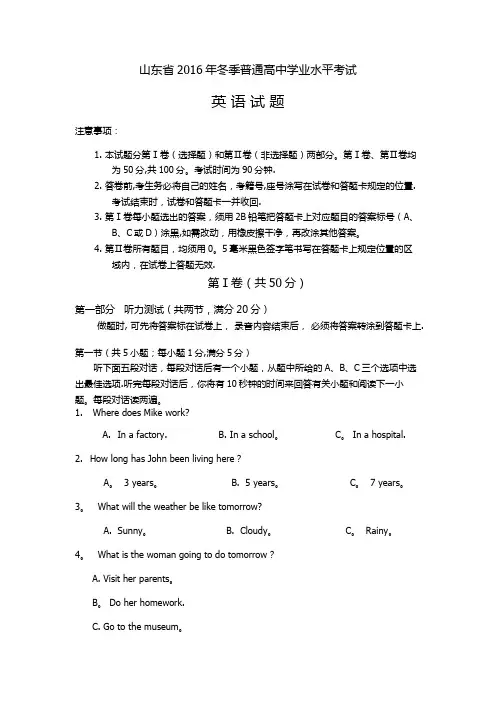
山东省2016年冬季普通高中学业水平考试英语试题注意事项:1.本试题分第Ⅰ卷(选择题)和第Ⅱ卷(非选择题)两部分。
第Ⅰ卷、第Ⅱ卷均为50分,共100分。
考试时间为90分钟.2.答卷前,考生务必将自己的姓名,考籍号,座号涂写在试卷和答题卡规定的位置.考试结束时,试卷和答题卡一并收回.3.第Ⅰ卷每小题选出的答案,须用2B铅笔把答题卡上对应题目的答案标号(A、B、C或D)涂黑,如需改动,用橡皮擦干净,再改涂其他答案。
4.第Ⅱ卷所有题目,均须用0。
5毫米黑色签字笔书写在答题卡上规定位置的区域内,在试卷上答题无效.第Ⅰ卷(共50分)第一部分听力测试(共两节,满分20分)做题时, 可先将答案标在试卷上,录音内容结束后,必须将答案转涂到答题卡上.第一节(共5小题;每小题1分,满分5分)听下面五段对话,每段对话后有一个小题,从题中所给的A、B、C三个选项中选出最佳选项.听完每段对话后,你将有10秒钟的时间来回答有关小题和阅读下一小题。
每段对话读两遍。
1. Where does Mike work?A.In a factory.B. In a school。
C。
In a hospital.2.How long has John been living here?A。
3 years。
B. 5 years。
C。
7 years。
3。
What will the weather be like tomorrow?A. Sunny。
B. Cloudy。
C。
Rainy。
4。
What is the woman going to do tomorrow?A. Visit her parents。
B。
Do her homework.C. Go to the museum。
英语试题第1页(共8页)5. What time is it now?A。
5:00。
B. 5:30。
C。
6:00。
第二节(共15小题;每小题1分,满分15分)听下面三段对话和一段独白.每段对话和独白后有几个小题,从题中所给的A、B、C 三个选项中选出最佳选项。