
牛津深圳初中八年级英语上册 Unit 1 Encyclopaedias grammar课件
- 格式:ppt
- 大小:3.04 MB
- 文档页数:24
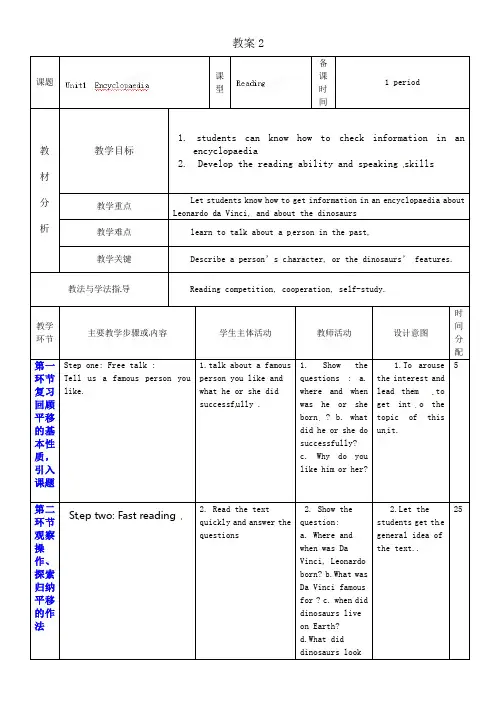
教案2
课题 课型 备课时间 1 period
教
材
分
析 教学目标 1. students can know how to check information in an
encyclopaedia
2. Develop the reading ability and speaking skills
教学重点 Let students know how to get information in an encyclopaedia about
Leonardo da Vinci, and about the dinosaurs
教学难点 learn to talk about a person in the past,
教学关键 Describe a person’s character, or the dinosaurs’ features.
教法与学法指导 Reading competition, cooperation, self-study.
教学环节 主要教学步骤或内容 学生主体活动 教师活动 设计意图 时间
分配
第一环节
复习回顾平移的基本性质,引入课题
Step one: Free talk :
Tell us a famous person you
like. 1.talk about a famous
person you like and
what he or she did
successfully . 1. Show the
questions : a.
where and when
was he or she
born ? b. what
did he or she do
successfully?
c. Why do you
like him or her? 1.To arouse
the interest and
lead them to

八年级英语上海牛津版(2012教材)上册 Module 1 Amazing things Unit 1
Encyclopaedias (2)同步练习
(答题时间:40分钟)
微课程:重点单词(上册 Module 1 Amazing things Unit 1 Encyclopaedias (2))同步练习
Ⅰ. 用括号中所给单词的正确形式填空。
1. She does not have _______(some) questions about dinosaurs.
2. Is there _______(something) on the blackboard?
3. One day, Sammy _______(go) for a walk in the mountains.
4. It was _______ (make) in 1964 by John Landy.
5. These _______(sheep) are very important to the farmers there.
Ⅱ. 选择并抄写单词
1. He threw a brick _______(through; across) the window.
2. _______(Sometimes; Sometime) I go to work by car.
3. There is a window _______(among; between) the two doors.
4. Water is very _______(importance; important) to us.
5. He ___________(ordered; made) us to stand well.
Ⅲ. 阅读理解
The earth is changing. Tomorrow it will be different. All the living

Unit 1 Encyclopaedias
评价标准
语言
知识 语音 朗读句子,掌握句子重读规则,凸显重要信息。
词汇 高频词 human,dinosaur,inventor,musician,scientist,born,countryside,intelligence,ability,perhaps,invention,notebook,include,even,however,suddenly,nobody,win,dollar
高频
词组 in the countryside,human being,die out,find out,go for a walk
功能 谈论百科全书中自己感兴趣的知识和信息。
语法 1.掌握限定词some和any的用法;
2.掌握不定代词somebody,anybody和nobody等的用法。
语言
技能 读 运用略读和寻读相结合的方法获取信息。
听 捕捉数字等关键信息,并正确地记录下来。
说 运用所学的词汇和百科全书中的信息谈论人物或事物。
写 根据提示词和图片完成看图写作。
文化
品格 1.使用百科全书的知识和信息;
2.分享查阅百科全书的方法,交流读后感。
思维
品质 培养好奇心,激发求知欲,努力探索新知识。
学习过程
Reading
一、词汇讲解
1.Leonardo da Vinci(1452—1519)was an Italian painter, inventor, musician, engineer and scientist.
莱昂纳多·达·芬奇(1452—1519)是意大利画家、发明家、音乐家、工程师和科学家。
词干加后缀“-er / -or / -ist / -ian”表示行为者,“……的人”。
e. g. He has many dreams such as becoming an actor, an artist and a reporter.
Unit 1 Encyclopaedias检测题
(时间:60分钟;满分:100分)
一、听力部分(每小题1分,满分20分)
(一)听句子,选出该句的最佳答语。(句子听一遍)(每小题1分)
1. A. The Blue Danube. B. Johann Strauss. C. Rap music.
2. A. Vienna. B. Paris. C. London.
3. A. Yes, I don’t. B. Yes, I do. C. Yes, I have.
4. A. In Austria. B. A composer. C. In 1756.
5. A. That’s right. B. All right. C. That’s all right.
(二)听对话,选择正确答案。(对话听两遍)(每小题1分)
6. How long has the boy been in the school orchestra?
A. Two years and a half. B. Half a year. C. Two years.
7. What is Sally’s job?
A. She is a teacher. B. She is a composer. C. She is a musician.
8. Where did Mozart come from?
A. Austria. B. Australia. C. France.
9. Who can play the guitar?
A. Tom. B. Tom’s brother. C. Tom’s father.
10. What does Jack’s father like?
A. Pop music. B. Beijing Opera. C. Classical music.