
Mitigating Threats and Attacks with Access Lists
- 格式:ppt
- 大小:2.00 MB
- 文档页数:32


如何应对ai带来的威胁英语作文英文回答:The rise of artificial intelligence (AI) brings both immense opportunities and significant challenges. While AI has the potential to revolutionize various aspects of life, there are also concerns about its potential negative impacts, including job displacement, privacy and security risks, bias and discrimination, and the potential for misuse. To mitigate these threats and harness the benefits of AI, it is essential to adopt a proactive and multifaceted approach.1. Investing in Education and Reskilling:Preparing the workforce for the AI revolution is crucial. Governments and educational institutions should invest in programs that provide training and reskilling opportunities to individuals in fields that are likely to be affected by AI. By equipping workers with new skills andknowledge, they can adapt to the changing job market and remain competitive.2. Establishing Ethical Guidelines and Regulations:It is essential to develop clear ethical guidelines and regulations for the development and deployment of AI systems. These guidelines should address issues such as privacy, transparency, accountability, and safety. By setting ethical standards, governments and organizations can ensure that AI systems are developed and used responsibly.3. Ensuring Inclusivity and Fairness:AI systems should be designed to be inclusive and fair. They should not perpetuate existing biases or discriminate against certain groups of people. Developers and organizations should incorporate measures into AI systems to mitigate bias and promote fairness.4. Fostering Collaboration and Dialogue:Collaboration among stakeholders, including industry leaders, researchers, policymakers, and civil society organizations, is crucial. By facilitating open dialogue and sharing knowledge, we can collectively identify and address potential risks and develop effective mitigation strategies.5. Promoting Research and Development:Continued research and development are essential to advance the field of AI and mitigate potential negative impacts. Governments and organizations should invest in research efforts to explore the ethical, social, and economic implications of AI and develop innovative solutions to address these challenges.中文回答:应对人工智能带来的威胁。
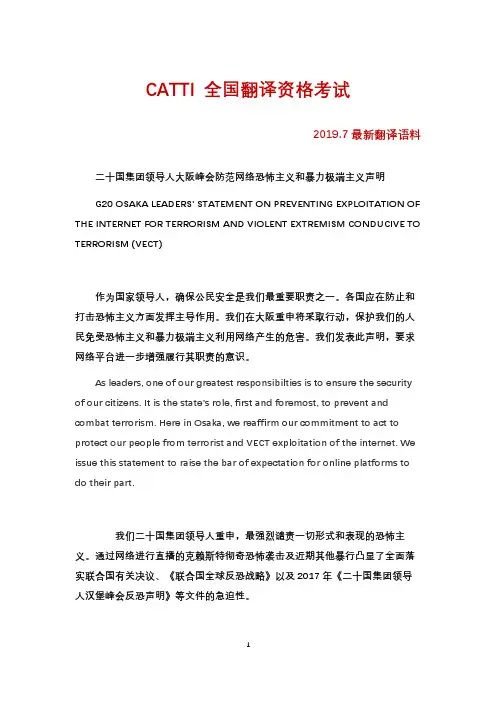
CATTI 全国翻译资格考试2019.7最新翻译语料二十国集团领导人大阪峰会防范网络恐怖主义和暴力极端主义声明G20 OSAKA LEADERS' STATEMENT ON PREVENTING EXPLOITATION OF THE INTERNET FOR TERRORISM AND VIOLENT EXTREMISM CONDUCIVE TO TERRORISM (VECT)作为国家领导人,确保公民安全是我们最重要职责之一。
各国应在防止和打击恐怖主义方面发挥主导作用。
我们在大阪重申将采取行动,保护我们的人民免受恐怖主义和暴力极端主义利用网络产生的危害。
我们发表此声明,要求网络平台进一步增强履行其职责的意识。
As leaders, one of our greatest responsibilties is to ensure the security of our citizens. It is the state's role, first and foremost, to prevent and combat terrorism. Here in Osaka, we reaffirm our commitment to act to protect our people from terrorist and VECT exploitation of the internet. We issue this statement to raise the bar of expectation for online platforms to do their part.我们二十国集团领导人重申,最强烈谴责一切形式和表现的恐怖主义。
通过网络进行直播的克赖斯特彻奇恐怖袭击及近期其他暴行凸显了全面落实联合国有关决议、《联合国全球反恐战略》以及2017年《二十国集团领导人汉堡峰会反恐声明》等文件的急迫性。

网络安全英语怎么说随着互联网的发展和普及,网络安全问题越来越受到人们的关注。
了解网络安全英语的表达方式,对于掌握相关知识和交流沟通都具有重要意义。
本文将介绍几种常用的网络安全英语表达方式,帮助读者更好地理解和运用。
一、常用网络安全英语词汇1. Network security 网络安全2. Cybersecurity 网络安全3. Firewall 防火墙4. Malware 恶意软件5. Virus 病毒6. Phishing 钓鱼网站7. Hacking 黑客攻击8. Data breach 数据泄漏9. Password 密码10. Encryption 加密11. Authentication 认证二、网络安全英语常用表达1. Protect personal information 保护个人信息In order to maintain network security, it is important to protect personal information such as passwords, bank account details, and home addresses.2. Install antivirus software 安装反病毒软件To prevent malware and viruses from infecting your computer, it is recommended to install reliable antivirus software and regularly update it.3. Be cautious about phishing emails 注意钓鱼邮件Phishing emails are designed to trick users into revealing personal information. It is important to be cautious and not click on suspicious links or provide sensitive information in response to such emails.4. Use strong passwords 使用强密码A strong password contains a combination of letters, numbers, and symbols. It is advisable to use different passwords for different online accounts and change them regularly to enhance security.5. Keep software up to date 保持软件更新Software updates often include security patches and bug fixes. It is crucial to regularly update operating systems, web browsers, and other software to protect against potential vulnerabilities.6. Enable two-factor authentication 启用双重身份认证Two-factor authentication adds an extra layer of security by requiring users to provide two forms of identification, such as a password and a unique verification code sent to their mobile device.7. Regularly backup data 定期备份数据In case of a data breach or system failure, regularly backing up important files and data is essential to prevent loss and ensure quick recovery.三、网络安全英语扩展阅读除了基本的网络安全英语词汇和常用表达,了解一些扩展阅读内容也有助于进一步提升网络安全意识和英语表达能力。