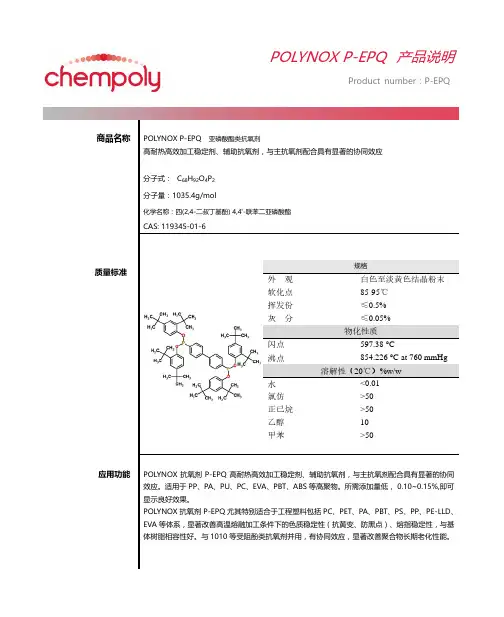
DPQ氧化剂
- 格式:pdf
- 大小:1.02 MB
- 文档页数:25
$FFRXQWVDQG5DSLG&RPPXQLFDWLRQVLQ&KHPLFDO6\QWKHVLV
ThiemeSupporting Information
for DOI: 10.1055/s-0036-1588598
© Georg Thieme Verlag KG Stuttgart · New York 20161
SUPPORTING INFORMATION
3,3′,5,5′-Tetra-tert-butyl-4,4′-diphenoquinone (DPQ)-Air as a
New Organic Photocatalytic System: Use in the Oxidative Photocyclization
of Stilbenes to Phenacenes
Manuel Carrera, Mónica de la Viuda and Albert Guijarro*
Departamento de Química Orgánica and Instituto Universitario de Síntesis Orgánica,
Unidad Asociada del CSIC, Universidad de Alicante, Campus de Sant Vicent del
Raspeig, Apdo. 99, 03080, Alicante, Spain.
Contents
1. General ..................................................................................................................... 3
2. Photochemical set up: ............................................................................................. 3
2.1. Using a lamp: ..................................................................................................... 3
2.2. With sunlight: .................................................................................................... 4
3. Synthesis and characterization of compounds ..................................................... 5
3.1. 3,3',5,5'-Tetra-tert-butyl-4,4’-diphenoquinone (DPQ):...................................... 5
3.2. 3,3',5,5'-Tetra-tert-butylbiphenyl-4,4'-diol (DPQH
2): ....................................... 5
3.3. (E)-1,2-Di-(1-naphtyl)ethene (1 or DNE). ......................................................... 5
3.4. Diethyl (1-naphthylmethyl)phosphonate (P1): .................................................. 6
3.5. Picene (or [5]phenacene, 2). .............................................................................. 6
3.6. 1-[(E)-2-(2-methylphenyl)vinyl]naphthalene (3)............................................... 7
3.7. 1-Methylchrysene (4). ........................................................................................ 7
3.8. 1-(Bromomethyl)chrysene (5). .......................................................................... 7
3.9. Diethyl (1-chrysenylmethyl)phosphonate (P2).................................................. 8
3.10. 1-[(E)-2-(1-naphtyl)vinyl]chrysene (6). ......................................................... 8
3.11. [7]Phenacene (7). ........................................................................................... 9
4. UV-Vis spectra of 1 (DNE), DPQ, DPQH
2 and mixtures. ................................... 9
5. Differential scanning calorimetries (DSC) and applied melting point
corrections. .................................................................................................................... 10
6. 1
H NMR and 13
C NMR spectra of compounds ................................................... 12
6.1. DPQ (300 MHz, CDCl
3) .................................................................................. 13
6.2. DPQH
2 (300 MHz, CDCl
3) .............................................................................. 14
6.3. (E)-1,2-Di-(1-naphtyl)ethene (1 or DNE)(300 MHz, CDCl
3) ......................... 15
6.4. Diethyl (1-naphthylmethyl)phosphonate (P1) (300 MHz, CDCl
3).................. 16 2
6.5. Picene (300 MHz, CDCl
3) (2) .......................................................................... 17
6.6. 1-[(E)-2-(2-methylphenyl)vinyl]naphthalene (3) (300 MHz, CDCl
3) ............. 18
6.7. 1-Methylcrhysene (4) (300 MHz, CDCl
3) ....................................................... 19
6.8. 1-(Bromomethyl)chrysene (5) (300 MHz, CDCl
3) .......................................... 20
6.9. Diethyl (1-chrysenylmethyl)phosphonate (P2) (300 MHz, CDCl
3) ................ 21
6.10. 1-[(E)-2-(1-naphtyl)vinyl]chrysene (6) (400 MHz, CDCl
3) ........................ 22
6.11. [7]Phenacene (7) (400.13 MHz, C
2D
2Cl
4, 358 K) ....................................... 23
7. References and notes. ............................................................................................ 24
3
1. General
Commercially available starting materials (Acros, Sigma-Aldrich) and solvents for
photochemistry, chromatography and recrystallizations were used without further
purification; dimethoxyethane (DME) was dried and distilled over Na/K alloy right
before use. Degassed reactions were carried out under argon atmosphere. All glassware
was dried in an oven at 100°C and cooled to room temperature. Gas chromatography
analyses (GLC) were carried out with a Hewlett Packard HP-5890 instrument equipped
with a flame ionization detector and a 30 m HP-5 capillary column (0.32 mm diam, 0.25
μm film thickness), using nitrogen as carrier gas (12 psi). Column chromatography was