
tooeitheralsoaswell辨析及练习题
- 格式:docx
- 大小:8.93 KB
- 文档页数:1
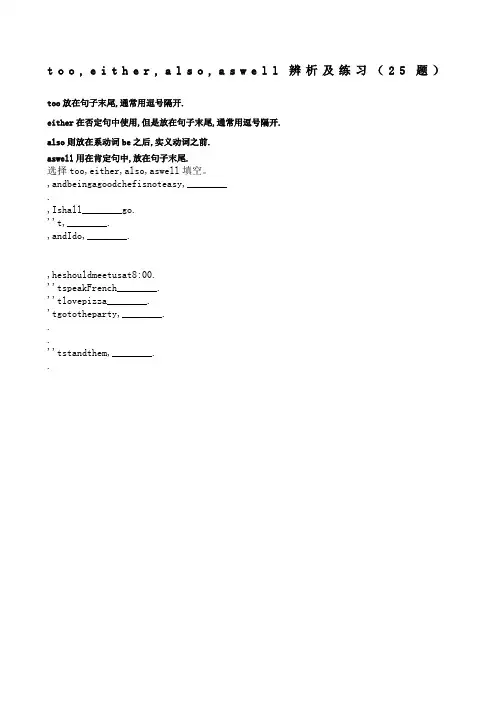

区分英语中的4个“也”– TOO, AS WELL, ALSO, EITHER;延展词组EITHER…OR…, NEITHER…NOR, NOT ONLY…BUTALSO…, AS WELL AS1.too通常用于肯定句的末尾,用逗号隔开,表示同意或附和前面的说法/表示与前面提到的某个情况或事实相同或相似。
例句:I like apples, too. (我也喜欢苹果。
)I like ice cream, too. (我也喜欢冰淇淋。
)I can speak English, too. (我也可以说英语。
)2.also通常用于句子中间,表示另一个相关的事实或情况/表示与前面提到的某个情况或事实相同或相似。
例句:I also like pears. (我也喜欢梨。
)He is also a doctor. (他也是一名医生。
)I also like ice cream. (我也喜欢吃冰淇淋。
)She is also a good student. (她也是一个好学生。
)3.as well常用于肯定句的末尾,表示补充或列举/表示与前面提到的某个情况或事实相同或相似。
例句:I like apples as well. (我也喜欢苹果。
)He is a doctor as well. (他也是一名医生。
)4.either常用于否定句的末尾,表示“也不”。
例句:I don't like apples either. (我也不喜欢苹果。
)Either you or she is responsible for this mistake. (你或者她应该对这个错误负责。
)I don't like either coffee or tea. (我不喜欢咖啡和茶中的任何一种。
)We can either go to the park or stay at home. (我们可以去公园或者待在家里。
)延展词组5.either...or...是一个常用的连词短语,表示二选一的情况。

tooalsoaswelleither的区别too also as well either的区别:too作为副词,意为太、过于,用于形容词和副词前;also作为副词,意为而且、也,放在行为动词之前,特殊动词之后;as well意为也、还,常位于句末;either可作代词和副词,意为任何一个、要么要么,常用于否定句,且放句末。
一、too的基本含义及用法介绍too作为副词,意为(用于形容词和副词前)太,过于,过度;也;又;还;(评说某事物使情况更糟)而且。
例句:He's far too young to go on his own.他年纪太小,不能独自一人去。
Can I come too?我也可以来吗?She broke her leg last week─and on her birthday too!她上星期把腿摔断了,而且还是在她生日那一天!I'm not too sure if this is right.这是否正确,我没有太大把握。
二、also的基本含义及用法介绍also作为副词,意为而且;此外;也;同样。
例句:She was not only intelligent but also very musical.她不仅聪明,而且极具音乐天分。
I didn't like it that much. Also, it was much too expensive. 我并不怎么喜欢它。
再说它太贵了。
She's fluent in French and German. She also speaks a little Italian.她的法语和德语讲得流利,也会说一点意大利语。
三、as well的基本含义及用法介绍as well意为也、还。
例句:They sell books as well as newspapers.他们既卖报也卖书。

also too either as well的区别和用法(实用版)目录1.引言2.also, too, either 和 as well 的含义和用法的区别3.also 和 too 的用法4.either 的用法5.as well 的用法6.总结正文一、引言在英语中,副词"also", "too", "either"和"as well"经常被用来表示不同的意思。
尽管它们在某些情况下可以互换使用,但它们之间仍然存在一些关键的差异。
在本文中,我们将详细讨论这些差异以及如何正确使用这些副词。
二、also, too, either 和 as well 的含义和用法的区别1.also:也,用于表示某个观点或行为也适用于另一个观点或行为。
例句:I like apples and I also like oranges.(我喜欢苹果,我也喜欢橙子。
)2.too:也,用于表示强调,通常放在句尾。
例句:I am very tired, too.(我也非常累。
)3.either:(两者之中)任何一个,用于表示两者之间的选择。
例句:You can choose either a book or a magazine.(你可以选择一本书或一份杂志。
)4.as well:也,用于表示某个观点或行为同样适用于另一个观点或行为。
通常放在句尾。
例句:She is a great dancer and a great singer as well.(她是一名优秀的舞者,同时也是一名优秀的歌手。
)三、also 和 too 的用法1.also:用于句中,表示两个观点或行为之间的联系。
例句:He is a talented artist and he also plays the piano.(他是一名有才华的艺术家,而且他也会弹钢琴。
)2.too:用于句尾,表示强调。

Too, also, as well, either区别答:too, also, either, as well.这些“也”到底有什么区别呢?我们来看看下面的句子就明白了。
1) too放在句子末尾,通常用逗号隔开。
e.g: I am a student, too.我也是一名学生。
2)either在否定句中使用,但是放在句子末尾,通常用逗号隔开。
e.g: Lucy doesn’t go to the party, either.露西也没有去参加派对。
3) also则放在系动词be之后,实义动词之前。
e.g: I am also a student.我也是一名学生。
Li Ming also takes part in a ceremony.李明也参加了仪式。
4) as well 用在肯定句中,放在句子末尾。
e.g: Tony speaks Japanese as well.托尼也会说日语。
再举个例子:She has knowledge and experience as well.她既有知识,又有经验。
总之,too是肯定句中的“也”,either则是否定句中的“也”,放的位置都在句子末尾;also则是放在句中的“也”;aswell是放在句末的“也”。
【牛刀小试】根据汉语意思完成下面的句子(每空词数不限):1. She speaks French and German and a little Russian.2. I’ve read the book and I’ve seen the film, .3. Mary didn’t go there yesterday, and I didn’t go there, .4. He is going to London and his sister is going .【启发点拨】as well,also,too和either都可表示“也”,它们各自的用法如下:(1) as well常用于肯定句中,且位于句末;(2) also用于肯定句中,通常位于句中;(3) too用于肯定句中,通常位于句末,常用逗号和前面的部分隔开;(4) either多用于否定句中,常位于句末。